The discovery, explained · Chemist no. 337 of 350
The Solvay Process: Making Washing Soda from Salt, Chalk and Ammonia
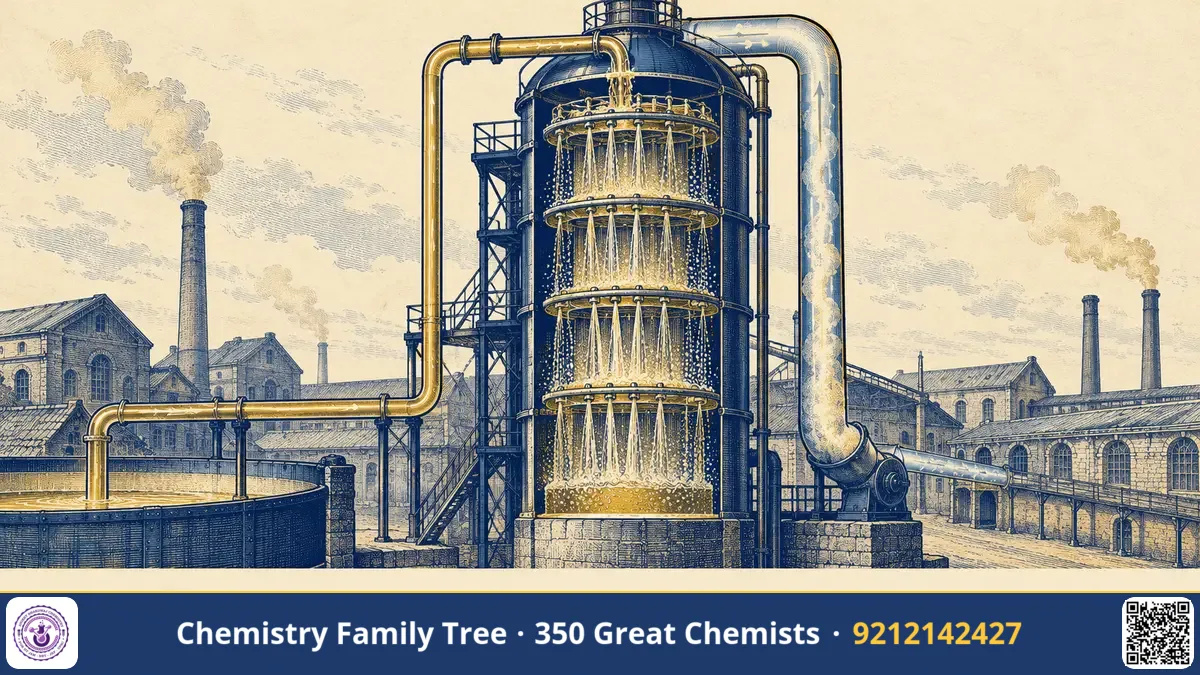
Look at a glass bottle, a bar of soap, a packet of detergent or a sheet of window glass. The common raw material behind all of them is sodium carbonate, or soda ash (Na₂CO₃). For centuries, soda came from the ashes of plants, and then from the Leblanc process, which was dirty and wasteful. In 1861 the Belgian chemist Ernest Solvay patented a far better method, the ammonia-soda process. It uses only common salt, limestone and ammonia, and ammonia is recycled almost completely. The Solvay process became the main method of making soda ash for well over a century and is one of the most important examples of continuous chemical engineering taught in industrial chemistry.
The Scientific Problem Before the Discovery
Demand for sodium carbonate grew rapidly in the nineteenth century because of glass, soap, textile and paper industries. The Leblanc process, in use since the late eighteenth century, made soda from salt via sodium sulphate:
2NaCl + H₂SO₄ → Na₂SO₄ + 2HCl
Na₂SO₄ + 2C → Na₂S + 2CO₂
Na₂S + CaCO₃ → Na₂CO₃ + CaS
It consumed large amounts of sulphuric acid, coal and limestone, and it released clouds of hydrogen chloride gas and left heaps of foul calcium sulphide waste that gave off H₂S. The ammonia-soda idea was known: in 1811 Augustin Fresnel observed that passing CO₂ into ammoniacal brine precipitated sodium bicarbonate. But the reaction could not be made practical, because ammonia was too expensive to be lost, and chemists could not design equipment to run it continuously. Solvay solved the engineering problem.
The Discovery: Step by Step
Solvay, working with his brother Alfred, developed a tall carbonating column, divided into compartments by perforated plates, that brings the ammoniacal brine and CO₂ gas into close and prolonged contact. In 1863 the brothers founded Solvay et Cie, and a first plant started at Couillet near Charleroi in Belgium. After initial difficulties, production climbed steadily, and in a few decades Solvay plants operated in many countries.
- Step 1: Brine purification and ammoniation. Saturated sodium chloride solution is absorbed with ammonia gas in an absorber, giving ammoniacal brine. Cooling is needed because dissolving NH₃ is exothermic.
- Step 2: Carbonation. The ammoniacal brine flows down the Solvay tower while CO₂ rises from below. Sodium bicarbonate, which is the least soluble salt in the mixture at low temperature, precipitates.
- Step 3: Filtration and calcination. The NaHCO₃ is filtered and heated to about 150 to 200 °C to give soda ash. CO₂ released is returned to the process.
- Step 4: Lime kiln. Limestone is heated at about 1000 °C to give CO₂ (for step 2) and quicklime (CaO).
- Step 5: Ammonia recovery. Quicklime is slaked with water and used to liberate ammonia from the filtrate, which contains NH₄Cl. The ammonia goes back to step 1.
The Chemistry Behind It
NaCl + NH₃ + CO₂ + H₂O → NaHCO₃ ↓ + NH₄Cl            (carbonation)
2NaHCO₃ → Na₂CO₃ + H₂O + CO₂                           (calcination, ~ 175 °C)
CaCO₃ → CaO + CO₂                                      (lime kiln)
CaO + H₂O → Ca(OH)₂                                    (slaking)
2NH₄Cl + Ca(OH)₂ → 2NH₃ + CaCl₂ + 2H₂O                 (ammonia recovery)

Overall:  CaCO₃ + 2NaCl → Na₂CO₃ + CaCl₂
The overall reaction cannot be run directly, because CaCO₃ is insoluble and the reaction is thermodynamically unfavourable. The Solvay process achieves it through a cycle of intermediates, with ammonia acting like a catalyst that is regenerated. The only by-product is aqueous calcium chloride.
Why does NaHCO₃ precipitate? In the mixed solution, the ions Na⁺, Cl⁻, NH₄⁺ and HCO₃⁻ could in principle form four salts. Sodium bicarbonate has the lowest solubility at the temperatures used (about 15 °C in the tower), and so it separates out. This is an example of the solubility product and the common-ion effect in action. Ammonia keeps the solution slightly basic, which favours the formation of HCO₃⁻ from dissolved CO₂.
| Feature | Leblanc | Solvay |
|---|---|---|
| Raw materials | NaCl, H₂SO₄, coal, CaCO₃ | NaCl, CaCO₃, NH₃ (recycled) |
| By-products | HCl, CaS (foul waste) | CaCl₂ solution |
| Process type | Batch | Continuous |
| Purity of product | Low | High |
| Cost | High | Low |
Applications Today
- Glass. Soda ash lowers the melting point of silica in soda-lime glass, about half of soda ash use worldwide.
- Detergents and chemicals. Used to make sodium silicate, phosphates, sodium bicarbonate and other chemicals.
- Water treatment. Used to remove permanent hardness: Ca²⁺ + Na₂CO₃ → CaCO₃ + 2Na⁺.
- Paper, textiles and metallurgy. Used in pulp processing and as a flux.
- Indian context. India makes soda ash at several plants in Gujarat, using seawater brine and limestone, with Tata Chemicals at Mithapur and other producers such as GHCL, Nirma and DCW. India is a large consumer of soda ash for glass, detergents and chemicals.
- Environment. Disposal of calcium chloride waste and the energy use are the main issues, and some producers use natural trona (mined in the USA) instead.
Exam Corner
- Main reaction: NaCl + NH₃ + CO₂ + H₂O → NaHCO₃ + NH₄Cl; NaHCO₃ is the least soluble.
- The only waste product is CaCl₂; ammonia is recovered with Ca(OH)₂.
- Overall: CaCO₃ + 2NaCl → Na₂CO₃ + CaCl₂.
- The Solvay process cannot be used for K₂CO₃, because KHCO₃ is fairly soluble.
- Washing soda is Na₂CO₃·10H₂O; baking soda is NaHCO₃.
Common Misconceptions
- "Ammonia is consumed in the Solvay process." It is recycled, with only small make-up losses.
- "Na₂CO₃ precipitates directly." The precipitate is NaHCO₃, which is heated to give Na₂CO₃.
- "The Solvay process is the same as the Haber process." They are unrelated. Haber makes ammonia, while Solvay uses ammonia as a carrier.
Quick Revision Box
- Patent 1861; first plant at Couillet, Belgium, 1863.
- Raw materials: brine, limestone, ammonia (recycled).
- Key step: precipitation of NaHCO₃ in the Solvay tower.
- Calcination: 2NaHCO₃ → Na₂CO₃ + H₂O + CO₂.
- Ammonia recovery with slaked lime.
- By-product: CaCl₂.
FAQ
Why is it called the ammonia-soda process?
Because ammonia is used as an intermediate to produce soda (sodium carbonate) from salt.
What is a Solvay tower?
A tall column with perforated plates where ammoniacal brine meets rising CO₂ so that NaHCO₃ crystallises.
Why did the Solvay process replace the Leblanc process?
It was cheaper, cleaner, continuous and gave purer product.
Is the Solvay process green?
It is much cleaner than Leblanc, but it uses much energy and produces CaCl₂ brine waste.
Published by ABC Chemistry — IIT-JAM | CSIR-NET | GATE Chemistry Coaching. Visit abcchemistry.com

About the chemist
Ernest Solvay
1838-1922 · Belgium
Solvay ammonia-soda process