The discovery, explained · Chemist no. 286 of 350
Ernst Otto Beckmann: From Oximes to Nylon and From Boiling Points to Molar Mass
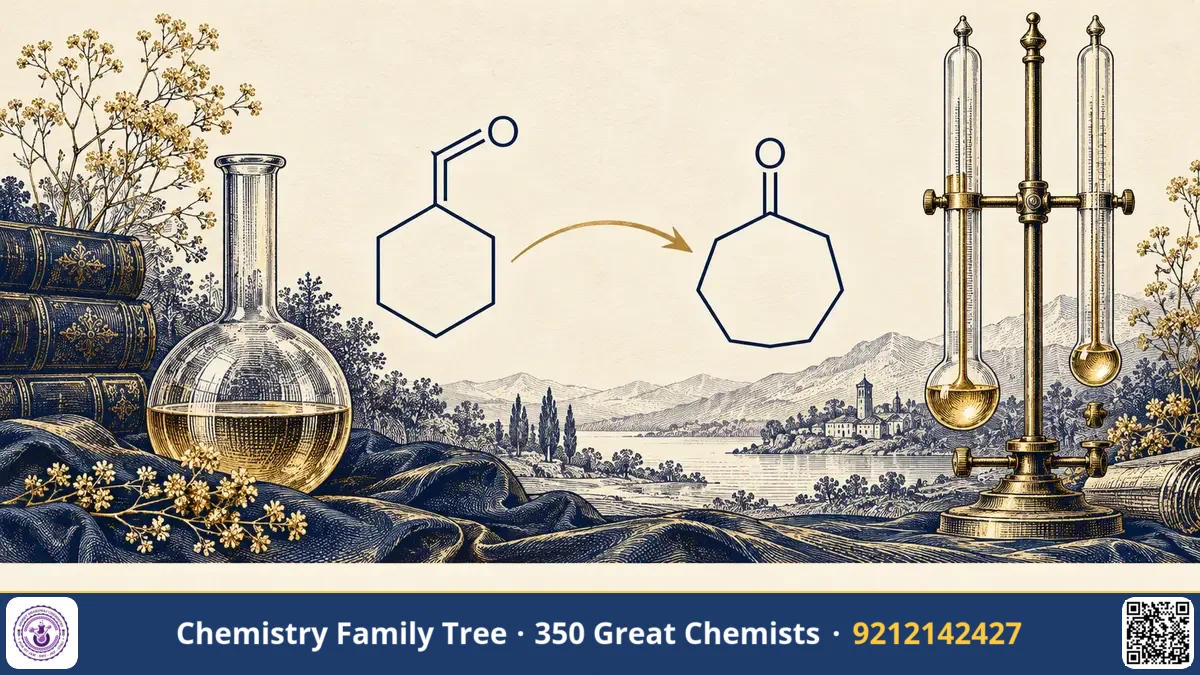
Two things that look unrelated, a plastic fibre and a thermometer, share the name of one German chemist. Ernst Otto Beckmann discovered in 1886 that ketoximes rearrange under acid to give amides, a reaction that today produces millions of tonnes of caprolactam for nylon-6. He also invented a sensitive differential thermometer that made it possible to determine molar masses of dissolved substances by measuring tiny changes in boiling or freezing points. Both topics appear regularly in IIT-JAM, CSIR-NET and GATE papers. This post explains how they work.
The Scientific Problem Before the Discovery
By the 1880s, oximes (R₂C=N–OH), formed from aldehydes or ketones with hydroxylamine, were an important class of compounds for identifying carbonyl groups. But chemists knew little about what else the oxime group could do, and the structure of oximes was uncertain. Why did some oximes exist in two isomeric forms? How were atoms arranged around the C=N bond? Meanwhile, determining the molecular mass of an unknown compound was a serious problem. Vapour density methods worked only for volatile compounds. Raoult had shown that dissolved substances lower the freezing point and raise the boiling point of solvents, and van't Hoff had given the theory, but the temperature changes were very small, often only a few hundredths of a degree, and ordinary thermometers could not measure them accurately.
The Discovery / Experiment
1. The Beckmann rearrangement (1886). Beckmann treated benzophenone oxime with phosphorus pentachloride and obtained benzanilide, an amide, not the expected simple product. Acids such as concentrated H₂SO₄, PCl₅, SOCl₂ or polyphosphoric acid all promote the same change:
Ph₂C=N–OH  --(PCl₅ or H₂SO₄)-->  Ph–CO–NH–Ph (benzanilide)
Cyclohexanone oxime  --(H₂SO₄, oleum)-->  ε-caprolactam
2. The Beckmann thermometer (about 1888). He designed a mercury thermometer with a very large bulb and a long, finely graduated stem covering only about five to six degrees, with a small reservoir at the top so that the mercury level could be adjusted to fit any starting temperature. Readings were possible to 0.01 °C, and by estimation to 0.001 °C.
3. Cryoscopic and ebullioscopic methods. Using his thermometer, Beckmann determined molar masses of dissolved solids from the freezing-point depression (cryoscopy) and boiling-point elevation (ebullioscopy). The Beckmann apparatus is still described in physical chemistry textbooks.
The Chemistry Behind It
Mechanism of the rearrangement.
- The oxime –OH is protonated (or converted to a leaving group such as –OPCl₄), turning it into a good leaving group (water).
- The group that is anti (trans) to the leaving group migrates from carbon to nitrogen as water leaves, in a concerted step. This gives a nitrilium ion.
- Water attacks the nitrilium carbon, and tautomerisation of the resulting imidic acid yields the amide.
The key stereochemical rule: the migrating group is the one anti to the departing OH group. If the oxime is a single geometric isomer, only one amide forms. That is why the reaction was used to assign configuration of oximes. In the Hantzsch–Werner picture of syn and anti oximes, the Beckmann rearrangement was a chemical test of the configuration. Migrating group retains its stereochemistry, similar to the Curtius rearrangement.
Ring expansion. For a cyclic ketoxime, the nitrogen is inserted into the ring, giving a lactam one atom larger:
cyclohexanone (C₆) → oxime → ε-caprolactam (7-membered ring: 6 C + 1 N)
n caprolactam → [–NH–(CH₂)₅–CO–]ₙ  nylon-6 (ring-opening polymerisation)
Colligative properties. The working equations are:
ΔTf = Kf · m ΔTb = Kb · m M = (Kf · w₂ · 1000) / (ΔTf · w₁)
where w₂ is the mass of solute and w₁ is the mass of solvent in grams. For water, Kf = 1.86 K kg/mol and Kb = 0.52 K kg/mol. Because ΔT is small, a thermometer reading to 0.01 K is essential.
Applications Today
- Nylon-6 industry: Caprolactam made via cyclohexanone oxime is the monomer for nylon-6 used in textiles, carpets, ropes and engineering plastics. Indian producers make nylon filament yarn for fabrics and fishing nets.
- Pharmaceuticals: Beckmann rearrangement is used to prepare lactams and amides in drug synthesis, including intermediates for some analgesics and antibiotics, and to build the azepine ring found in some drugs.
- Structure determination: The reaction has helped assign structures to ketones and oxime geometry.
- Laboratory teaching: The Beckmann thermometer principle and cryoscopy experiments are part of physical chemistry practicals in Indian universities.
- Green chemistry: Current research targets cleaner catalysts (zeolites and ionic liquids) to avoid the large amount of ammonium sulphate by-product generated by the oleum process.
Exam Corner
- Beckmann rearrangement: oxime to N-substituted amide under acid; group anti to OH migrates.
- Cyclohexanone oxime gives ε-caprolactam, the monomer of nylon-6.
- Acetophenone oxime (E, with phenyl anti to OH) gives acetanilide (N-phenylacetamide), as phenyl migrates.
- Beckmann thermometer: differential thermometer with a mercury reservoir, readable to 0.01 °C.
- Molar mass from cryoscopy: M = Kf × w₂ × 1000 / (ΔTf × w₁).
Common Misconceptions
- "The group that is more bulky always migrates." The anti group migrates, regardless of size, unless the oxime isomerises under the conditions.
- "The Beckmann thermometer measures absolute temperature." It measures small differences; it must be set for the working range.
- "Nylon-6 and nylon-6,6 come from the same monomers." Nylon-6 is made from one monomer, caprolactam; nylon-6,6 from hexamethylenediamine and adipic acid.
Quick Revision Box
- Beckmann rearrangement (1886): ketoxime to amide/lactam.
- Anti group migrates to nitrogen; nitrilium ion intermediate.
- Cyclohexanone oxime to caprolactam to nylon-6.
- Reagents: H₂SO₄, PCl₅, SOCl₂, PPA.
- Beckmann thermometer reads small temperature differences to 0.01 °C.
- Used for ΔTf and ΔTb molar mass determination.
FAQ
What is the product when cyclohexanone oxime undergoes Beckmann rearrangement?
ε-Caprolactam, a seven-membered cyclic amide that is polymerised to nylon-6.
Which group migrates in the Beckmann rearrangement?
The group that is anti (trans) to the hydroxyl group on the C=N bond migrates from carbon to nitrogen.
Why is a special thermometer needed for freezing-point depression?
Because the change is small, a few hundredths to tenths of a degree, and an ordinary thermometer lacks the precision to measure it.
What is the difference between Beckmann and Hofmann rearrangements?
Beckmann converts oximes into amides; Hofmann converts primary amides into amines with one carbon fewer. Both involve migration to nitrogen.
Published by ABC Chemistry — IIT-JAM | CSIR-NET | GATE Chemistry Coaching. Visit abcchemistry.com
About the chemist
Ernst Otto Beckmann
1853-1923 · Germany
Beckmann rearrangement; Beckmann thermometer