Biography · Chemist no. 261 of 350
Germain Henri Hess (1802-1850): The Founder of Thermochemistry
Introduction
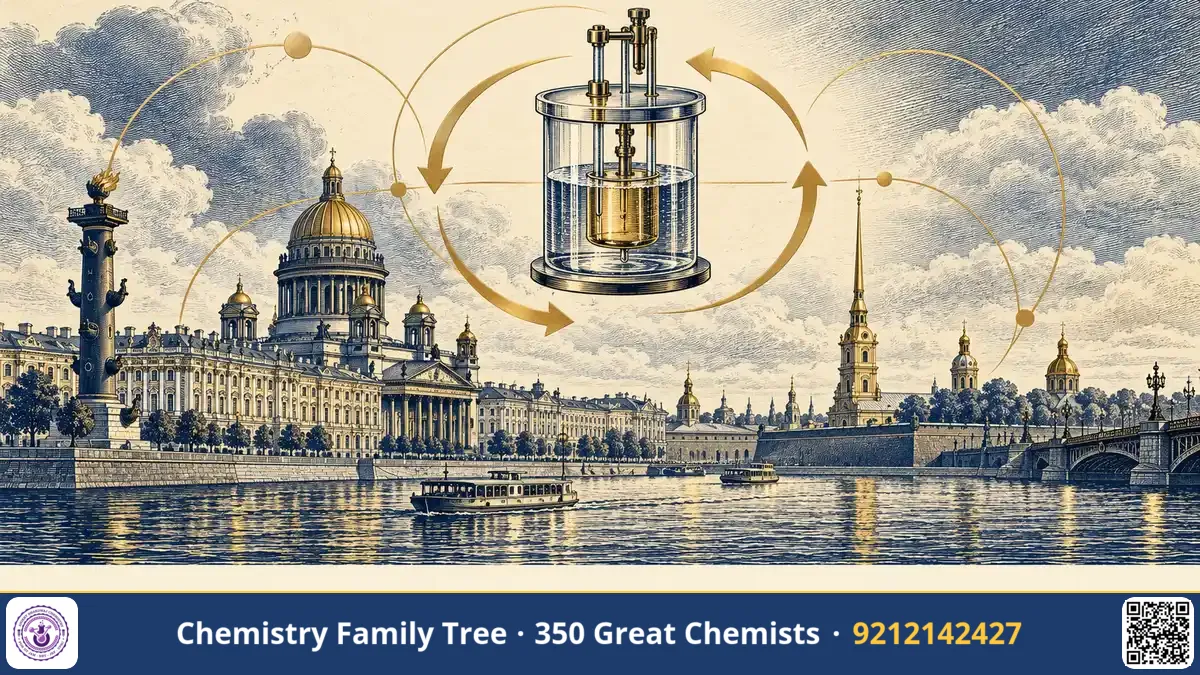
Germain Henri Hess (in Russian, German Ivanovich Gess) was a Swiss-born Russian chemist and physician who is remembered as the founder of thermochemistry. His law of constant heat summation, published in 1840, allowed chemists to calculate heats of reactions that cannot be measured directly. His legacy in one line: he showed that the heat of a reaction depends only on where it begins and ends, not on the route taken.
Early Life and Family
Hess was born on 8 August 1802 in Geneva, Switzerland. His father moved the family to Russia in 1805, when Hess was three years old, and took work as a tutor in a Moscow family. Germain therefore grew up in Moscow and became, in effect, a Russian scientist, though he kept his Swiss roots. He was educated in Moscow in a private school and then in the gymnasium, where he learned Russian and German.
Education and Mentors
Hess studied medicine at the University of Dorpat (now Tartu, in Estonia), and graduated in 1825 with a doctorate in medicine. Dorpat was then a leading university in the Russian Empire. During his studies he was drawn towards chemistry, and his teacher was the chemist Gottfried Osann. After graduating, he went on a trip to Sweden in 1825, where he visited the laboratory of Jöns Jacob Berzelius in Stockholm. Berzelius, the leading chemist of the day, became a friend and lifelong correspondent. Hess then went back to Russia, working briefly as a doctor in Irkutsk, Siberia, where he also studied the mineral waters and rocks of the region.
Career Timeline
| Year | Event |
|---|---|
| 1802 | Born in Geneva, 8 August |
| 1805 | Family moved to Russia |
| 1825 | Medical doctorate, Dorpat; visited Berzelius in Stockholm |
| 1820s | Worked as a physician in Irkutsk, Siberia |
| 1828 | Elected adjunct of the St Petersburg Academy of Sciences |
| 1830s | Professor of chemistry at several St Petersburg institutes |
| 1831 | Published a chemistry textbook, Fundamentals of Pure Chemistry |
| 1834 | Became a full academician |
| 1840 | Law of constant heat summation published |
| 1850 | Died in St Petersburg, 13 December |
Major Scientific Contributions
- Hess's law (1840): The total enthalpy change is independent of the route. See our discovery blog for examples and applications.
- Thermochemistry: He measured heats of neutralisation, hydration and combustion. He also found the law of thermoneutrality of salts: in neutral salt solutions, mixing does not produce heat change (the heat of reaction between neutral salt solutions is nearly zero). This was one of the first insights into the nature of electrolyte solutions.
- Textbook of chemistry: His book Foundations of Pure Chemistry (1831) was the standard Russian textbook for many years, and went through several editions. It gave a lot of Russian chemical terms, and it was the book from which young Mendeleev studied.
- Mineralogy and analysis: He studied minerals and mineral waters, which reflects his interest in practical chemistry.
Awards, Honours and Nobel Prize
Hess was elected to the St Petersburg Academy of Sciences, becoming an adjunct in 1828 and a full academician in 1834. He was a respected teacher at the Mining Institute, the Technological Institute and the Main Pedagogical Institute in St Petersburg. His best-known honour is that his law carries his name. He did not receive a Nobel Prize, as he died in 1850, long before the prizes began in 1901.
Personality, Struggles and Lesser-Known Facts
- He was a physician who became a chemist and then the founder of a new branch of physical chemistry.
- His thermochemical work was ahead of his time. Few contemporaries valued it, as the idea of energy conservation was not widely accepted until after Joule and Mayer in the 1840s.
- He kept a tight friendship with Berzelius, who valued his ideas and corresponded with him.
- He taught Mendeleev's generation. Mendeleev later wrote that he studied from Hess's textbook as a student.
- He died in St Petersburg in 1850 at the age of 48, still in the middle of his scientific career.
Legacy and Influence on Modern Chemistry
Hess's law is a basic part of chemical thermodynamics. Later scientists such as Marcellin Berthelot, Julius Thomsen and Wilhelm Ostwald extended thermochemistry, and the first law of thermodynamics (Mayer, Joule, Helmholtz) gave the law a general base. Today we use it for tables of standard enthalpies of formation, for the Born-Haber cycle and for industrial energy balance. In India, all Class 11 students learn it in the chapter on thermodynamics, and it is a source of numerical problems in JAM, NET and GATE.
Lessons for Students
- Be open to cross-training. A doctor became a chemist and a founder of thermochemistry.
- Careful measurement beats speculation. Hess's law came from calorimetry.
- Write good textbooks. Teaching passes ideas to the next generation.
- Be patient. His idea was recognised only after energy conservation became accepted.
- Move across borders. Swiss by birth, German by training, Russian by career.
Quick Facts Box
- Born: 8 August 1802, Geneva
- Died: 13 December 1850, St Petersburg
- Nationality: Swiss-born, Russian
- Field: Thermochemistry
- Famous for: Hess's law of constant heat summation (1840)
- Nobel Prize: None (died before 1901)
FAQ
Was Hess Swiss or Russian?
Both. He was born in Geneva but lived and worked in Russia from the age of three.
Was Hess a doctor?
Yes, he took a medical degree at Dorpat in 1825.
Which Russian chemist studied from Hess's textbook?
Dmitri Mendeleev used it as a student.
Why is Hess called the founder of thermochemistry?
Because he put heats of reaction on a systematic basis and formulated the first general law of thermochemistry.
Published by ABC Chemistry — IIT-JAM | CSIR-NET | GATE Chemistry Coaching. Visit abcchemistry.com
About the chemist
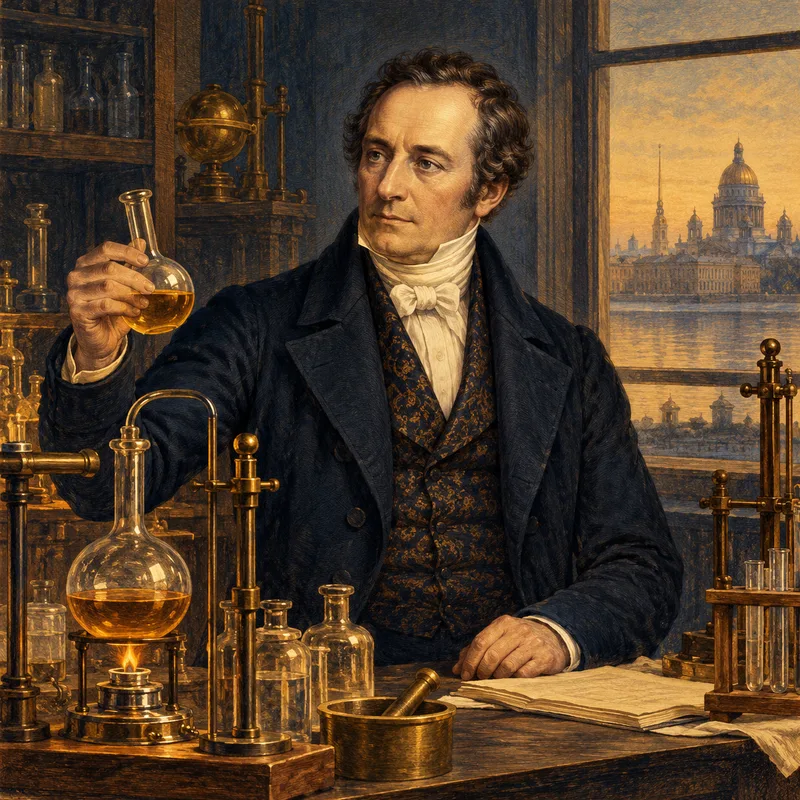
Germain Henri Hess
1802-1850 · Russia
Hess's law of thermochemistry