The discovery, explained · Chemist no. 293 of 350
The Stork Enamine Reaction: A Gentler Way to Alkylate Ketones
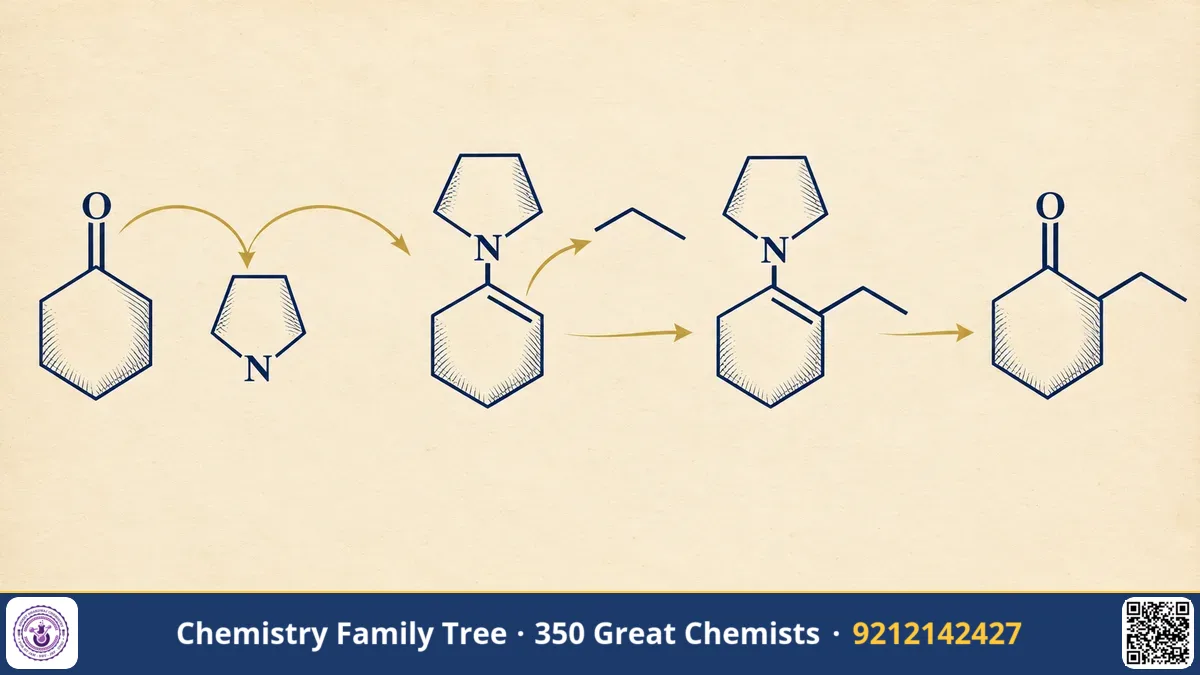
How do you attach an alkyl group to the carbon next to a carbonyl without a mess of side reactions? Before the 1950s the standard method used strong bases such as sodium ethoxide or sodium amide. The enolate formed this way often reacted twice, or reacted on oxygen instead of carbon, or underwent self-condensation. In 1954 Gilbert Stork and co-workers at Columbia University showed that a ketone could first be converted into an enamine, which is a mild, neutral nucleophile. The enamine reacts cleanly with an alkyl halide, and simple hydrolysis returns the α-alkylated ketone. This Stork enamine alkylation is still a classic in textbooks and exams.
The Scientific Problem Before the Discovery
Alkylation of ketone enolates was a central way to make C-C bonds, but it came with serious difficulties:
- Polyalkylation: the mono-alkylated product is still acidic and gets alkylated again.
- Self-condensation: the strongly basic conditions allow aldol reactions.
- O- versus C-alkylation: enolates are ambident nucleophiles and may react at oxygen.
- Regiochemistry: unsymmetrical ketones give mixtures of the two possible enolates.
Chemists needed a neutral, selective, mild alternative. The key insight was that nitrogen can push electron density into a C=C bond in the same way that oxygen does in an enolate, but without creating a strongly basic medium.
The Discovery: Step-by-Step
The reaction has three stages.
Step 1: Enamine formation. A ketone reacts with a secondary amine (commonly pyrrolidine, piperidine or morpholine) with an acid catalyst, and water is removed (Dean-Stark trap or drying agent).
Cyclohexanone + pyrrolidine → 1-pyrrolidino-cyclohexene (enamine) + H₂O
Step 2: Alkylation. The β-carbon of the enamine is nucleophilic, because the nitrogen lone pair is conjugated with the C=C bond (N-C=C ↔ N⁺=C-C⁻). It attacks a reactive alkyl halide (allyl, benzyl, methyl iodide, α-halo ester, or an electron-poor alkene in a Michael reaction). The result is an iminium salt.
Enamine + R-X → α-alkyl iminium halide
Step 3: Hydrolysis. Dilute aqueous acid hydrolyses the iminium ion, giving the α-alkylated ketone and regenerating the amine salt.
Iminium + H₂O → 2-R-cyclohexanone + R₂NH₂⁺ X⁻
The enamine also reacts with acyl halides to give 1,3-diketones after hydrolysis, and with Michael acceptors such as methyl vinyl ketone or acrylonitrile to give 1,5-dicarbonyl compounds, which can be used in Robinson-type annulations.
The Chemistry Behind It
Why is the enamine a good nucleophile? The nitrogen lone pair donates into the π bond, raising the HOMO energy and placing partial negative charge on the β-carbon. Yet the enamine is a neutral molecule, so no strong base is needed.
Why is polyalkylation avoided? The product of the first alkylation is a charged iminium ion, which cannot be alkylated again until it is hydrolysed. Proton loss from the iminium would regenerate an enamine, but this is slow and the conditions are mild, so mono-alkylation dominates.
Regiochemistry. With unsymmetrical ketones such as 2-methylcyclohexanone, the enamine prefers the less substituted double bond. This happens because of allylic (A1,3) strain between the substituent and the N-alkyl groups when the more substituted enamine tries to remain planar. Thus alkylation occurs at the less hindered α-carbon, which is the opposite of the selectivity of the thermodynamic enolate.
Other Stork contributions you should know
- Stork-Eschenmoser hypothesis: The stereochemistry of polyene cyclisations, such as the biosynthetic conversion of squalene oxide to lanosterol, is explained by the chair-like folding of an all-trans polyene so that trans (anti) additions give fused rings with defined stereocentres.
- Stork-Danheiser transposition: A vinylogous ester of a 1,3-diketone is attacked by an organometallic reagent, and acid hydrolysis then gives a 3-substituted cyclohexenone.
- Radical cyclisation: Stork showed that radical cyclisations (for example with Bu₃SnH and a catalytic initiator) can build five-membered rings with good stereocontrol, and used bromoacetals as radical precursors.
- Stork olefination: A modified Wittig route for making (Z)-vinyl iodides.
Applications Today
- Total synthesis: Enamine and related enolate-type chemistry is used to construct rings in natural products, steroids and alkaloids. Stork himself used such ideas in synthesis of alkaloids such as lycopodine and reserpine, and of quinine.
- Pharmaceutical process chemistry: Mild C-C bond formation next to carbonyls is common in drug intermediates.
- Organocatalysis: The modern field of organocatalysis, for which Benjamin List and David MacMillan received the Nobel Prize in Chemistry in 2021, uses chiral secondary amines (such as proline) to form enamines and iminium ions in situ. This is a direct descendant of the Stork enamine concept.
- Teaching: The reaction shows students how nitrogen lone pairs control carbon nucleophilicity.
- Indian research labs frequently use proline-catalysed aldol and Mannich reactions that rely on enamine intermediates.
Exam Corner
- Stork enamine reaction: ketone + secondary amine → enamine → alkylation → iminium → hydrolysis → α-alkyl ketone.
- Secondary amines (pyrrolidine, morpholine, piperidine) are used; primary amines would give imines, and tertiary amines cannot form enamines.
- The nucleophilic site of the enamine is the β-carbon, not nitrogen (although N-alkylation can occur reversibly).
- The less substituted enamine is favoured, so alkylation occurs at the less substituted α-carbon.
- Enamines with acyl chlorides give 1,3-diketones; with Michael acceptors they give 1,5-dicarbonyl compounds.
Common Misconceptions
- "Any amine makes an enamine." Only secondary amines do so with ketones. Primary amines form imines.
- "Enamines are as basic as enolates." They are much less basic, which is why the reaction is mild and free of polyalkylation.
- "Hydrolysis step is optional." Without it you only have the iminium salt, not the ketone product.
Quick Revision Box
- Year and place: 1954, Columbia University.
- Three steps: enamine formation, alkylation, hydrolysis.
- Nucleophile: β-carbon of enamine (N-C=C ↔ N⁺=C-C⁻).
- Typical amines: pyrrolidine, piperidine, morpholine.
- Mono-alkylation; less substituted α-position reacts.
- Also: Stork-Eschenmoser hypothesis, radical cyclisation, Stork-Danheiser reaction.
FAQ
What is the Stork enamine reaction?
It is the α-alkylation or acylation of a ketone or aldehyde through its enamine derivative, followed by hydrolysis back to the carbonyl compound.
Why use enamines instead of enolates?
Enamines are neutral and mildly nucleophilic, so they give less polyalkylation, fewer side reactions and no need for strong bases.
Which amines are used?
Secondary cyclic amines such as pyrrolidine, piperidine and morpholine are most common. Pyrrolidine gives the most reactive enamines.
How is it related to organocatalysis?
Organocatalysts like proline form enamine intermediates with carbonyl compounds, just as in the Stork reaction, but they do so catalytically and enantioselectively.
Published by ABC Chemistry — IIT-JAM | CSIR-NET | GATE Chemistry Coaching. Visit abcchemistry.com
About the chemist
Gilbert Stork
1921-2017 · United States
Stork enamine reaction; total synthesis