The discovery, explained · Chemist no. 81 of 350
Inner-Sphere Electron Transfer: Henry Taube's Discovery About How Electrons Move Between Metal Complexes
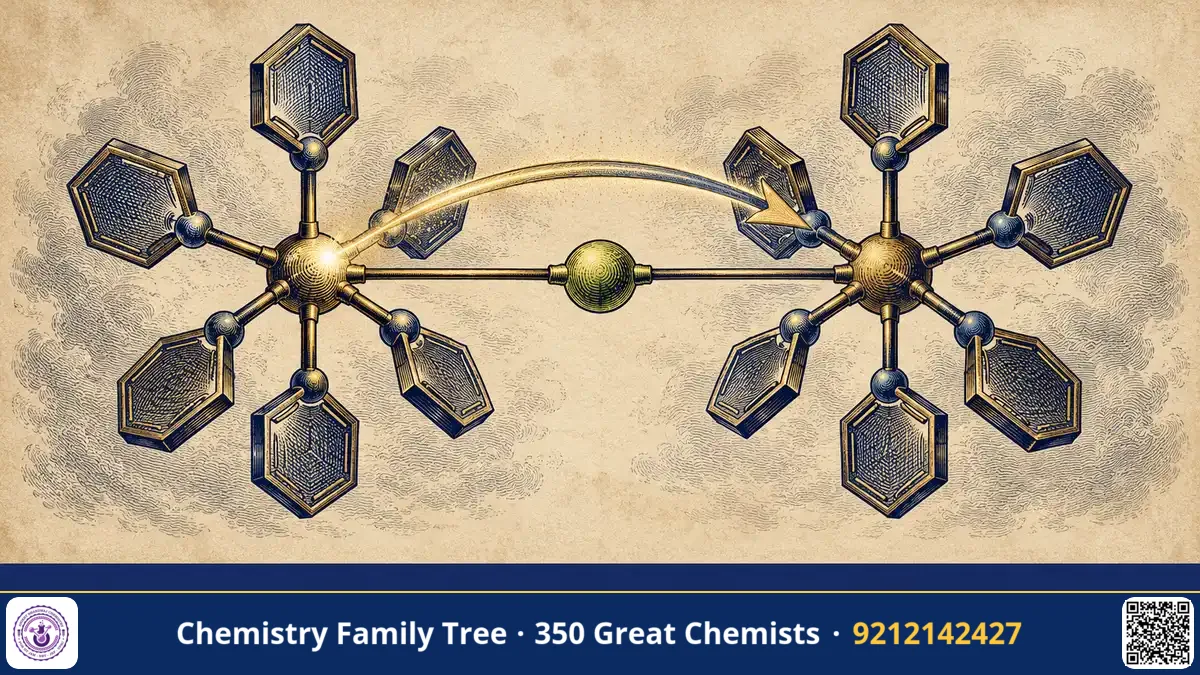
Every time iron in your blood carries oxygen, every time a battery charges, and every time a plant turns light into chemical energy, electrons jump from one species to another. Chemists once treated this as a black box: electrons go in, electrons come out. Henry Taube opened the box. By studying the reactions of coloured metal complexes in water, he showed that an electron can be passed through a bridging ligand that links two metal centres, a process now called the inner-sphere mechanism. He received the Nobel Prize in Chemistry in 1983 "for his work on the mechanisms of electron transfer reactions, especially in metal complexes". This blog explains his key experiment and the ideas of lability and inertness behind it, which are core topics for IIT-JAM, CSIR-NET and GATE.
The Scientific Problem Before the Discovery
In the 1940s and early 1950s chemists could measure how fast many redox reactions in solution run, but they did not know the pathway. When Fe2+ and Fe3+ exchange an electron, does one ion first touch the other? Does the electron tunnel through the layer of water molecules around each ion? Or does some molecule act as a bridge?
The difficulty is that these reactions are usually very fast, and the products are chemically identical to the reactants in electron-exchange reactions. Nothing visible changes. To learn the mechanism, Taube needed a system where something permanent would reveal what had happened. He found it by using the difference between labile and inert complexes.
The Discovery / Experiment — Step by Step
Labile and inert complexes
A complex is labile if its ligands are replaced quickly (half-life under about a minute) and inert if substitution is slow. Taube noticed, through ideas related to crystal field theory, that the d-electron configuration controls this. Octahedral Cr(III) (d3) and low-spin Co(III) (d6) are inert, because their t2g orbitals are half-filled or filled and the crystal field stabilisation energy is large. Cr(II) (high-spin d4) is labile, because it has an electron in an eg antibonding orbital, and Co(II) high-spin d7 is also labile.
The key experiment (1953)
Taube reacted the inert cobalt(III) complex [Co(NH3)5Cl]2+ with the labile chromium(II) ion [Cr(H2O)6]2+ in acid solution. The overall reaction is:
[Co(NH3)5Cl]2+ + [Cr(H2O)6]2+ + 5 H3O+ → [Co(H2O)6]2+ + [Cr(H2O)5Cl]2+ + 5 NH4+
Here is the logic of the reasoning:
- Cr(II) is labile, so it can quickly lose a water molecule and bind to the chloride of the cobalt complex. This forms a bridged species: (NH3)5CoIII-Cl-CrII(H2O)5.
- An electron passes from Cr(II) to Co(III) through the chloride bridge. Now we have Co(II) (labile) and Cr(III) (inert).
- Cr(III) is inert, so the chloride stays attached to chromium. Co(II) is labile, so its ammonia ligands are quickly replaced by water, and in acid they become NH4+.
- The product [Cr(H2O)5Cl]2+ contains the chloride that was originally on cobalt. Because Cr(III) does not exchange ligands quickly, this chloride cannot have come from the solution.
Taube proved this using an isotope experiment. When he added radioactive chloride (36Cl) to the solution, the chromium product contained almost none of it. The chloride in the product was the one transferred from cobalt. This was direct evidence that a ligand moved together with the electron, and therefore that the two metals shared a bridging ligand at the moment of electron transfer.
The Chemistry Behind It
Inner-sphere versus outer-sphere
| Feature | Inner-sphere | Outer-sphere |
|---|---|---|
| Contact between metals | Linked by a shared bridging ligand | Coordination spheres stay intact and separate |
| Ligand change | At least one complex must be substitution-labile | No bond breaking needed |
| Evidence | Ligand transfer in the product | Rates fit theory without ligand transfer |
| Example | Co(III)/Cr(II) with Cl- bridge | [Fe(CN)6]4-/[Fe(CN)6]3-; [Ru(NH3)6]2+/3+ |
The steps of the inner-sphere route are (1) precursor complex formation, (2) electron transfer in the bridged complex, and (3) successor complex dissociation. The bridging ligand must have a lone pair or pi system that can bind both metals. Common bridges are Cl-, Br-, OH-, SCN-, N3- and CN-. The bridging ligand also affects the rate, which Taube used to study the transition state.
Mixed valence: the Creutz-Taube ion
Taube also studied ruthenium ammine complexes. In 1969 his student Carol Creutz and Taube prepared a pyrazine-bridged dimer, [(NH3)5Ru-pz-Ru(NH3)5]5+, now called the Creutz-Taube ion. Its ruthenium centres appear to be in a formal +2.5 state, so it became the standard test case for how strongly electrons are shared in mixed-valence compounds, and it is classified by Robin and Day in the context of valence delocalisation.
Applications Today
- Biochemistry: electron transfer in cytochromes, iron-sulphur proteins and copper proteins (such as azurin) is studied using Taube's framework.
- Solar energy research: ruthenium polypyridyl complexes, related to his ruthenium work, are used in dye-sensitised solar cells and photocatalysis.
- Water treatment and industry: redox reactions of metal ions in corrosion, hydrometallurgy and electroplating involve the same mechanistic ideas.
- Molecular electronics: mixed-valence molecules serve as models for molecular wires and switches.
Exam Corner — 5 Likely Points
- Inert octahedral ions: d3 (Cr3+), low-spin d4, d5, d6 (Co3+). Labile: d0, d1, d2, high-spin d4 to d10 in general.
- Taube's classic experiment: [Co(NH3)5Cl]2+ + Cr2+(aq) gives [Cr(H2O)5Cl]2+; chloride is transferred, proving the bridge.
- Inner-sphere needs a bridging ligand and ligand substitution; outer-sphere does not.
- The Creutz-Taube ion is a pyrazine-bridged diruthenium mixed-valence ion.
- Mechanism steps: precursor complex, electron transfer, successor complex, dissociation.
Common Misconceptions
- "Labile means unstable." No. Lability is about speed of ligand substitution (kinetics), while stability refers to thermodynamics.
- "Co(III) is always inert." Low-spin octahedral Co(III) is inert, but high-spin examples such as [CoF6]3- are more labile.
- "Electrons always move through bonds." In outer-sphere reactions they tunnel between separated complexes without a bridge.
Quick Revision Box
- Taube won the 1983 Nobel Prize in Chemistry for electron-transfer mechanisms in metal complexes.
- Inner-sphere: bridging ligand shared between two metal centres.
- Key test: ligand ends up on the metal that was originally inert after reaction.
- Cr(III) d3 and Co(III) low-spin d6 are inert; Cr(II) and Co(II) are labile.
- Creutz-Taube ion: pyrazine-bridged Ru dimer used for mixed-valence studies.
- Outer-sphere electron transfer is described quantitatively by Marcus theory.
FAQ
Why was a chromium and cobalt pair chosen?
Because the reactant cobalt(III) and the product chromium(III) are inert, while the reactant chromium(II) and product cobalt(II) are labile. This allowed the ligand location to "freeze" and be analysed.
Is inner-sphere always faster than outer-sphere?
No. Rates depend on the reaction, the ligands and the metals. Some outer-sphere reactions are extremely fast.
What is a mixed-valence compound?
It is a compound that contains the same element in two different oxidation states, or in an intermediate state, such as the Creutz-Taube ion.
How is Taube's work connected to Marcus theory?
Marcus explained theoretically how fast outer-sphere electron transfer should be. Taube provided much of the experimental data and the inner-sphere pathway, so the two views complement each other.
Published by ABC Chemistry — IIT-JAM | CSIR-NET | GATE Chemistry Coaching. Visit abcchemistry.com
About the chemist
Henry Taube
1915-2005 · Canada/United States · Nobel Chemistry 1983
Electron transfer in metal complexes