The discovery, explained · Chemist no. 252 of 350
Hermann Kolbe: Electrolysis, Salicylic Acid and the Synthesis of Acetic Acid
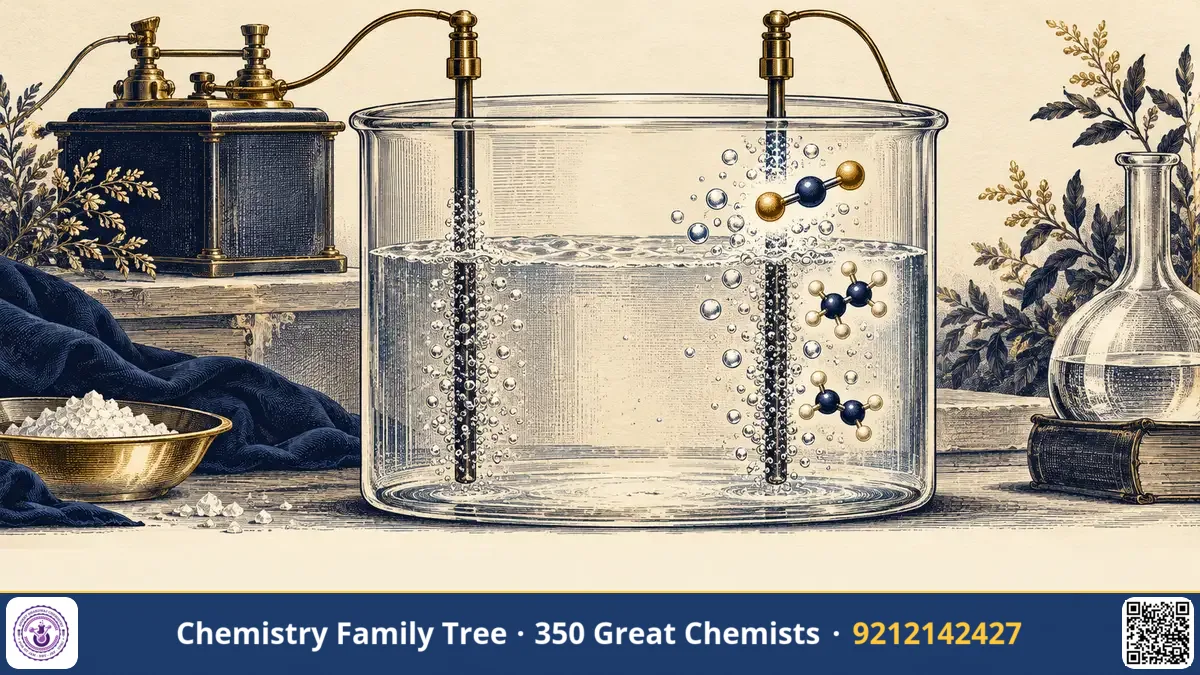
Two named reactions carry the name of Adolph Wilhelm Hermann Kolbe (1818-1884): the Kolbe electrolysis, in which the electrolysis of sodium salts of carboxylic acids gives alkanes, and the Kolbe-Schmitt reaction, which converts phenoxide and carbon dioxide into salicylic acid, the parent compound of aspirin. Both are regular questions in JAM, NET and GATE. Kolbe also did something even more important for the history of science: in 1845 he synthesised acetic acid starting from its elements, using inorganic reagents only, and thus helped to end the belief in the "vital force". This post explains each discovery, the mechanism and the exam points.
The Scientific Problem Before the Discovery
When Kolbe began his career in the 1840s, vitalism was still a strong belief in many circles. Wohler had made urea in 1828 from ammonium cyanate, but critics said that it was an exception. Acetic acid, the acid of vinegar, was a well-known product of fermentation and a typical "organic" acid. Could it be built from inorganic materials such as carbon, sulfur, chlorine and water?
There was also the problem of organic radicals. Chemists wanted to isolate "free radicals" like methyl and ethyl, and Kolbe thought that electrolysis of organic acids might do it. Finally, there was the question of how to make hydroxy acids such as salicylic acid, which was then obtained only from natural sources like willow bark and wintergreen oil, in a cheap way.
The Discovery / Experiment
1. Synthesis of acetic acid from elements (1845)
- Carbon disulfide (made from carbon and sulfur) was treated with chlorine to give carbon tetrachloride.
- Carbon tetrachloride, passed through a red-hot tube, lost chlorine and formed tetrachloroethylene (C2Cl4).
- Tetrachloroethylene, treated with chlorine and water in sunlight, gave trichloroacetic acid.
- Reduction of trichloroacetic acid (with electrolytic hydrogen, later with sodium amalgam) replaced the chlorine atoms by hydrogen and gave acetic acid.
CS2 + 3 Cl2 -> CCl4 + S2Cl2
2 CCl4 --(red heat)--> C2Cl4 + 2 Cl2
C2Cl4 + 2 H2O + 3 Cl2 -> 2 CCl3COOH + 4 HCl
CCl3COOH + 6 [H] -> CH3COOH + 3 HCl
This was a clear case of a complete synthesis of an organic acid from inorganic starting materials, and it came, importantly, without any biological source.
2. Kolbe electrolysis (1849)
Kolbe passed a current through a concentrated aqueous solution of potassium or sodium acetate using platinum electrodes. At the anode he collected a mixture of gases: carbon dioxide and a hydrocarbon (ethane). Hydrogen formed at the cathode, and the solution became alkaline.
Anode:    2 CH3COO(-)  ->  CH3-CH3 + 2 CO2 + 2 e(-)
Cathode:  2 H2O + 2 e(-)  ->  H2 + 2 OH(-)
Overall:  2 CH3COONa + 2 H2O -> C2H6 + 2 CO2 + H2 + 2 NaOH
Kolbe thought that the product was the free methyl radical, but the molecular formula C2H6 showed it was ethane, formed by joining two methyl radicals.
3. Kolbe-Schmitt reaction (1860, improved 1885)
Kolbe heated sodium phenoxide in a stream of dry carbon dioxide and found that sodium salicylate formed. Rudolf Schmitt, his student, improved the process in 1885 by carrying out the reaction under pressure (about 100 atm and 125 C), which gave much better yield.
C6H5ONa + CO2  --(125 C, 5-100 atm)-->  o-HOC6H4COONa
o-HOC6H4COONa + H+  ->  o-HOC6H4COOH    (salicylic acid)
An industrial factory based on Kolbe's method was set up in Dresden by his student Friedrich von Heyden in 1874, to supply salicylic acid as an antiseptic and food preservative. This made salicylic acid cheap, and later it was acetylated to make aspirin.
The Chemistry Behind It
Kolbe electrolysis mechanism
- At the anode, the carboxylate ion loses one electron to give an acyloxy radical RCOO·.
- The acyloxy radical quickly loses CO2 to give an alkyl radical R·.
- Two alkyl radicals on the electrode surface couple to form R-R.
RCOO(-) -> RCOO. + e(-) ; RCOO. -> R. + CO2 ; 2 R. -> R-R
Features to remember: the number of carbon atoms in the alkane product is twice the number in R; so sodium propionate gives butane and sodium succinate gives ethylene. A mixture of two different carboxylates gives three alkanes (cross-coupling), so the method is best for symmetrical products. High current density, concentrated solutions, platinum anodes and slightly acidic or neutral pH favour radical coupling; with a dilute solution or other anodes, the radical is oxidised further and gives alcohols or esters instead (Hofer-Moest reaction).
Kolbe-Schmitt mechanism
Sodium phenoxide is an electron-rich aromatic ring. Carbon dioxide is a weak electrophile. The phenoxide attacks CO2 by electrophilic aromatic substitution at the ortho position. The sodium ion holds the phenoxide oxygen and the CO2 oxygen together in a six-membered chelate, which directs the reaction to the ortho position. A proton shift (tautomerisation) restores aromaticity, and acidification gives salicylic acid.
Na+ phenoxide + CO2 -> [ortho-carboxylation, chelated by Na+] -> sodium salicylate
With K+ (larger, weaker chelation) and higher temperature (about 200 C): para product,
4-hydroxybenzoic acid
This is a favourite exam point: sodium gives ortho; potassium and higher temperature favour para.
Applications Today
- Aspirin and salicylates: Salicylic acid from the Kolbe-Schmitt process is acetylated to aspirin. Millions of tonnes of the chemical chain are produced each year. Salicylic acid itself is used in creams for acne and warts in India and elsewhere.
- Dyes and preservatives: 4-hydroxybenzoic acid is used to make parabens, preservatives in cosmetics and medicines.
- Electrosynthesis: Kolbe electrolysis is used for coupling of carboxylic acids from biomass, such as fatty acids, to make biofuels and chemical precursors, and for synthesis of long-chain diacids.
- Green chemistry: Carboxylation using CO2 as a feedstock is an area of present research.
Exam Corner
- Kolbe electrolysis of sodium acetate: ethane and CO2 at the anode, H2 and NaOH at the cathode.
- Number of carbons in product alkane is 2 x (carbons in R); sodium propionate gives butane.
- Kolbe-Schmitt: sodium phenoxide + CO2 (125 C, 4-7 atm), then H+, gives salicylic acid; potassium phenoxide at higher temperature gives p-hydroxybenzoic acid.
- Mechanism of Kolbe electrolysis: radical; Kolbe-Schmitt: electrophilic aromatic substitution by CO2.
- Salicylic acid + acetic anhydride gives aspirin.
Common Misconceptions
- "Kolbe electrolysis gives alkanes with the same carbon number as the acid." It gives one with twice the carbon number of R, i.e. two carbon atoms fewer than twice the acid.
- "The Kolbe-Schmitt reaction is a free-radical reaction." It is an electrophilic aromatic substitution on the phenoxide ion.
- "Phenol itself reacts with CO2." Not under the same conditions; the phenoxide (formed with NaOH) is the reactive species.
Quick Revision Box
- Hermann Kolbe (1818-1884), German chemist.
- 1845: acetic acid synthesised from elements.
- 1849: Kolbe electrolysis, 2 RCOO- gives R-R + 2CO2 (anode).
- 1860: Kolbe-Schmitt (Schmitt 1885): phenoxide + CO2 gives salicylate.
- Na gives ortho; K and heat give para.
- Salicylic acid is the precursor of aspirin.
FAQ
What is Kolbe electrolysis?
It is the electrolysis of an aqueous solution of an alkali salt of a carboxylic acid, giving an alkane with double the carbon chain of R at the anode.
Why does the Kolbe-Schmitt reaction give the ortho product?
The small sodium ion forms a chelate between the phenoxide and CO2, which delivers CO2 to the ortho position.
What is the connection of Kolbe with aspirin?
His method made salicylic acid cheap on an industrial scale. Salicylic acid is acetylated to aspirin.
How did Kolbe contribute to ending vitalism?
He made acetic acid from carbon, sulfur, chlorine and water, with no living source involved.
Published by ABC Chemistry — IIT-JAM | CSIR-NET | GATE Chemistry Coaching. Visit abcchemistry.com
About the chemist
Hermann Kolbe
1818-1884 · Germany
Kolbe electrolysis; Kolbe-Schmitt reaction