The discovery, explained · Chemist no. 34 of 350
Hund's Rule: Why Electrons Prefer to Stay Unpaired
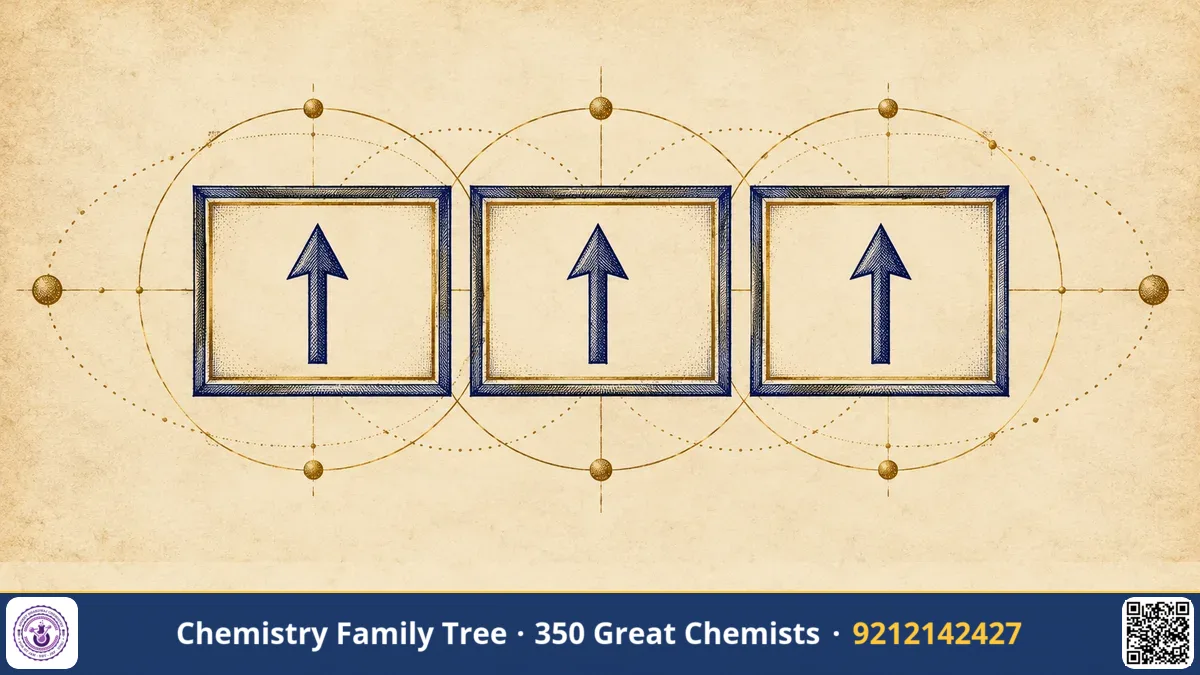
Look at the electron configuration of carbon: 1s² 2s² 2p². The two 2p electrons could sit together in one p orbital, or they could occupy two different p orbitals. Which is lower in energy? The answer, found by the German physicist Friedrich Hund in 1925-1927 from a study of atomic spectra, is the second: electrons spread out over degenerate orbitals with parallel spins before any pairing takes place. This is Hund's rule of maximum multiplicity. It is one of the first rules every student learns for writing electron configurations, and it explains the magnetism of atoms, the stability of half-filled shells, and the spectra of atoms and molecules. Hund also discovered quantum tunnelling in molecules and, with Robert Mulliken, helped to found molecular orbital theory.
The Scientific Problem Before the Discovery
By the mid-1920s the Bohr-Sommerfeld model and Pauli's exclusion principle (1925) explained how many electrons each shell can hold. But they did not say how electrons are distributed among orbitals of equal energy, or which state of an atom has the lowest energy. Atomic spectra were rich and complicated. For atoms with several electrons, a given configuration such as p² gives rise to several energy levels, called terms. Spectroscopists had measured these terms but needed rules to know their order and to interpret them.
Also, the new quantum mechanics was applied mainly to atoms. Chemists needed to know what happens in molecules. How do the electrons in a molecule such as O₂ arrange themselves? Why are some molecules symmetric and others not? Hund was in the right place to answer: Göttingen, where Max Born and James Franck were working on molecular and atomic spectra.
The Discovery: Step by Step
Step 1: Analysing atomic spectra
Hund studied the line spectra of atoms and the energy terms for configurations such as p² and p³. By comparing theory and experiment he noticed a regular pattern about the term of lowest energy. Between 1925 and 1927 he set out the empirical rules that now bear his name.
Step 2: The three Hund's rules for atomic terms
For the ground-state term of an atom with a given electron configuration:
- Maximum multiplicity (spin): the term with the greatest total spin S, that is, the most unpaired electrons with parallel spins, has the lowest energy.
- Maximum orbital angular momentum: among terms with the same S, the one with the largest total orbital angular momentum L is lowest.
- Spin-orbit coupling: for a subshell less than half full, the level with the lowest total angular momentum J (J = |L - S|) is lowest; for a subshell more than half full, the highest J (J = L + S) is lowest.
Chemistry textbooks usually quote the first rule in this form: in a set of degenerate orbitals, electrons occupy separate orbitals with parallel spins before pairing begins.
Step 3: Why electrons spread out
Electrons with parallel spins obey the Pauli principle by staying in different regions of space. This reduces their mutual repulsion and lowers the energy. This effect, called exchange energy, is a purely quantum mechanical effect with no classical analogue. The more pairs of parallel-spin electrons, the greater the exchange stabilisation.
Step 4: Examples
Carbon  (2p²):  ↑ ↑ _     2 unpaired electrons, S = 1, term ³P
Nitrogen (2p³): ↑ ↑ ↑     3 unpaired electrons, S = 3/2, term ⁴S
Oxygen  (2p⁴):  ↑↓ ↑ ↑    2 unpaired electrons, term ³P
The superscript is the spin multiplicity 2S + 1. Nitrogen has the maximum number of unpaired p electrons and an especially stable half-filled subshell.
Step 5: Tunnelling and molecules
In 1927 Hund also applied the new quantum mechanics to molecules. Looking at a molecule with two equivalent minima in the potential energy curve, such as the two mirror-image forms of a pyramidal molecule, he showed that a particle can pass through the barrier between them even if it does not have enough energy to go over it. This is quantum tunnelling. For ammonia, NH₃, the nitrogen atom oscillates through the plane of the three hydrogens (inversion). The same mathematics explains alpha decay of nuclei and how electrons move in many chemical and biological processes.
The Chemistry Behind It
Electron configurations
When you fill the 2p, 3d or 4f subshells, apply the Aufbau principle for order, the Pauli exclusion principle (no two electrons in an atom share the same four quantum numbers), and Hund's rule for distribution. For d⁵ in Mn²⁺ and f⁷ in Gd³⁺, each orbital holds one electron with parallel spin, giving large magnetic moments.
Magnetic moment
The spin-only magnetic moment in Bohr magnetons is
μ = √(n(n + 2)) BM (n = number of unpaired electrons)
For Fe³⁺ (d⁵, five unpaired electrons in a high-spin complex): μ = √35 ≈ 5.92 BM.
Exceptional configurations
Chromium is [Ar] 3d⁵ 4s¹ and copper is [Ar] 3d¹⁰ 4s¹, not 3d⁴ 4s² and 3d⁹ 4s². Half-filled and fully filled d subshells are extra stable because of exchange energy and symmetry.
Hund's cases in molecules
Hund also classified the ways in which angular momenta of electrons and rotation of the molecule couple in diatomic molecules. These classifications, called Hund's cases (a) to (e), are essential in rotational and electronic spectroscopy.
Molecular orbitals
Hund's rule also applies to molecular orbitals. In O₂, the two electrons in the degenerate π* orbitals occupy separate orbitals with parallel spins, which gives paramagnetism.
Applications Today
- Writing ground-state configurations for atoms, ions and complexes, and thereby predicting magnetic behaviour.
- Coordination chemistry: high-spin and low-spin complexes depend on competition between crystal-field splitting and pairing energy, in which Hund's exchange energy plays a role.
- Spectroscopy and astrophysics: term symbols identify atomic and ionic lines in the spectra of stars, flames and lamps.
- Magnetic materials: ferromagnetism and the magnetism of rare earth elements used in strong magnets arise from unpaired electrons, as in neodymium magnets.
- Tunnelling technologies: the scanning tunnelling microscope, tunnel diodes and flash memory all use quantum tunnelling.
- India context: Hund's rule is a core topic in the NCERT Class 11 chapter on structure of atom and in the JEE, NEET and JAM syllabus.
Exam Corner
- Hund's rule: degenerate orbitals are singly occupied with parallel spins before pairing.
- Nitrogen (2p³), Mn²⁺ (3d⁵) and Gd³⁺ (4f⁷) have the maximum number of unpaired electrons in their subshells.
- Cr: [Ar] 3d⁵ 4s¹ and Cu: [Ar] 3d¹⁰ 4s¹ are exceptions explained by extra stability of half-filled and filled subshells.
- Spin-only magnetic moment: μ = √(n(n + 2)) BM.
- Hund discovered quantum tunnelling in molecules (1927) and co-developed molecular orbital theory.
Common Misconceptions
- "Electrons repel so they avoid pairing." This is partly true, but the main effect is exchange energy, a quantum effect.
- "Hund's rule applies only to atoms." It applies to molecular orbitals as well.
- "Hund's rule decides the order of filling of subshells." The Aufbau (n + l) rule does that. Hund's rule applies within a subshell.
Quick Revision Box
- Hund's rule (1925-27): fill degenerate orbitals singly with parallel spins first.
- Maximum multiplicity gives the lowest-energy term.
- Exchange energy stabilises parallel spins.
- Half-filled d⁵ and f⁷ and filled shells are extra stable.
- Hund discovered tunnelling in molecules (1927).
- Spin-only moment: μ = √(n(n + 2)) BM.
FAQ
What is multiplicity?
Multiplicity is 2S + 1, where S is the total spin. A state with two unpaired electrons has S = 1 and multiplicity 3 (a triplet).
Does Hund's rule always give the right ground state?
It works well for the ground terms of free atoms. It is less reliable for excited states and for heavy elements where other effects dominate.
Is Hund's rule related to the Pauli principle?
Yes, indirectly. Pauli exclusion keeps same-spin electrons apart, and this lowers repulsion energy.
Did Hund win a Nobel Prize?
No. He received many honours, including the Max Planck Medal, but not a Nobel Prize.
Published by ABC Chemistry — IIT-JAM | CSIR-NET | GATE Chemistry Coaching. Visit abcchemistry.com

About the chemist
Friedrich Hund
1896-1997 · Germany
Hund's rules; molecular orbital theory