The discovery, explained · Chemist no. 185 of 350
Irwin Rose: The Enzymologist Who Brought Rigour to the Ubiquitin Story
Some discoveries depend on a bright idea; others depend on patient, rigorous chemistry. Irwin Rose (1926–2015) was a master of the second kind. For decades he studied how enzymes work at the level of bond breaking and bond making. When Avram Hershko and Aaron Ciechanover visited his laboratory at the Fox Chase Cancer Center in Philadelphia, his methods helped to turn a puzzling observation into a defined chemical pathway. In 2004 the three shared the Nobel Prize in Chemistry "for the discovery of ubiquitin-mediated protein degradation".
This post looks at Rose's approach, the enzymology tools he used, and the part he played in the ubiquitin system.
The Scientific Problem Before the Discovery
By the late 1970s the Israeli group had shown that a small protein, APF-1, becomes attached to target proteins in an ATP-dependent reaction. Yet this was only a descriptive observation. Key questions remained, and they were exactly the kind that a mechanistic enzymologist asks:
- What type of chemical bond joins APF-1 to the target protein?
- What is the fate of ATP: does it go to ADP + Pi or AMP + PPi?
- What are the intermediates? Is there an activated form of APF-1?
- Is the tag removed later, and is APF-1 reused?
Without these answers the system would be a black box, and a convincing mechanism for an ATP-dependent protein modification could not be written.
The Discovery: Step by Step
Rose had spent his career on classical questions: stereochemistry of enzyme reactions, proton transfer in glycolysis, and how enzymes use isotopes to reveal their mechanisms. He applied the same logic:
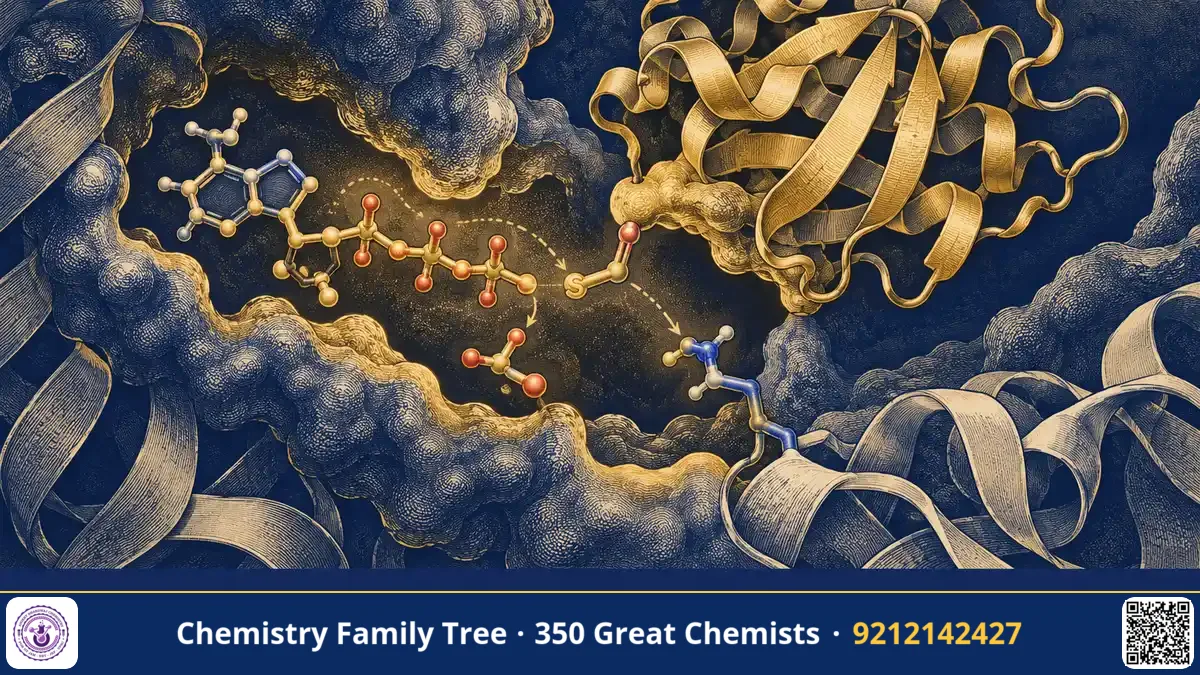
- Determine the fate of ATP: Experiments on the reticulocyte fractions showed that ATP was hydrolysed to AMP and pyrophosphate (PPi), pointing to an acyl-adenylate intermediate like those in amino acid activation.
- Isotope exchange: A standard enzymological test is the exchange of labelled pyrophosphate with ATP. If the enzyme forms an adenylate intermediate (Ub–AMP), it will catalyse 32PPi ↔ ATP exchange in the presence of the substrate Ub. Such measurements supported an activated intermediate.
- Intermediates: The activation of ubiquitin by the E1 enzyme involves formation of a thioester between the C-terminus of ubiquitin and a cysteine of E1; this was supported by tests with reducing agents and hydroxylamine, which cleave thioesters.
- Linkage type: The group established that the ubiquitin C-terminus is bound to ε-amino groups of lysine residues of the substrate by an isopeptide (amide) bond.
- Reversibility and recycling: Rose and co-workers showed that isopeptidases remove ubiquitin from proteins, which allows free ubiquitin to return to the pool. This was an early view of deubiquitinating enzymes.
The Chemistry Behind It
The enzymology of ubiquitin activation is a classic example of "acyl activation". Compare amino-acid activation in protein synthesis with ubiquitin activation:
Amino acid + ATP → aminoacyl–AMP + PPi
Ub–COO⁻ + ATP → Ub–CO–AMP + PPi
Both give a mixed anhydride (acyl phosphate-AMP) which carries high group-transfer potential. The ΔG°′ of ATP hydrolysis to AMP + PPi is around −32 kJ/mol, and the PPi is hydrolysed by pyrophosphatase, pulling the reaction forward. Then the acyl group passes to an enzyme cysteine:
Ub–CO–AMP + E1–SH → Ub–CO–S–E1 + AMP
Thioesters are "high-energy" bonds, with ΔG°′ of hydrolysis of about −31 kJ/mol, so they can transfer the acyl group to an amine by aminolysis without needing more ATP. Thus a single ATP investment ends up as an isopeptide bond.
The nature of an isotope exchange experiment deserves attention, because it is a favourite topic in physical organic chemistry. If an enzyme reaction goes through a covalent intermediate, a partial reaction can occur in the absence of the final acceptor. For a ping-pong mechanism, labelled product exchanges with substrate. Rose also introduced the use of isotope exchange at equilibrium to assign the order of substrate binding in enzymes, one of the standard tools of enzyme kinetics taught today.
Applications Today
- Drug targets: Inhibitors of E1 enzymes and deubiquitinases are being developed for cancer.
- Proteasome inhibitors: Bortezomib and related drugs, used for multiple myeloma, are an outcome of the ubiquitin-proteasome field.
- Assay design: The quantitative enzymology of E1–E2–E3 is used in high-throughput screens.
- Understanding disease: Defects in ubiquitin ligases or deubiquitinases cause neurodegenerative and developmental disorders.
- Teaching: Isotope-exchange experiments remain a core concept in biochemistry and physical organic chemistry.
Exam Corner
- Irwin Rose shared the Nobel Prize in Chemistry 2004 with Ciechanover and Hershko; he worked at the Fox Chase Cancer Center.
- Ubiquitin activation: ATP → AMP + PPi, giving ubiquitin adenylate and then an E1 thioester.
- Thioester and acyl-adenylate bonds have a high group-transfer potential.
- Isotope exchange (e.g., 32PPi–ATP) detects covalent intermediates such as acyl-adenylates.
- Isopeptidases (deubiquitinases) remove ubiquitin and permit recycling.
Common Misconceptions
- "Rose was a student of Hershko." No. Rose was an established senior biochemist; Hershko and Ciechanover worked with him in a collaboration.
- "ATP is hydrolysed to ADP and Pi." In E1 activation of ubiquitin ATP gives AMP and PPi.
- "The Nobel was in Physiology or Medicine." It was in Chemistry.
Quick Revision Box
- Irwin Rose (1926–2015): American biochemist, Fox Chase Cancer Center.
- Specialist in enzyme mechanisms and isotope methods.
- Showed the ubiquitin pathway uses an AMP-intermediate and thioester chemistry.
- Isopeptide bond joins Ub Gly-76 to substrate Lys.
- Recycling by isopeptidases.
- Nobel Prize in Chemistry 2004, shared three ways.
FAQ
What was Rose's special skill?
Mechanistic enzymology: using isotopes, stereochemistry and kinetic tests to find out exactly how enzymes make and break bonds.
Why does the reaction produce AMP and PPi?
The enzyme attacks the alpha phosphate of ATP, releasing PPi and forming an adenylate, similar to amino acid activation.
What is isotope exchange?
A method where a labelled product or substrate swaps its label with another molecule in the presence of enzyme, revealing partial reactions and intermediates.
What happens to ubiquitin after degradation?
It is removed from the substrate by deubiquitinating enzymes and used again.
Published by ABC Chemistry — IIT-JAM | CSIR-NET | GATE Chemistry Coaching. Visit abcchemistry.com
About the chemist
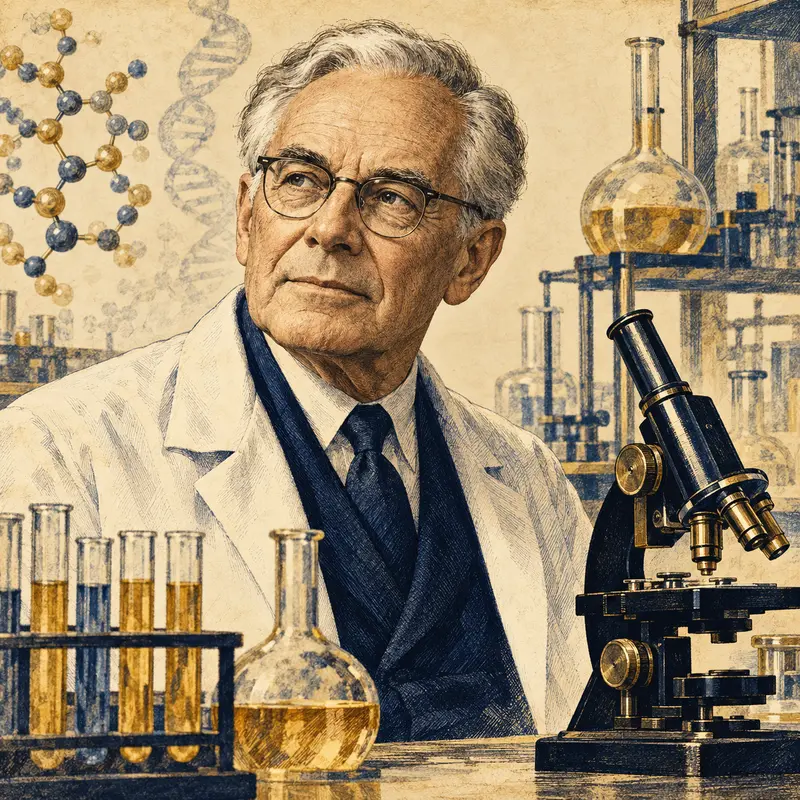
Irwin Rose
1926-2015 · United States · Nobel Chemistry 2004
Ubiquitin-mediated protein degradation