The discovery, explained · Chemist no. 122 of 350
John Howard Northrop: Crystals of Digestive Enzymes and the End of a Great Debate
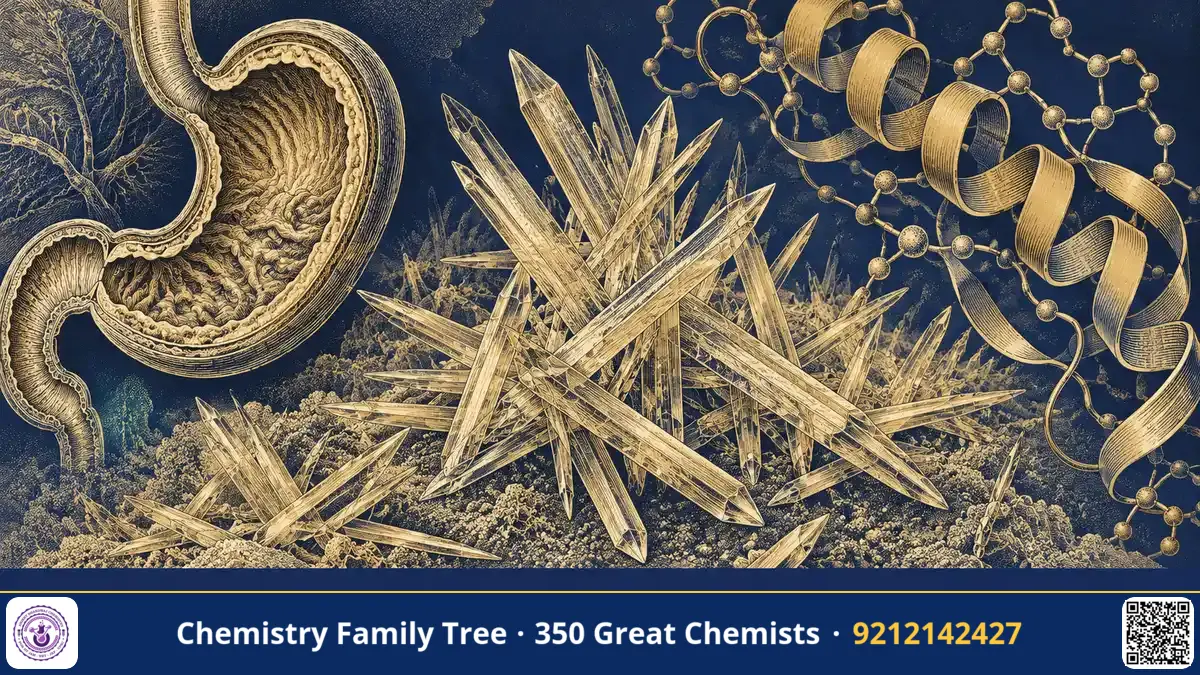
In 1926 James Sumner reported crystals of urease and said that enzymes are proteins. Many chemists did not accept it. They felt that Sumner's case was a single special example, or that the real catalyst was a small impurity. The question was settled by John Howard Northrop at the Rockefeller Institute, who in 1930 crystallised pepsin, the main digestive enzyme of the stomach, and went on to crystallise trypsin, chymotrypsin and other proteins. He proved by careful tests that these crystals were pure proteins and that their activity belonged to the protein itself. He also explained how inactive precursors called zymogens become active enzymes. For the preparation of enzymes and virus proteins in a pure form, he shared half of the 1946 Nobel Prize in Chemistry with Wendell Stanley, while the other half went to James Sumner.
The Scientific Problem Before the Discovery
Nearly all enzyme preparations in the 1920s were crude. Their activity could be very high, but the amount of protein in them was often small, and the activity could not be linked to a single substance. Richard Willstätter and his colleagues had purified enzymes such as peroxidase and invertase to the point where the solutions gave no protein reactions, and they concluded that the enzymes could not be proteins.
- Sumner's urease crystals were important, but one example did not decide the general rule.
- Proteins were thought by some to be loose aggregates of small units, not definite compounds. Without a proof of purity, one could not claim that a protein was a true chemical individual.
- Digestive enzymes were a special puzzle. Pepsin works in strong acid and trypsin in mild alkali, but how were they made in the body without digesting the cells that produced them?
The Discovery: Step by Step
Pepsin
- Starting material. Northrop used commercial pepsin, an impure powder prepared from the stomach lining of pigs. The activity was measured by the rate at which pepsin digests a standard protein like haemoglobin or casein, giving soluble fragments that are not precipitated by trichloroacetic acid.
- Salting out. The pepsin was dissolved and precipitated using magnesium sulfate at acidic pH, so that other proteins stayed in solution or were removed.
- Crystallisation (1930). Slow changes in salt concentration and pH gave fine needle-like crystals. These were collected, dissolved and recrystallised several times.
- Tests of purity. The key was that the proteolytic activity per unit weight of protein stayed constant through repeated recrystallisation. Northrop also used solubility measurements: a pure substance shows a constant solubility, however much solid is added, in agreement with the phase rule. A mixture would show a changing solubility curve.
- Conclusion. Crystalline pepsin is a protein, it is the enzyme, and the activity vanishes when the protein is denatured.
Trypsin, chymotrypsin and zymogens
With his colleague Moses Kunitz and others, Northrop crystallised trypsin (from pancreas) in the early 1930s and then chymotrypsin and their inactive precursors, trypsinogen and chymotrypsinogen, as well as pepsinogen. He found that the inactive precursors can be changed into the active enzyme:
pepsinogen → pepsin  (acid-catalysed, autocatalytic; a peptide fragment is removed)
trypsinogen + trypsin → 2 trypsin  (autocatalysis; N-terminal hexapeptide removed)
chymotrypsinogen → chymotrypsin  (trypsin cleaves one peptide bond)
This showed that cells make the enzyme as a safe, inactive zymogen and that activation takes place only in the right place, such as the stomach or the small intestine. It was a first case of regulation by proteolytic activation. The same idea appears later in the blood clotting cascade (prothrombin to thrombin) and in the activation of insulin from proinsulin.
Northrop and his colleagues, especially Moses Kunitz, crystallised several other proteins as well. Kunitz also isolated the soybean trypsin inhibitor, which forms a tight 1:1 complex with trypsin. In later years Northrop turned to bacteriophages, the viruses of bacteria, and studied them as chemical substances.
The Chemistry Behind It
Peptide bond hydrolysis. Proteases catalyse the cleavage of the amide linkage:
R–CO–NH–R′ + H₂O → R–COOH + H₂N–R′
Pepsin is an aspartic protease. Its active site has two aspartate residues, one deprotonated and one protonated, which act together with a water molecule. It works best at pH 1.5 to 2, as fits the stomach (pH about 1.5-3.5), and it cuts bonds next to large hydrophobic or aromatic residues such as Phe, Trp, Tyr and Leu.
Trypsin and chymotrypsin are serine proteases with a catalytic triad (Ser-195, His-57 and Asp-102 in chymotrypsin). Serine acts as a nucleophile, forming an acyl-enzyme intermediate. Trypsin cleaves on the carboxyl side of Lys and Arg (positively charged side chains), and chymotrypsin cleaves after aromatic residues such as Phe, Tyr and Trp.
Phase-rule solubility test. By the phase rule, in a two-component saturated system at fixed temperature, the concentration of a single pure substance in solution is fixed whatever the amount of solid. If the solid is a mixture, there are more components, and the solubility changes with the amount of solid. Northrop used this as a stringent test, which was a physical-chemistry way of proving purity.
Autocatalysis. In trypsinogen activation, a small amount of trypsin makes more trypsin, so the rate increases with the amount of product. The reaction shows a sigmoid time course.
Applications Today
- Medicine. Pancreatic enzyme supplements (containing trypsin and chymotrypsin among others) help patients with pancreatic insufficiency. Protease inhibitors are an important class of drugs, including blood pressure drugs (ACE inhibitors) and HIV protease inhibitors.
- Industry. Proteases are used in detergents, leather processing, cheese making and in meat tenderisers. Trypsin is used in cell culture to detach cells from dishes.
- Protein chemistry. Trypsin cuts proteins into peptides before mass spectrometry in proteomics. Its high specificity for Lys and Arg makes it a standard tool.
- Structure biology. Crystals of these enzymes allowed some of the first X-ray structures of enzymes, and chymotrypsin and pepsin structures taught us the mechanism of catalysis.
- India. Papain from raw papaya is a protease used in food and pharmaceutical industry.
Exam Corner
- Northrop crystallised pepsin (1930), then trypsin and chymotrypsin; he showed that their activity is a property of the protein.
- Zymogens (proenzymes): pepsinogen, trypsinogen, chymotrypsinogen; activation is by partial proteolysis.
- Pepsin: aspartic protease, optimum pH about 2. Trypsin: serine protease, cleaves after Lys/Arg, optimum pH about 8.
- Chymotrypsin catalytic triad: Ser-195, His-57, Asp-102.
- 1946 Nobel Prize in Chemistry: Sumner (half), Northrop and Stanley (shared half).
Common Misconceptions
- "Northrop discovered that enzymes are proteins first." Sumner's urease work was the first. Northrop's pepsin and other enzymes confirmed the rule in general.
- "A zymogen is a different protein from the enzyme." It is the same polypeptide chain, only with an extra segment that is removed to produce the active form.
- "All digestive enzymes work in acid." Pepsin does, but pancreatic enzymes like trypsin work at slightly alkaline pH in the small intestine.
Quick Revision Box
- Pepsin crystals, 1930; trypsin and chymotrypsin in the 1930s.
- Purity test: constant activity per mg protein on recrystallisation and constant solubility.
- Zymogens avoid self-digestion of the cells.
- Pepsin aspartic protease; trypsin and chymotrypsin serine proteases.
- Autocatalysis: trypsin activates trypsinogen.
- Shared the 1946 Nobel Prize in Chemistry.
FAQ
Why are digestive enzymes made as zymogens?
To protect the cells and ducts that produce them from digesting themselves; activation happens only in the gut.
What is the optimum pH of pepsin?
Around 2, which suits the acidic gastric juice. At neutral pH pepsin is inactive and gets denatured at high pH.
How did Northrop prove his crystals were pure?
By showing that activity per unit weight of protein and solubility stayed constant after repeated recrystallisation.
Was the prize in Chemistry or in Medicine?
It was the Nobel Prize in Chemistry for 1946.
Published by ABC Chemistry — IIT-JAM | CSIR-NET | GATE Chemistry Coaching. Visit abcchemistry.com
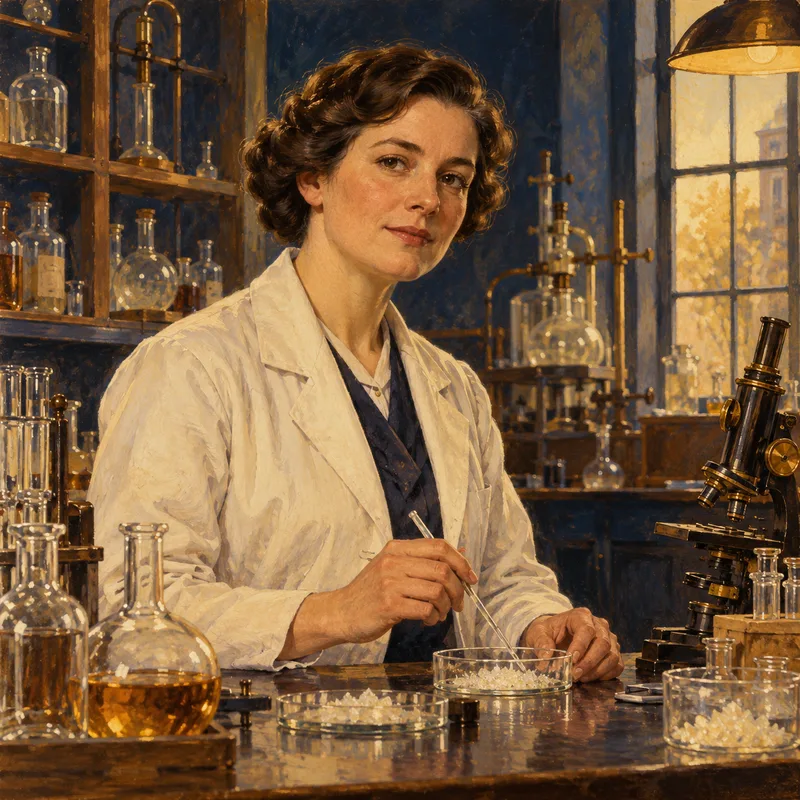
About the chemist
John Howard Northrop
1891-1987 · United States · Nobel Chemistry 1946
Crystallization of pepsin and enzymes