Biography · Chemist no. 256 of 350
John Alexander Reina Newlands (1837-1898): The Man Who Heard Music in the Elements
Introduction
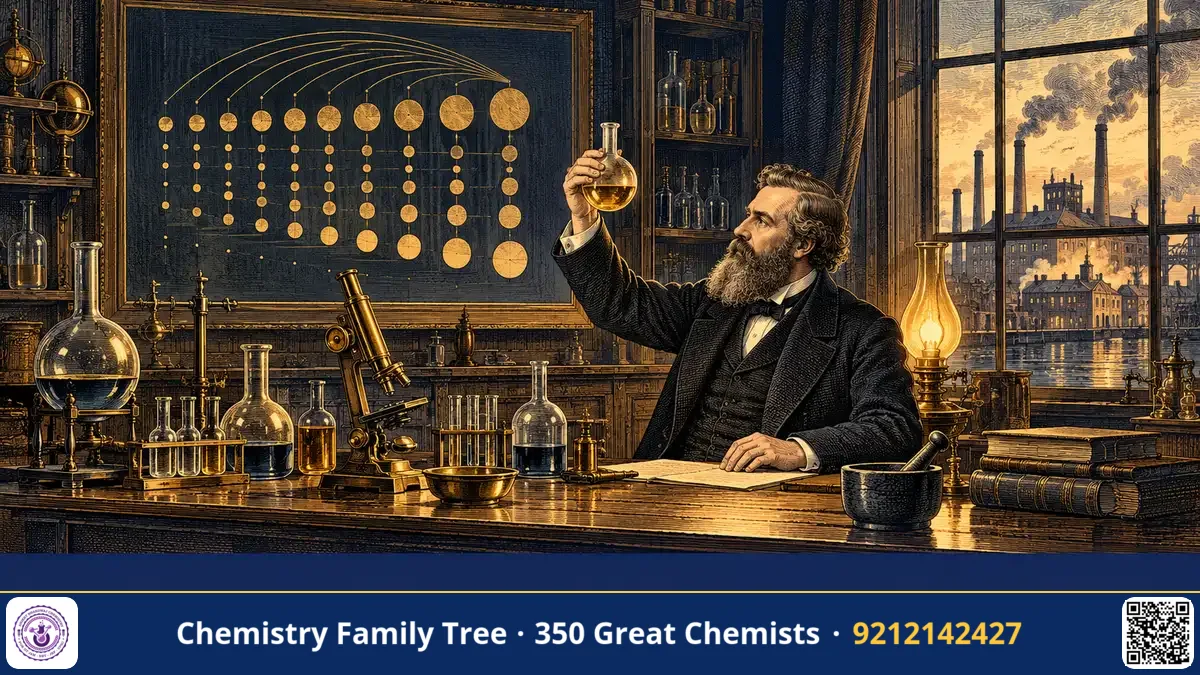
John Alexander Reina Newlands was an English analytical chemist who proposed the Law of Octaves in 1865, the first scheme to number the elements by atomic weight and to show that their properties repeat. His own society laughed at him; later, the Royal Society honoured him. His legacy in one line: he was an early pioneer of the periodic law who was proved right too late for comfort.
Early Life and Family
Newlands was born on 26 November 1837 in London (in the Southwark area). His father, William Newlands, was a Scottish Presbyterian minister, and his mother was of Italian descent. The middle name "Reina" came from his mother's family. Because of this heritage he had a close link with Italy. This became important in his life: in 1860 he joined Garibaldi's volunteers in Italy and fought in the campaign for Italian unification, a fact well known about him. He was taught at home by his father in his early years.
Education and Mentors
Newlands studied at the Royal College of Chemistry in London under the German chemist August Wilhelm von Hofmann, one of the most important teachers of chemistry in Britain. Hofmann's laboratory was a training ground for many Victorian chemists, including William Perkin. After his studies Newlands worked as an assistant to the chemist John Edward Way, who was the chemist of the Royal Agricultural Society. He learned analytical techniques, which suited his careful nature and later paid his bills.
Career Timeline
| Year | Event |
|---|---|
| 1837 | Born in London |
| 1860 | Served with Garibaldi in Italy |
| 1860s | Set up as an analytical chemist in London |
| 1863-64 | Published first papers on relations among atomic weights in Chemical News |
| 1865 | Presented the Law of Octaves |
| 1866 | Law criticised at the Chemical Society |
| Later 1860s | Worked as chemist at a London sugar refinery |
| 1869 | Mendeleev's periodic table appeared |
| 1870s | Returned to practice as a consulting analytical chemist |
| 1884 | Published a book on the Law of Octaves and related work |
| 1887 | Awarded the Davy Medal of the Royal Society |
| 1898 | Died in London, 29 July |
Major Scientific Contributions
- Law of Octaves: Every eighth element in order of atomic weight shows similar properties. See our discovery blog on the law for the table and its limits.
- Numbering of elements: He gave ordinal numbers to the elements, an idea that anticipated atomic number later defined by Moseley in 1913.
- Relationships among atomic weights: He noticed that the atomic weights of similar elements differ by regular numbers, for example 16 between Li, Na and K in his scheme.
- Sugar chemistry: As a working chemist in the sugar industry, he published papers on sugar analysis and refining and developed methods that served industry in his time.
- Analytical practice: He ran a laboratory for chemical analysis and consulted for manufacturers.
Awards, Honours and Nobel Prize
For many years Newlands received no official recognition. After Mendeleev's work had become famous, and especially after the discovery of gallium and germanium confirmed Mendeleev's predictions, Newlands wrote to Chemical News to claim priority for the idea of periodicity. In 1887 the Royal Society awarded him the Davy Medal, five years after it had been shared by Meyer and Mendeleev in 1882, in recognition of his part in the discovery of the periodic law. He did not receive a Nobel Prize and died before it could be considered for periodic-law work. The Nobel Prizes started in 1901, after his death.
Personality, Struggles and Lesser-Known Facts
- He fought for Italian unification with Garibaldi, an unusual start for an English chemist, and it shows his strong sense of conviction.
- In 1866 a member of the Chemical Society is said to have asked whether he had thought of arranging the elements alphabetically. The Society refused to publish his paper in its Proceedings, a decision it was later said to have regretted.
- He was a practical man who worked in a sugar refinery and then as a consulting analyst, so research was done alongside paid work, not in a university.
- After Mendeleev's fame, Newlands defended his own priority firmly, collected his papers and republished them in 1884 under the title On the Discovery of the Periodic Law.
- His brother, Bernard Newlands, also worked as a chemist in the sugar industry, and the two published together on sugar manufacture.
Legacy and Influence on Modern Chemistry
The modern periodic table lists elements by atomic number, which is exactly what Newlands began when he numbered the elements in order. His law helped to prepare chemists for the idea that the properties of elements are a periodic function of some basic quantity. Mendeleev later made the table complete, Moseley put atomic number in place of weight, and quantum theory explained why periods have 2, 8, 8, 18, 18, 32 elements. Newlands's chief contribution is seen today as proof that a good idea can be early and still correct. Textbooks across the world, including NCERT books in India, still carry the Law of Octaves as one of the stages in the classification of elements.
Lessons for Students
- Be willing to share early ideas, even if criticised, because criticism improves them.
- Do not give up on a pattern that is partly true; look for why it fails.
- Keep gaps in your table. Leaving space for the unknown, as Mendeleev did, makes a theory predictive.
- Work and research can go together. Newlands did science while holding a job in industry.
- Record your work. By republishing his papers he made sure history could judge him fairly.
Quick Facts Box
- Born: 26 November 1837, London
- Died: 29 July 1898, London
- Nationality: British (English)
- Field: Analytical chemistry; classification of elements
- Famous for: Law of Octaves (1865)
- Nobel Prize: None; Davy Medal 1887
FAQ
Where was John Newlands born?
He was born in London in 1837, to a Scottish father and an Italian mother.
Why is John Newlands famous?
For the Law of Octaves (1865), an early classification of elements by atomic weight in which every eighth element repeats properties.
Did Newlands get any recognition?
Yes. In 1887 the Royal Society gave him the Davy Medal for his contribution to the periodic law.
What did he do apart from the periodic law?
He worked as an analytical chemist and a sugar chemist, and fought in Italy with Garibaldi's volunteers in 1860.
Published by ABC Chemistry — IIT-JAM | CSIR-NET | GATE Chemistry Coaching. Visit abcchemistry.com
About the chemist
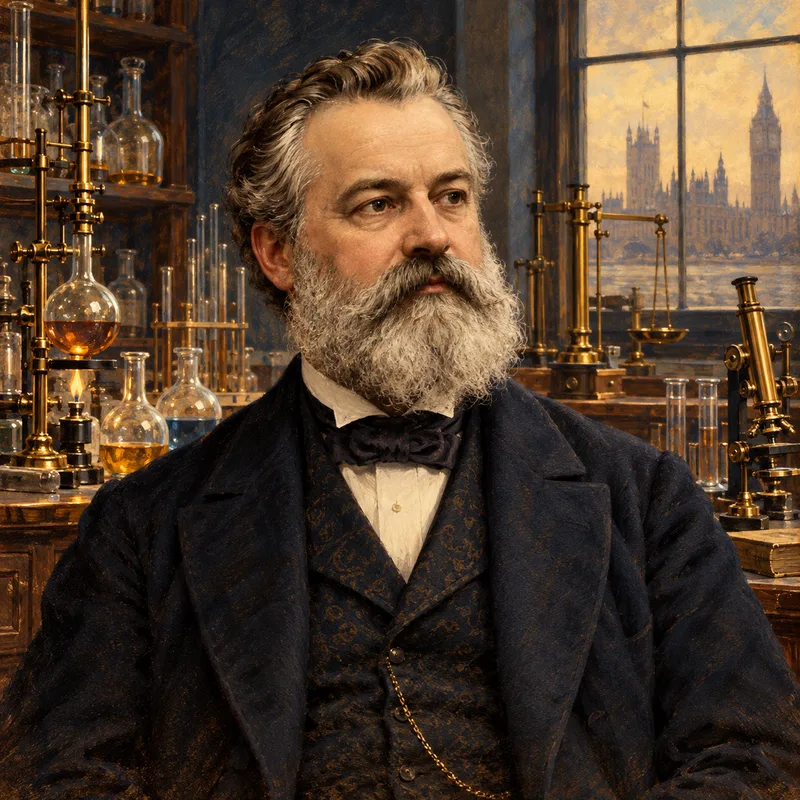
John Newlands
1837-1898 · United Kingdom
Law of octaves