The discovery, explained · Chemist no. 298 of 350
K. C. Nicolaou: Taxol, Cascade Reactions and the Art of Total Synthesis
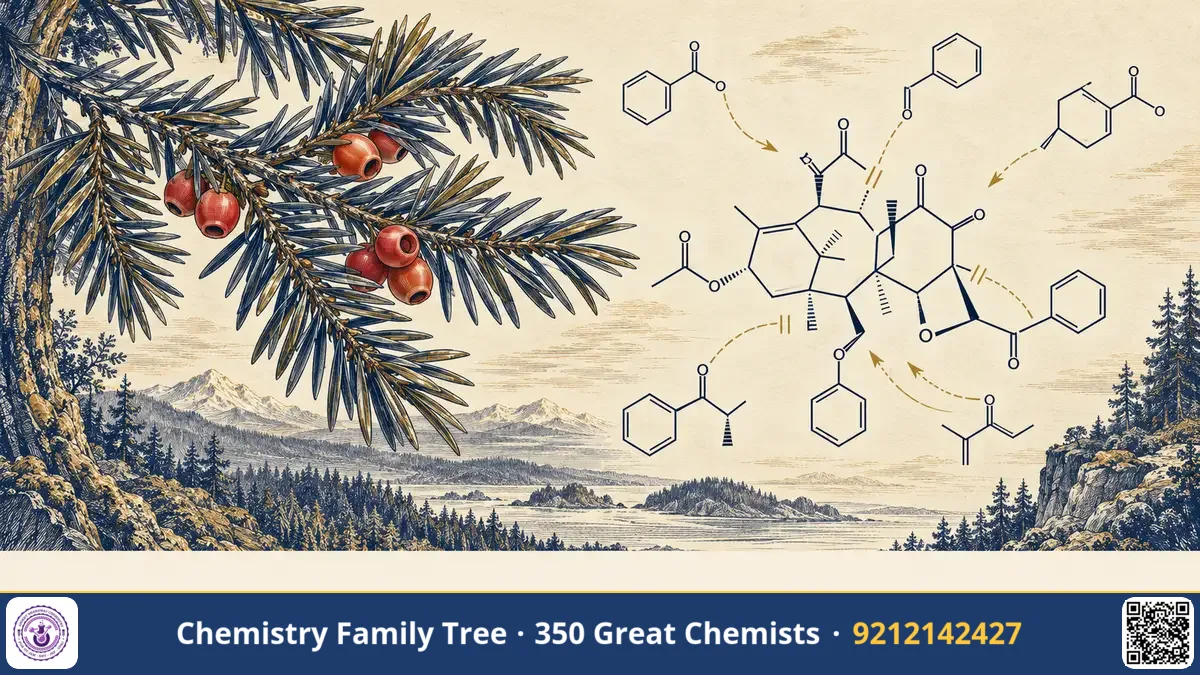
Total synthesis is the art of building a complex natural product from simple chemicals. It trains chemists, tests new reactions, and sometimes opens the way to new medicines. K. C. Nicolaou, a Cypriot-born American chemist, is among the most productive total synthesis chemists in history. His group completed the synthesis of Taxol (paclitaxel), the anticancer drug from the Pacific yew tree, in 1994, and of dozens of other targets, including calicheamicin γ1I, vancomycin and brevetoxin. Earlier, in 1982, he led the synthesis of the endiandric acids, a beautiful demonstration of a pericyclic reaction cascade. This post explains these landmarks with the chemistry that exam questions love.
The Scientific Problem Before the Discovery
Taxol was isolated from the bark of the Pacific yew (Taxus brevifolia) and found to be effective against ovarian and breast cancer. It acts by stabilising microtubules, which prevents cell division. But a tree has to be cut down to obtain the bark, and a patient needs several trees' worth of material. Supply was a severe problem. The molecule is also very complex: a 6-8-6 tricyclic diterpene core with 11 stereocentres, a strained oxetane ring and a sensitive side chain. A synthesis was seen as nearly impossible in the 1980s.
Separately, chemists were intrigued by the endiandric acids, a family of natural products from an Australian tree. They have several fused rings and multiple stereocentres, yet they are racemic in nature. This hinted that they might be formed non-enzymatically.
The Discovery: Step-by-Step
The endiandric acid cascade (1982)
Nicolaou proposed that the tetracyclic endiandric acids form by a spontaneous cascade from an achiral polyene precursor. Using a hexaene made from simple building blocks (obtained by partial hydrogenation of conjugated polyalkynes with a Lindlar catalyst), he demonstrated:
- 8π electrocyclisation (thermal, conrotatory) of the tetraene part to give a cyclooctatriene.
- 6π electrocyclisation (thermal, disrotatory) of the cyclooctatriene to give a bicyclo[4.2.0]octadiene.
- Intramolecular Diels-Alder reaction between the cyclohexadiene portion and the side-chain alkene to give the tetracyclic product.
Polyene → (8π conrotatory) → cyclooctatriene → (6π disrotatory) → bicyclo[4.2.0]octadiene → (intramolecular [4+2]) → endiandric acid skeleton
The result supported the idea that nature builds these molecules without enzymes, and is a favourite textbook illustration of the Woodward-Hoffmann rules (4n π electrons: conrotatory thermally; 4n+2: disrotatory thermally).
Taxol (1994)
Nicolaou's route was convergent: make the A ring and C ring separately and join them.
- Both the A-ring and C-ring fragments were prepared using Diels-Alder reactions, which control the stereochemistry efficiently.
- The two fragments were coupled by a Shapiro reaction: an arylsulfonylhydrazone of the A-ring was converted by strong base into a vinyllithium that added to the C-ring aldehyde.
- The eight-membered B ring was closed by a McMurry coupling: low-valent titanium (TiCl₃/Zn-Cu) coupled two carbonyl groups into a C=C bond (a diol or alkene).
- Further steps installed the oxetane ring and, finally, the side chain was attached through a β-lactam (Ojima lactam) coupling.
Robert Holton's group at Florida State independently completed a Taxol synthesis at almost the same time, using a different (linear) route from a natural precursor. Both are landmarks.
The Chemistry Behind It
Retrosynthetic analysis. Introduced by E. J. Corey, this means breaking a target mentally into simpler pieces using the reverse of known reactions. Nicolaou's group is known for retrosynthetic thinking, and he has written the textbook series Classics in Total Synthesis with Erik Sorensen and Scott Snyder, widely used in teaching.
Key reactions used by his group:
| Reaction | What it does |
|---|---|
| Diels-Alder [4+2] | Builds six-membered rings with stereocontrol |
| Shapiro reaction | Tosylhydrazone + 2 equiv. base gives vinyllithium (loss of N₂) |
| McMurry coupling | TiCl₃/Zn(Cu) couples two ketones/aldehydes to an alkene |
| Sonogashira / Stille / Suzuki | Pd-catalysed C-C bond formation used in many targets |
| Electrocyclisation cascade | Forms several rings in one operation |
Calicheamicin. This enediyne antibiotic binds in the DNA minor groove. After activation, it undergoes a Bergman cycloaromatisation: the enediyne forms a p-benzyne diradical that abstracts hydrogen from DNA and causes double-strand cleavage. Nicolaou completed its synthesis in 1992, which opened the way for antibody-drug conjugates.
Enediyne → (Bergman cyclisation) → 1,4-didehydrobenzene (p-benzyne diradical) → DNA strand cleavage
Applications Today
- Cancer therapy: Taxol (paclitaxel) and docetaxel are used for breast, ovarian and lung cancer. Today, supply comes largely from semi-synthesis from 10-deacetylbaccatin III in yew needles and from plant cell culture.
- Antibody-drug conjugates: Calicheamicin-type warheads are attached to antibodies, as in gemtuzumab ozogamicin and inotuzumab ozogamicin, targeting leukaemia cells.
- Antibiotics: Synthetic studies on vancomycin allowed the design of analogues against resistant bacteria.
- Method development: Strategies from total synthesis, such as cascades and cross-coupling, are used by the pharmaceutical industry, including Indian drug manufacturers making taxane drugs.
- Education: Total synthesis trains students in mechanism, stereochemistry and problem-solving.
Exam Corner
- Thermal 8π electrocyclisation is conrotatory; thermal 6π is disrotatory (Woodward-Hoffmann rules).
- Nicolaou's endiandric acid cascade: 8π conrotatory, then 6π disrotatory, then intramolecular Diels-Alder.
- Taxol: microtubule-stabilising diterpenoid with a tricyclic taxane core and an oxetane ring; A and C rings were joined by a Shapiro reaction, B ring closed by McMurry coupling.
- Shapiro reaction: tosylhydrazone + strong base (≥ 2 equiv. RLi) gives a vinyllithium and N₂.
- Calicheamicin cleaves DNA through Bergman cyclisation of an enediyne to a p-benzyne diradical.
Common Misconceptions
- "Taxol is made industrially by total synthesis." No. Total syntheses are too long. Industry uses semi-synthesis or cell culture.
- "Conrotatory always means thermal." It depends on the electron count: 4n π thermal is conrotatory, but 4n π photochemical is disrotatory.
- "McMurry coupling gives alcohols only." It gives alkenes after deoxygenation (diols are isolable at low temperature).
Quick Revision Box
- Nicolaou: Cypriot-born; Scripps/UCSD and later Rice University.
- 1982: endiandric acid cascade (8π, 6π, then Diels-Alder).
- 1992: calicheamicin γ1I; 1994: Taxol total synthesis (Shapiro + McMurry).
- Also: vancomycin, brevetoxin A, amphotericin B work.
- Book: Classics in Total Synthesis series.
- Taxol stabilises microtubules and blocks cell division.
FAQ
What is a cascade reaction?
It is a sequence of reactions in which each step creates the functionality needed for the next, so that several bonds form in one operation without isolating intermediates.
Why was Taxol's synthesis important if it is not used commercially?
It showed that such a complex molecule could be built from simple compounds, led to new reactions and strategies, and opened the way to analogues and understanding of structure-activity relationships.
What does the McMurry coupling use?
It uses low-valent titanium, typically generated from TiCl₃ or TiCl₄ and a reducing agent such as Zn(Cu) or LiAlH₄, to couple two carbonyl groups into an alkene.
Why are the endiandric acids racemic in nature?
They form from an achiral precursor by spontaneous pericyclic reactions rather than by enzymes, so no enantioselectivity is imposed.
Published by ABC Chemistry — IIT-JAM | CSIR-NET | GATE Chemistry Coaching. Visit abcchemistry.com
About the chemist
K. C. Nicolaou
1946- · United States
Total synthesis of taxol and other natural products