The discovery, explained · Chemist no. 274 of 350
Kazimierz Fajans: The Rules That Explain Why Ionic Bonds Are Never 100% Ionic
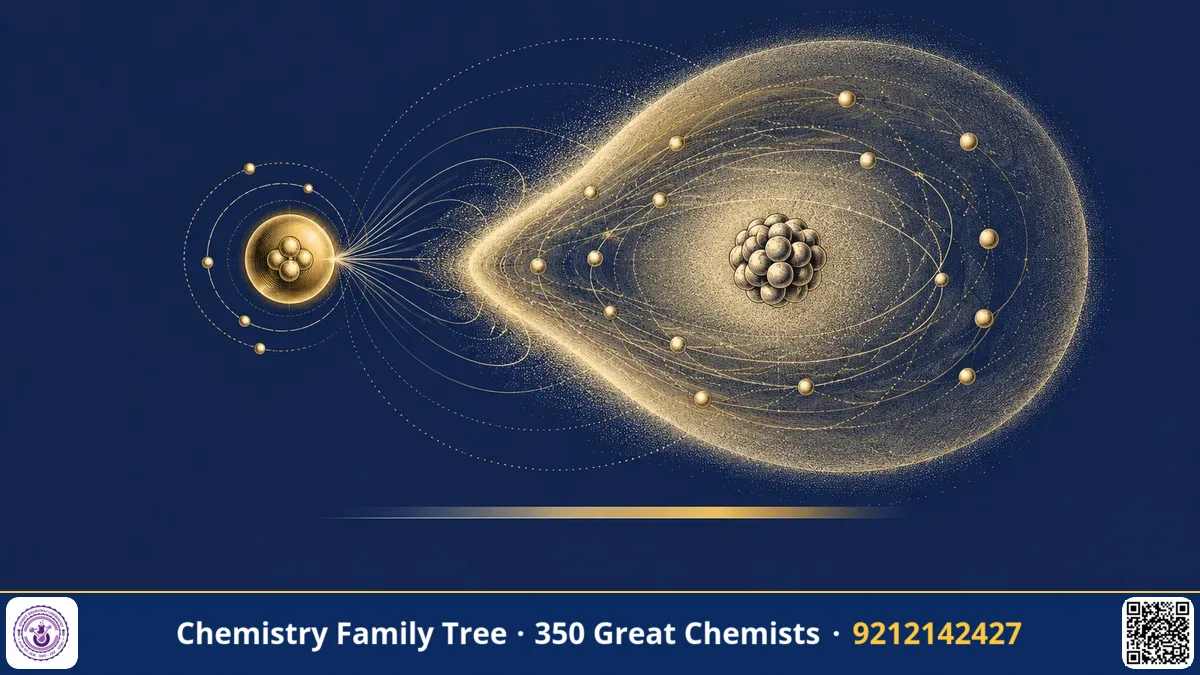
If you have studied chemical bonding for IIT-JAM, GATE or CSIR-NET, you have met Fajans' rules. They tell us when an "ionic" compound will show covalent character, and they explain why AgCl is insoluble but NaCl is soluble, or why AlCl₃ behaves very differently from NaCl. The rules were proposed by the Polish-American physical chemist Kazimierz Fajans in 1923–24. Fajans also formulated the radioactive displacement law (1913) and found the element protactinium-234 (brevium), and he developed adsorption indicators for precipitation titrations. This article explains these contributions in simple language.
The Scientific Problem Before the Discovery
In the early 20th century, chemists divided bonds into two extremes: ionic (full transfer of electrons) and covalent (equal sharing). Kossel's ionic theory and Lewis's covalent theory (1916) described these ideal cases. But real compounds do not fit perfectly. For example, both NaCl and AgCl have the same crystal structure type and the same formula type, yet their properties differ greatly: NaCl dissolves in water and melts at 801 °C, while AgCl is insoluble and melts at about 455 °C. A simple ionic model could not explain this difference. Chemists needed a way to predict the partial covalent character of bonds in ionic compounds.
The Discovery: Step by Step
Fajans built on the idea of polarisation of ions, which had been used by Born and by Fajans himself in the analysis of lattice energy and refraction of light. His argument is simple:
- A cation is positively charged and pulls the electron cloud of a nearby anion towards itself.
- The anion's electron cloud is distorted (polarised), and some electron density is shared between the two ions. The bond acquires covalent character.
- The extent of this polarisation depends on the properties of the cation and the anion. Fajans summarised this in the following rules.
The Chemistry Behind It
Covalent character increases with:
- Rule 1: Small cation size. A small cation has a high charge density and polarises strongly. Li⁺ is smaller than Na⁺, so LiCl is more covalent than NaCl. LiCl is soluble in organic solvents like ethanol, while NaCl is not.
- Rule 2: High cation charge. A higher charge pulls harder: NaCl < MgCl₂ < AlCl₃ in covalent character. AlCl₃ is covalent and fumes in moist air.
- Rule 3: Large anion size. A large anion has a loosely held electron cloud that is easy to distort: I⁻ > Br⁻ > Cl⁻ > F⁻ in polarisability. So AgI is more covalent than AgCl.
- Rule 4: High anion charge. A highly charged anion is easier to polarise: N³⁻ > O²⁻ > F⁻.
- Rule 5: Cation with a pseudo-noble-gas (18-electron) or irregular configuration. Cations such as Ag⁺ (4d¹⁰), Cu⁺, Zn²⁺, Cd²⁺ and Hg²⁺ have d electrons that shield the nuclear charge poorly, so they polarise more than noble-gas-type cations of the same size and charge such as Na⁺ and Ca²⁺. This is why AgCl (covalent character) differs from NaCl (mostly ionic), and CuCl is less soluble than NaCl.
Fajans' rules explain trends in many properties:
| Property | Effect of more covalent character |
|---|---|
| Melting point | Decreases (e.g. NaCl 801 °C, AlCl₃ sublimes at about 180 °C) |
| Solubility in water | Often decreases (AgCl, AgI insoluble) |
| Solubility in organic solvents | Increases (LiCl, anhydrous AlCl₃) |
| Colour | Deeper colour (AgCl white, AgBr pale yellow, AgI yellow; due to charge transfer) |
| Thermal stability | Carbonates of small, highly charged cations decompose more easily: MgCO₃ < CaCO₃ < BaCO₃ |
Ionic character:   NaCl  >  MgCl₂  >  AlCl₃
Covalent character: LiF < LiCl < LiBr < LiI
Thermal stability:  BeCO₃ < MgCO₃ < CaCO₃ < SrCO₃ < BaCO₃
Radioactive displacement law (1913). Fajans and Frederick Soddy independently stated how radioactive decay changes an element's place in the periodic table:
Alpha emission: A → A − 4, Z → Z − 2 (two places to the left)
Beta emission:  A → A,     Z → Z + 1 (one place to the right)
For example, ²³⁸U → ²³⁴Th + α, then ²³⁴Th → ²³⁴Pa + β⁻. Fajans also found with Oswald Göhring the short-lived isotope ²³⁴Pa (UX₂), which he named brevium because of its short half-life. The name protactinium was later adopted for the longer-lived isotope ²³¹Pa discovered by Hahn and Meitner (and Soddy and Cranston) in 1917–18.
Adsorption indicators (1923). Fajans introduced dyes such as fluorescein and eosin as end-point indicators for argentometric titrations. At the equivalence point, the precipitate's surface changes charge, and the dye is adsorbed on the precipitate, giving a colour change. The Fajans method is used for Cl⁻, Br⁻, I⁻ and SCN⁻:
Ag⁺ + Cl⁻ → AgCl↓
Before end point: AgCl·Cl⁻ (negative surface, dye anion repelled)
After end point:  AgCl·Ag⁺ (positive surface, dye anion adsorbed, pink/red)
Applications Today
- Predicting properties: Fajans' rules are used to predict melting points, solubility, thermal stability and colours of inorganic compounds.
- Analytical chemistry: The Fajans method is a standard titration in college practicals and in industrial chloride analysis, including water testing in India.
- Radiochemistry: The displacement laws are used to draw decay chains and to work out the products of nuclear reactions.
- Materials science: Polarisation concepts help in understanding photographic silver halides (AgBr), ceramics and semiconductor materials.
- Geochemistry: Ideas of ionic character help in understanding how elements are distributed among minerals.
Exam Corner
- Covalent character is highest for a small, highly charged cation with a large, highly charged anion (Fajans' rules). Arrange: LiCl, BeCl₂, NaCl, MgCl₂ and AlCl₃ by this principle.
- Pseudo-inert gas cations (Ag⁺, Cu⁺, Zn²⁺) polarise more than noble-gas-type cations of equal size and charge.
- Thermal stability of alkaline earth carbonates increases down the group as the cation polarising power decreases.
- Alpha emission: ΔZ = −2, ΔA = −4; beta emission: ΔZ = +1, ΔA = 0 (Soddy–Fajans group displacement law).
- Fajans' method uses adsorption indicators (fluorescein, eosin) in argentometric titrations.
Common Misconceptions
- "Fajans' rules decide whether a bond is ionic or covalent in a yes/no way." They describe a continuum from ionic to covalent, and they are qualitative.
- "Only cation properties matter." Anion size and charge matter just as much.
- "Soddy alone proposed the displacement law." Fajans and Soddy, with contributions from Russell, announced the laws in 1913; the group displacement law is often named after both.
Quick Revision Box
- Covalent character is favoured by: small cation, high cation charge, large anion, high anion charge, 18-electron cation.
- Examples: LiCl more covalent than NaCl; AlCl₃ more covalent than MgCl₂; AgI more covalent than AgCl.
- Effects: lower melting point, lower aqueous solubility, deeper colour, lower thermal stability.
- Alpha: Z − 2, A − 4. Beta: Z + 1.
- Brevium = ²³⁴Pa discovered by Fajans and Göhring (1913).
- Fajans titration uses adsorption indicators.
FAQ
What is polarising power?
It is the ability of a cation to distort the electron cloud of an anion. It increases with charge and decreases with size.
Why is AgCl less soluble than NaCl?
Ag⁺ has an 18-electron configuration and polarises Cl⁻ more strongly than Na⁺, so AgCl has more covalent character and lower solubility.
Is Fajans' rule quantitative?
No. It is a qualitative guide, though polarising power can be estimated by ionic potential (charge/radius).
Did Fajans receive a Nobel Prize?
No. He was nominated many times, but he never won it.
Published by ABC Chemistry — IIT-JAM | CSIR-NET | GATE Chemistry Coaching. Visit abcchemistry.com

About the chemist
Kazimierz Fajans
1887-1975 · Poland
Radioactive displacement law; Fajans' rules