The discovery, explained · Chemist no. 118 of 350
Leopold Ružička: Large Rings, Perfume Molecules and the Isoprene Rule
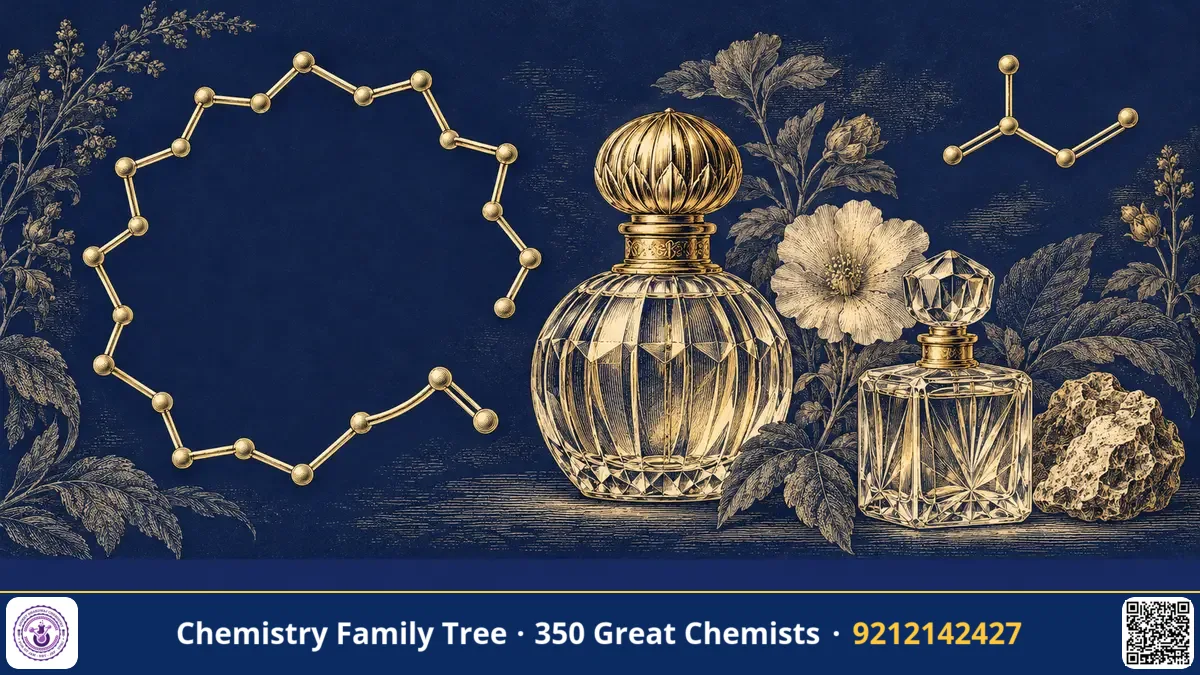
Why does musk smell the way it does, and why do thousands of natural products from rose oil to rubber to cholesterol seem to share one building block? Both questions were answered in the laboratory of Leopold Ružička. He showed that carbon rings with 15 or 17 atoms exist and are stable, which was against the best-known theory of the time. He worked out the structures of muscone and civetone, formulated the isoprene rule for terpenes, and made male sex hormones from cholesterol. For his work on polymethylenes and higher terpenes he shared the Nobel Prize in Chemistry for 1939 with Adolf Butenandt.
The Scientific Problem Before the Discovery
Adolf von Baeyer proposed in 1885 a "strain theory" that treated rings as flat polygons. A cyclopentane ring with internal angles of 108° has almost no strain, and cyclohexane at 120° has a little. Rings with more carbons would have larger angles and, according to the theory, would be more and more strained and difficult to make. For this reason chemists believed that rings of more than six or seven carbons could not be prepared and could not exist in nature.
On the other side stood natural products. Perfumers used musk (from the musk deer) and civet (from the civet cat) as expensive fixatives, and their chemical identity was unknown. The terpenes of essential oils, such as limonene, pinene, camphor and menthol, had also been studied for decades, but they appeared to have complicated and unrelated structures.
- Sachse (1890) and later Mohr (1918) had said that rings can pucker and avoid strain, but no one had made a large ring.
- Attempts to close rings of 8 to 12 carbons gave poor yields, and no 15-membered ring had been made.
The Discovery: Step by Step
Large rings, musk and civet
- Isolation and degradation. Ružička worked on muscone, the odorous principle of natural musk, and on civetone from the civet cat. Careful oxidation of civetone gave long-chain dicarboxylic acids, which showed that civetone is a large cyclic ketone with one double bond. He proved that civetone is a 17-membered ring, cycloheptadec-9-en-1-one, and muscone is 3-methylcyclopentadecanone, a 15-membered ring.
- Ring synthesis. He built large rings from long-chain dicarboxylic acids. The calcium or thorium salt of the diacid is strongly heated (pyrolysed), and the two ends close to give a cyclic ketone with loss of CO₂ and metal carbonate. This is the Ružička large-ring synthesis.
- Result. Yields of the 15- to 17-membered rings were small but definite, which proved that big rings exist. Rings with 8 to 11 members were hardest to form, but 14 or more were found easy and stable.
HOOC–(CH₂)ₙ–COOH → [Th or Ca salt, heat] → cyclic ketone (CH₂)ₙ₊₁C=O + CO₂ + carbonate
This showed that large rings are not planar. The carbons adopt a puckered shape with angles near 109.5°, so the Baeyer angle strain does not apply. The modest strain found in medium rings (8 to 11) arises from transannular hydrogen interactions and torsional strain. This understanding is part of conformational analysis, later developed by Barton and Hassel.
The isoprene rule
Otto Wallach had noticed that many terpenes seem to be built of isoprene (2-methylbuta-1,3-diene, C₅H₈) units. Ružička examined many cases and generalised this in 1921 as the isoprene rule: terpenes are made of five-carbon isoprene units, usually joined head to tail. Examples:
- Monoterpenes (C₁₀): geraniol, limonene, menthol, camphor
- Sesquiterpenes (C₁₅): farnesol, caryophyllene
- Diterpenes (C₂₀): phytol, abietic acid, retinol
- Triterpenes (C₃₀): squalene, lanosterol
- Tetraterpenes (C₄₀): carotenoids
- Polyterpenes: natural rubber, which is cis-1,4-polyisoprene
In the 1950s, with his students Eschenmoser, Jeger and Arigoni, he extended this into the biogenetic isoprene rule. This explains triterpenes and steroids as the result of cyclisation of squalene, a chain of six isoprene units. Squalene oxide cyclises in a chair-chair-chair conformation, with a series of cationic ring closures and methyl and hydride shifts, to give lanosterol, which in turn gives cholesterol.
Sex hormones
In 1934 Ružička and his group converted a cholesterol-derived steroid into androsterone, and in 1935 they made testosterone from cholesterol, within days of Butenandt, who reached the same goal independently. This was proof of structure by synthesis and a base for the commercial production of hormones.
The Chemistry Behind It
Ring strain. Real strain has three parts: angle strain (Baeyer), torsional strain (eclipsing) and steric or transannular strain. In cyclohexane chair, all three are nearly zero, so heat of combustion per CH₂ is the standard value, about 658.6 kJ/mol. Cyclopropane and cyclobutane have large angle strain. Rings of 14 or more carbons are essentially strain free, and the heat of combustion per CH₂ approaches the value for open-chain alkanes.
Isoprene unit. Head is the end near the methyl branch, and tail is the end away from it. Joining head to tail gives the regular chain of geraniol, and head to head gives the central bond in squalene. Biologically, the units come from isopentenyl pyrophosphate (IPP) and dimethylallyl pyrophosphate (DMAPP) by the mevalonate pathway or the non-mevalonate (MEP) pathway.
Odour and shape. Large-ring ketones with 14 to 17 carbons have a musky odour, but small changes in ring size change smell. This is an early example of the link between structure and olfactory activity.
Applications Today
- Perfumery. Synthetic macrocyclic musks replaced animal musk, which came from the endangered musk deer. This is an animal-friendly and economical industry; India is also an important producer of essential oils and aroma chemicals.
- Medicine. Macrocyclic drugs, such as macrolide antibiotics (erythromycin) and cyclosporine, follow from the understanding of large rings.
- Pharmaceutical industry. The steroid hormone and contraceptive industry grew from the synthetic routes of Ružička and Butenandt.
- Materials. Natural rubber and polyterpenes, resins and fragrances all link to isoprenoid chemistry. Crown ethers and cyclodextrins are also examples of macrocyclic chemistry.
Exam Corner
- Isoprene rule: terpenes are built from C₅ units (2-methylbuta-1,3-diene) joined mostly head to tail.
- Muscone = 3-methylcyclopentadecanone (15-membered); civetone = cycloheptadec-9-en-1-one (17-membered).
- Baeyer strain theory assumes planar rings; it works for 3-4 membered rings but fails for larger rings.
- Squalene (C₃₀) cyclises to lanosterol, the precursor of cholesterol.
- Ružička shared the 1939 Nobel Prize in Chemistry with Butenandt for polymethylenes and higher terpenes.
Common Misconceptions
- "Larger rings are always more strained." Strain is highest for 3 and 4 membered rings and for medium (8-11) rings, but large rings are almost strain free.
- "The isoprene rule means terpenes are made from isoprene." Isoprene is a pattern. In cells the units come from IPP and DMAPP, not free isoprene.
- "Ružička and Butenandt made steroid hormones in one joint project." They worked separately, in competing laboratories, and reached testosterone almost simultaneously.
Quick Revision Box
- Isoprene rule (1921): C₅ units, head-to-tail.
- Muscone: C₁₆H₃₀O, 15-membered ring; civetone: C₁₇H₃₀O, 17-membered ring.
- Large-ring synthesis: pyrolysis of Ca or Th salts of dicarboxylic acids.
- Monoterpene C₁₀, sesquiterpene C₁₅, diterpene C₂₀, triterpene C₃₀, tetraterpene C₄₀.
- Testosterone made from cholesterol in 1935.
- Nobel Prize in Chemistry, 1939.
FAQ
What is the biogenetic isoprene rule?
It explains how triterpenes and steroids form in nature by the cyclisation of squalene or its oxide through carbocation intermediates, with ring closures and 1,2-shifts.
Why did Baeyer's theory fail for large rings?
Because it assumed that rings are flat. Large rings are puckered and keep tetrahedral bond angles.
Is muscone still obtained from deer?
Almost all commercial musk used in perfumes today is synthetic, which protects the musk deer.
What was Ružička's Nobel Prize for?
For his work on polymethylenes (large rings) and higher terpenes, in the Chemistry prize for 1939.
Published by ABC Chemistry — IIT-JAM | CSIR-NET | GATE Chemistry Coaching. Visit abcchemistry.com
About the chemist
Leopold Ružička
1887-1976 · Switzerland · Nobel Chemistry 1939
Polymethylenes and higher terpenes