The discovery, explained · Chemist no. 223 of 350
Quantum Confinement: How Louis Brus Explained Why Tiny Crystals Change Colour With Size
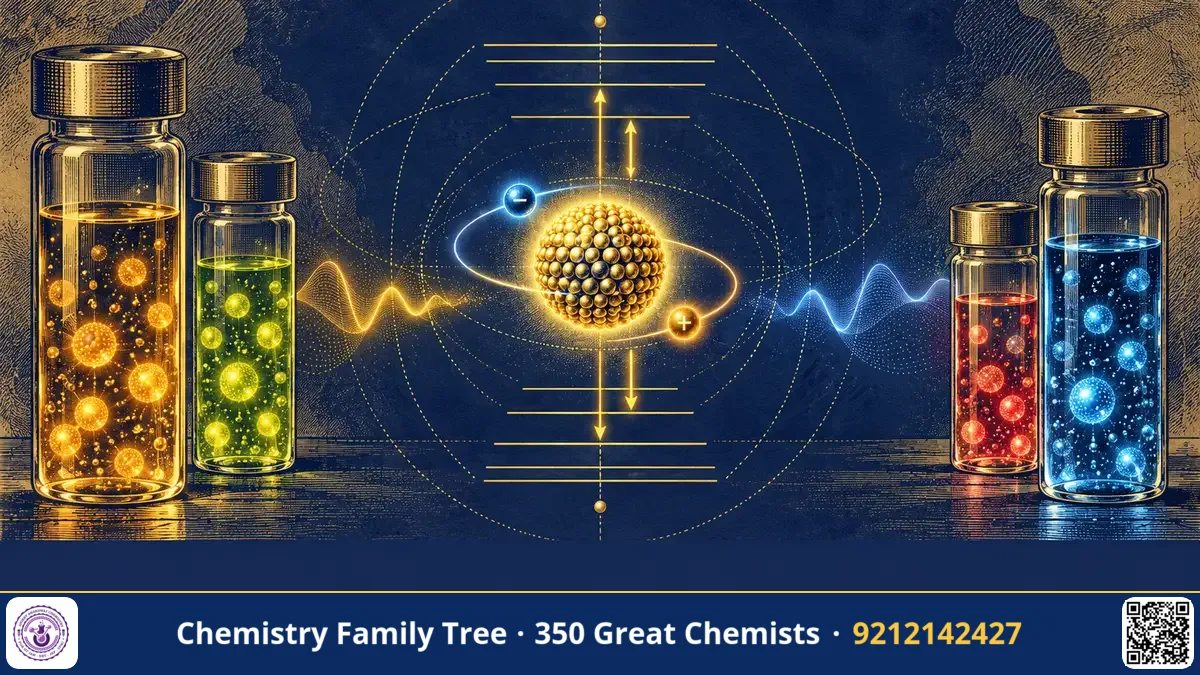
Why does the same material shine with different colours when its particles become very small? In the early 1980s, Louis Brus, a physical chemist at Bell Laboratories in New Jersey, discovered that tiny semiconductor crystals of cadmium sulfide (CdS) floating in a liquid changed their optical absorption as their size changed. He then explained it with a clear physical model. This was the first time that quantum dots were demonstrated and understood in a liquid colloid. In 2023, Brus shared the Nobel Prize in Chemistry with Alexei Ekimov and Moungi Bawendi "for the discovery and synthesis of quantum dots".
For students, Brus's work is a beautiful example of the textbook "particle in a box" idea explaining real, colourful materials. This post covers the problem, the experiment, the Brus equation, and exam points.
The Scientific Problem Before the Discovery
Chemists and physicists knew that a bulk semiconductor, such as CdS, has a fixed band gap: a gap between the filled valence band and the empty conduction band. The band gap decides the colour of light it absorbs. Bulk CdS is yellow-orange because it absorbs light of energy above about 2.4 eV, which corresponds to blue and violet light.
But a bulk crystal contains about 10^23 atoms, while a molecule has only a few. What happens in between? As particles are made smaller and smaller, at what point do they stop behaving as a bulk solid and start behaving like a large molecule? Brus was interested in the electronic structure of clusters and the question of how bands develop from molecular orbitals. In the early 1980s, Alexei Ekimov in the Soviet Union had observed size-dependent colours in glass doped with copper chloride crystals, but his work was published in Russian journals and was not widely known in the West. Brus worked independently, and used a very different system: crystals in solution.
The Discovery / Experiment
Brus and his co-workers (including Rosetta Rossetti and Shuji Nakahara) were studying photocatalysis on small semiconductor particles. They prepared colloidal CdS particles by precipitation in solution and found something surprising:
- Freshly prepared, very small particles absorbed light at shorter wavelengths (higher energy) than the bulk material.
- When the same solution was left to age, or heated, the particles grew by a process called Ostwald ripening and the absorption edge moved back toward the bulk value.
- Measurements of particle size by electron microscopy confirmed that smaller particles gave a bluer shift.
Brus published this in 1983 and 1984 (J. Chem. Phys.), and then in 1984 gave an explanatory model. Together with measurements of the optical spectra, this made quantum confinement a quantitative, testable idea.
The Chemistry Behind It
The exciton. When light excites the semiconductor, an electron moves to the conduction band and leaves a hole in the valence band. The attracted electron-hole pair is an exciton. In bulk CdS, the electron and hole are loosely bound with a typical separation (the exciton Bohr radius) of a few nanometres. If the crystal is smaller than this, the pair cannot take its natural size and is confined.
Particle in a box. For a particle of mass m in a box of length L, the energy is E = n²h²/(8mL²). The smaller the box, the higher the energy. In a nanocrystal of radius R, the electron and the hole are confined in a sphere. The band gap rises, and the energy levels become discrete rather than continuous bands.
The Brus equation. An approximate expression for the lowest excited state energy of a spherical nanocrystal is:
E(R) ≈ Eg(bulk) + (ħ²π² / 2R²)(1/m_e* + 1/m_h*) − 1.8 e² / (4π ε0 ε R)
Here Eg(bulk) is the bulk band gap; the second term is the confinement energy, which grows as 1/R²; m_e* and m_h* are effective masses of the electron and hole; and the third term is the Coulomb attraction between the electron and hole, which decreases the energy and varies as 1/R. Because the confinement term varies faster with R, it dominates for small R, so the band gap increases as the crystal shrinks.
| Term | Meaning | Dependence on R |
|---|---|---|
| Eg(bulk) | Bulk band gap | Constant |
| Confinement term | Kinetic energy of electron and hole in a sphere | Proportional to 1/R², positive |
| Coulomb term | Electron-hole attraction | Proportional to 1/R, negative |
The effect is strongest in the "strong confinement" regime, where R is smaller than the exciton Bohr radius. It is why CdSe nanocrystals can emit light across the visible spectrum depending only on their size, a property that Bawendi's synthesis later exploited.
Brus's later work extended to the chemistry of silicon and germanium nanocrystals, carbon nanotubes, graphene, and Raman scattering of single molecules on silver nanoparticles (surface-enhanced Raman spectroscopy), as well as to the electron-transfer reactions of molecules.
Applications Today
- QLED displays. Quantum dots provide pure colours in televisions and monitors.
- Bioimaging. Fluorescent labels for cells, tissues and diagnostics.
- Photovoltaics. Solar cells with tunable absorption and the potential to use multiple excitons from one photon.
- Catalysis. Semiconductor nanocrystals drive photochemical reactions, including hydrogen production from water and CO2 reduction, topics also studied in India.
- Sensors. Changes in dot fluorescence can detect metal ions, toxins or biological molecules.
Exam Corner
- Quantum confinement: when particle size is smaller than the exciton Bohr radius, the band gap increases and levels become discrete.
- The confinement energy scales as 1/R²; the Coulomb term as 1/R.
- Smaller particle leads to blue shift of the absorption edge and emission.
- Particle in a 1D box: E_n = n²h²/(8mL²).
- 2023 Nobel Prize in Chemistry: Ekimov, Brus and Bawendi.
Common Misconceptions
- "Brus invented quantum dots." Ekimov first observed them in glass; Brus found and explained them in solution; Bawendi made them uniform.
- "The colour change is due to chemical change." The composition is unchanged; the size alone changes the energy levels.
- "A bigger dot has a bigger band gap." The opposite is true.
Quick Revision Box
- Early 1980s: Brus at Bell Labs observes size-dependent spectra in colloidal CdS.
- Explanation: quantum confinement of the exciton.
- Brus equation: confinement term (1/R²) minus Coulomb term (1/R).
- Decreasing size increases the band gap and blue-shifts light.
- Ekimov saw the effect earlier in glass; Bawendi perfected synthesis.
- Nobel Prize in Chemistry 2023 (shared).
FAQ
What is an exciton?
It is a bound pair of an excited electron and the hole it leaves behind, held together by Coulomb attraction.
Why are quantum dots described as artificial atoms?
Because their electrons occupy discrete energy levels like those in atoms, and these levels can be tuned by changing size.
What is the effective mass?
It is the apparent mass of an electron or hole moving in the periodic potential of a crystal, which can differ from the free electron mass.
Is the Brus equation exact?
No, it is an approximation using the effective mass model and works best for moderately sized dots; more advanced theory is needed for very small ones.
Published by ABC Chemistry — IIT-JAM | CSIR-NET | GATE Chemistry Coaching. Visit abcchemistry.com

About the chemist
Louis Brus
1943- · United States · Nobel Chemistry 2023
Discovery of colloidal quantum dots