The discovery, explained · Chemist no. 248 of 350
Marcellin Berthelot: Building Organic Molecules from the Elements
In the early nineteenth century, many scientists believed that compounds found in living things, like sugars, fats and alcohol, could be made only by a "vital force" inside a living organism. Friedrich Wohler's urea synthesis of 1828 raised doubts, but it was Marcellin Berthelot (1827-1907) who showed on a wide scale that organic compounds can be made in the laboratory, even starting from the elements themselves. He prepared acetylene, methane, methanol, ethanol, formic acid, benzene and synthetic fats. He also studied esterification equilibrium, and he built the bomb calorimeter, founding modern thermochemistry. This post explains what he did and why it matters for your exams.
The Scientific Problem Before the Discovery
The doctrine of vitalism, supported by Berzelius, said that organic substances could not be made from inorganic matter without the action of a living organism. Wohler's urea synthesis (1828) was thought by many to be an exception, since the starting material, ammonium cyanate, was itself obtained from animal matter or at least close to organic chemistry. Chemists like Gerhardt were arguing that organic chemistry was just a study of carbon compounds, but there were few examples of syntheses from simple, truly inorganic sources.
The second problem was the lack of any quantitative way to predict whether a reaction would proceed. Chemists knew that reactions give out or take in heat, but there were no standard methods to measure these amounts accurately.
The Discovery / Experiment
1. Synthesis of organic compounds from simple substances (1850s-1860s)
- Formic acid (1855): Carbon monoxide heated with potassium hydroxide gives potassium formate; acidifying gives formic acid.
- Methane (1856): A mixture of carbon disulfide and hydrogen sulfide passed over red-hot copper gives methane.
- Ethanol from ethylene (1855): Ethylene absorbed in concentrated sulfuric acid gives ethyl hydrogen sulfate, which with water gives ethanol. This is the ancestor of the industrial hydration of ethylene.
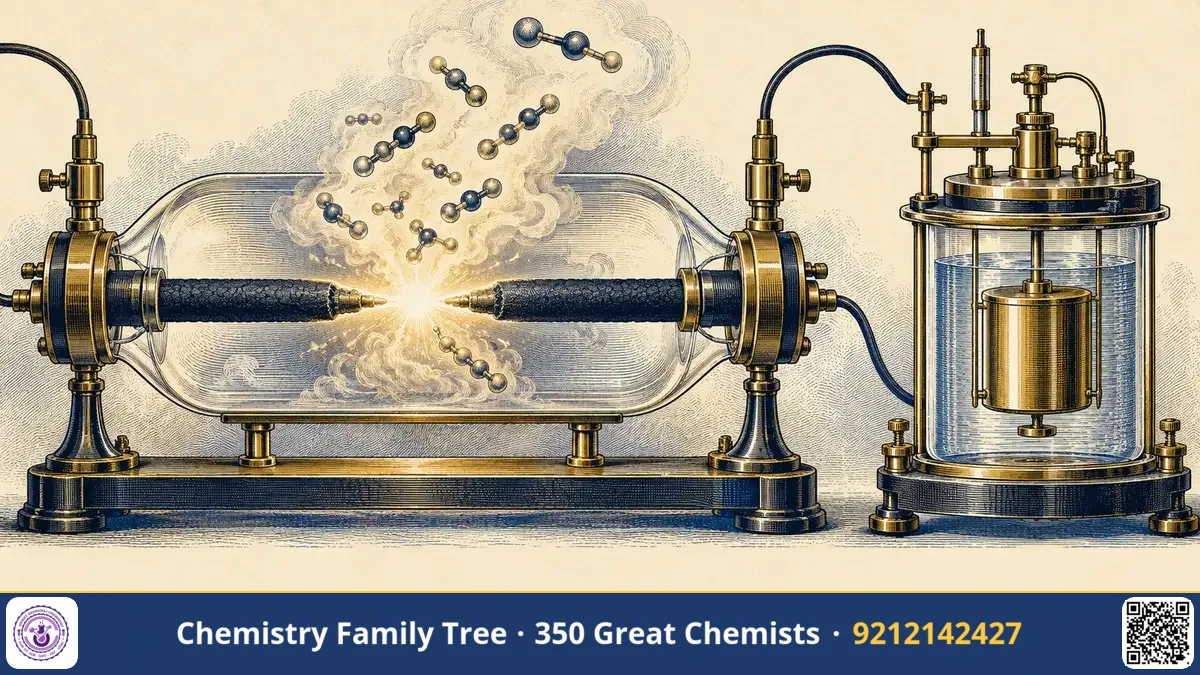
- Acetylene (1860): An electric arc between carbon electrodes in an atmosphere of hydrogen gives acetylene from its elements. He named it.
- Benzene (1866): Heating acetylene in a red-hot tube gave benzene and other aromatic products.
- Fats (1854): Heating glycerol with fatty acids gave glycerides, the first synthetic fats.
CO + KOH  -> HCOOK                      (potassium formate, 150-200 C, pressure)
CS2 + 2 H2S + 8 Cu -> CH4 + 4 Cu2S      (methane)
C2H4 + H2SO4 -> C2H5HSO4 ;  C2H5HSO4 + H2O -> C2H5OH + H2SO4
2 C + H2  --(electric arc)-->  C2H2
3 C2H2  --(red heat)-->  C6H6
C3H5(OH)3 + 3 RCOOH  ->  C3H5(OCOR)3 + 3 H2O
2. Esterification equilibrium (1862)
With Leon Pean de Saint-Gilles, Berthelot studied the reaction of acetic acid with ethanol for many months in sealed tubes. They found that the reaction never goes to completion but stops at a fixed point, at which about two thirds of the acid or alcohol has been used when starting from equal molar amounts.
CH3COOH + C2H5OH  <=>  CH3COOC2H5 + H2O
K = [ester][water] / [acid][alcohol] = about 4 (at room temperature)
Starting with 1 mol each: equilibrium gives about 2/3 mol ester
This was one of the first careful studies of chemical equilibrium and reaction rate, before the law of mass action of Guldberg and Waage (1864-1867) was widely known.
3. Thermochemistry and the bomb calorimeter (1870s-1880s)
Berthelot designed the calorimetric bomb, a strong steel vessel in which a sample burns in oxygen at high pressure, with the heat measured by the rise in temperature of the water around it. It is the same principle as the bomb calorimeter used today. He measured heats of combustion and formation of hundreds of compounds. He proposed the principle of maximum work: every chemical change taking place without outside energy tends towards the production of the substance or system that gives off the most heat. We now know this is not always true, since it is the free energy change, not the enthalpy change alone, that decides spontaneity.
The Chemistry Behind It
These syntheses showed that carbon compounds obey the same laws as other chemicals. The acetylene reaction is endothermic, and the arc provides the energy:
2 C(s) + H2(g) -> C2H2(g) deltaH(f) = +227 kJ/mol (endothermic)
The bomb calorimeter measures the heat of combustion at constant volume, which is the change in internal energy, deltaU. To get enthalpy, use the relation:
deltaH = deltaU + (deltan_gas) R T
Benzene: C6H6(l) + 7.5 O2 -> 6 CO2 + 3 H2O(l)   deltan = 6 - 7.5 = -1.5
The principle of maximum work belongs to the same period as the Berthelot-Thomsen principle (Julius Thomsen of Denmark worked independently on similar lines). We now correct it with the Gibbs relation deltaG = deltaH - T deltaS. At low temperatures, where the T deltaS term is small, deltaH is a good guide, so many exothermic reactions are spontaneous, but there are well-known exceptions such as the dissolving of ammonium nitrate in water, which is endothermic yet spontaneous.
The esterification study is a good example of dynamic equilibrium: forward and reverse rates become equal. An acid catalyst speeds up both directions equally and does not shift the equilibrium. To get more ester, you either use excess of one reagent or remove water (as in the Dean-Stark method).
Applications Today
- Acetylene: Used for oxy-acetylene welding and cutting in Indian workshops, and as a feedstock for chemicals such as vinyl chloride and acrylates (in some countries).
- Ethanol: Industrial ethanol from the hydration of ethylene continues from Berthelot's idea, using phosphoric acid catalyst today.
- Bomb calorimetry: Used to measure calorific value of coal, biomass, fuels and food. In India, labs measure the energy content of coal and biodiesel with it.
- Esters and fats: Esterification is used in perfumes, flavours, biodiesel and polymers like PET.
Exam Corner
- Berthelot synthesised acetylene from carbon and hydrogen with an electric arc (1860); trimerisation of acetylene to benzene on heating (Berthelot 1866; modern: red-hot iron tube).
- Fischer esterification equilibrium: K approx. 4 for acetic acid and ethanol; yield about 67 percent from 1:1 mixture.
- Bomb calorimeter measures deltaU (constant volume); deltaH = deltaU + deltan R T.
- Principle of maximum work (Berthelot-Thomsen) is not generally valid: spontaneity is decided by deltaG.
- Vitalism disproved by syntheses of Wohler (urea, 1828) and Berthelot.
Common Misconceptions
- "Wohler alone ended vitalism." The urea synthesis was a first blow, but the doctrine survived for decades. Berthelot's many syntheses from basic elements did more to end it.
- "Exothermic means spontaneous." Not always; entropy matters.
- "A catalyst increases the yield of ester at equilibrium." It speeds up approach to equilibrium but does not change K.
Quick Revision Box
- Marcellin Berthelot (1827-1907), French chemist.
- Syntheses: formic acid (1855), methane, ethanol from ethylene, acetylene (1860), benzene (1866).
- Synthetic fats from glycerol and fatty acids (1854).
- Esterification equilibrium with Pean de Saint-Gilles (1862).
- Designed the bomb calorimeter; principle of maximum work.
- deltaH = deltaU + deltan R T.
FAQ
What did Berthelot synthesise from the elements?
He made acetylene by striking an electric arc between carbon electrodes in hydrogen, and from this he obtained benzene and many other compounds.
What is the principle of maximum work?
It says that spontaneous chemical changes go in the direction in which most heat is released. It is only approximately true, since free energy decides the direction.
Why is a bomb calorimeter measured at constant volume?
The sample burns in a sealed steel container, so volume is constant and the heat measured equals the change in internal energy.
Did Berthelot win a Nobel Prize?
No. He lived until 1907 and the Nobel prizes began in 1901, but he did not receive one, although many honours came his way.
Published by ABC Chemistry — IIT-JAM | CSIR-NET | GATE Chemistry Coaching. Visit abcchemistry.com
About the chemist
Marcellin Berthelot
1827-1907 · France
Organic synthesis; thermochemistry