The discovery, explained · Chemist no. 300 of 350
Chain Reactions and the Steady State: The Kinetics of Max Bodenstein
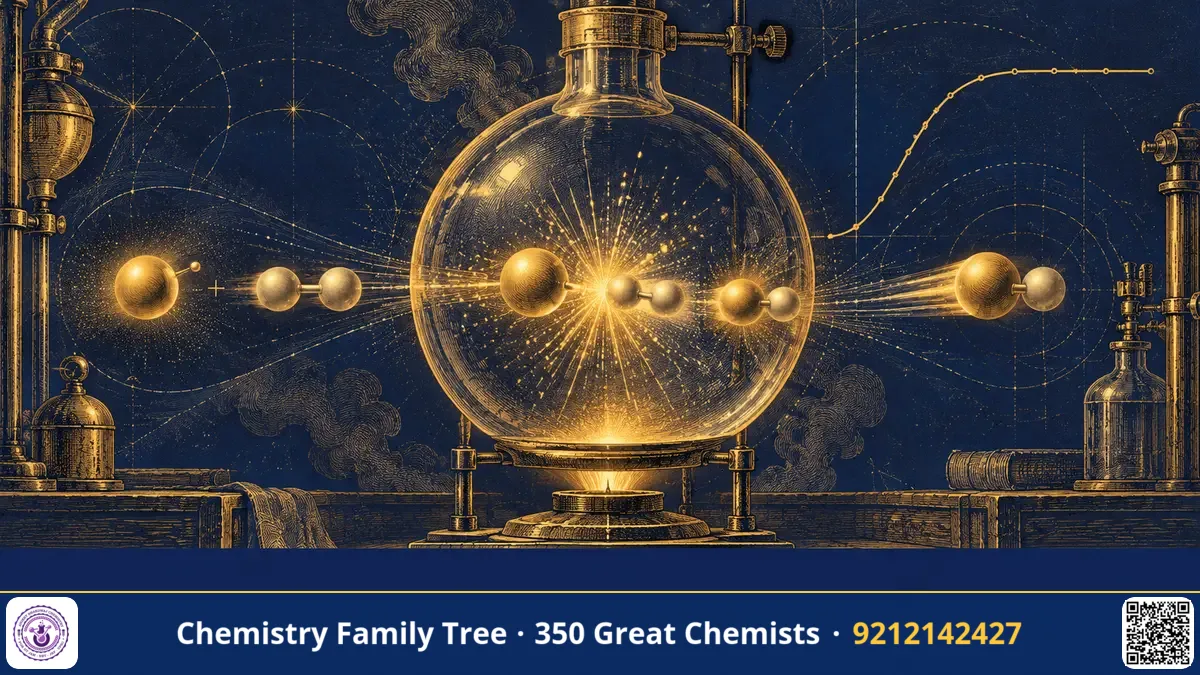
Why does a reaction like H₂ + Br₂ → 2HBr have such a strange rate law, with a square root of bromine concentration and a hydrogen bromide term in the denominator? Why does a flash of light convert thousands of molecules of hydrogen and chlorine to HCl for each photon absorbed? In the early twentieth century, the German physical chemist Max Bodenstein answered these questions. By measuring reaction rates with great precision, he established the idea of chain reactions and the steady-state approximation (sometimes called the Bodenstein principle). These two tools are the foundation of modern chemical kinetics and are used in almost every mechanism problem in exams.
The Scientific Problem Before the Discovery
By the 1890s chemists believed that simple reactions follow simple stoichiometry. The reaction H₂ + I₂ → 2HI looked like a perfect example of a bimolecular process: one molecule of H₂ collides with one molecule of I₂. Bodenstein carefully tested this by heating sealed glass bulbs of H₂ and I₂ and measuring the amounts of HI formed and of the HI decomposition in the reverse direction. His data, collected around 1894-1899, gave rate laws consistent with the elementary second-order forward reaction and second-order reverse reaction (2HI → H₂ + I₂), and the equilibrium constant matched the ratio of rate constants. This became the model example of a bimolecular gas reaction, used for decades in textbooks.
But other reactions did not behave this way. The hydrogen-bromine reaction gave a complicated rate law that nobody could explain, and the photochemical hydrogen-chlorine reaction proceeded with enormous efficiency. In 1913 Bodenstein reported that the quantum yield of the photochemical H₂ + Cl₂ reaction could reach very large values, of the order of a million molecules of HCl per photon. Einstein's law of photochemical equivalence (one photon activates one molecule) seemed to be violated.
The Discovery: Step-by-Step
1. H₂ + Br₂: a strange rate law
In 1906 Bodenstein and S. C. Lind measured the thermal reaction between hydrogen and bromine and found the empirical rate law:
d[HBr]/dt = k [H₂] [Br₂]^½ / (1 + k' [HBr]/[Br₂])
The fractional order (½) and the inhibition by the product HBr could not come from a single bimolecular step. A different type of mechanism was needed.
2. The chain mechanism
The reaction mechanism, completed by Christiansen, Herzfeld and Polanyi in 1919-1920 following Bodenstein's idea of chains, is:
- Initiation: Br₂ → 2Br· (thermal dissociation)
- Propagation: Br· + H₂ → HBr + H·
- Propagation: H· + Br₂ → HBr + Br·
- Inhibition: H· + HBr → H₂ + Br·
- Termination: 2Br· → Br₂
The chain carriers Br· and H· are regenerated in the propagation steps, so one initiation event can produce thousands of HBr molecules. This is why the quantum yield in the photochemical H₂ + Cl₂ reaction (Cl· and H· chain carriers) can be 10⁴ to 10⁶.
3. The steady-state approximation
Bodenstein recognised that the concentrations of reactive intermediates such as H· and Br· are always tiny and nearly constant, because they are consumed as quickly as they are formed. Therefore, d[H·]/dt ≈ 0 and d[Br·]/dt ≈ 0.
d[H·]/dt = k₂[Br·][H₂] - k₃[H·][Br₂] - k₄[H·][HBr] ≈ 0
d[Br·]/dt = 2k₁[Br₂] - k₂[Br·][H₂] + k₃[H·][Br₂] + k₄[H·][HBr] - 2k₅[Br·]² ≈ 0
Solving these two equations gives [Br·] = (k₁/k₅)^½ [Br₂]^½ and a rate that reproduces the experimental law exactly, with k = 2k₂(k₁/k₅)^½ and k' = k₄/k₃.
The Chemistry Behind It
Types of chain reactions. A chain has four parts: initiation (creates radicals), propagation (a radical reacts and creates another), inhibition or retardation (a radical consumes product), and termination (two radicals combine). Chain length is the number of propagation cycles per initiation.
| Reaction | Chain carriers | Notable feature |
|---|---|---|
| H₂ + Cl₂ → 2HCl (light) | Cl·, H· | Quantum yield about 10⁶ |
| H₂ + Br₂ → 2HBr | Br·, H· | Rate inhibited by HBr, order ½ in Br₂ |
| H₂ + I₂ → 2HI | (Mostly molecular) | Classic bimolecular reaction (later refined) |
| H₂ + O₂ (explosion) | H·, O·, ·OH | Branching chain, explosion limits |
Why HBr and HCl behave differently. In the H₂ + Cl₂ reaction, the step Cl· + H₂ → HCl + H· is almost thermoneutral (small activation energy), so chains are long and the reaction is explosive in light. In the H₂ + Br₂ reaction, the corresponding step Br· + H₂ → HBr + H· is endothermic (activation energy about 75 kJ/mol), so the reaction is slow and the rate law has the inhibition term.
The steady-state approximation versus the pre-equilibrium approximation. The steady-state approach sets the net rate of formation of an intermediate to zero. The pre-equilibrium approach assumes that a fast reversible step is at equilibrium before a slow step. Both are used in exams, and they give the same results when the second step is much slower than the reverse of the first.
Other Bodenstein contributions. His name is also attached to the dimensionless Bodenstein number (Bo = uL/D), which compares convective transport with axial dispersion in chemical reactors. He also studied the oxidation of SO₂ (relevant to sulfuric acid manufacture), the decomposition of N₂O₅, and gas equilibria in many other systems.
Applications Today
- Polymer industry: Free-radical polymerisation of ethene, styrene and vinyl chloride is a chain reaction with initiation, propagation and termination.
- Atmospheric chemistry: Ozone depletion by chlorine radicals is a catalytic chain, Cl· + O₃ → ClO· + O₂, ClO· + O → Cl· + O₂.
- Combustion: Flames and engine knock depend on branching chain mechanisms with H·, O· and OH· radicals.
- Chemical engineering: Rate laws derived with the steady-state approximation are used in reactor design, and Bodenstein numbers in tubular reactors.
- Biochemistry: The Michaelis-Menten equation is derived with a steady-state assumption for the enzyme-substrate complex, a method that directly follows Bodenstein's approach.
Exam Corner
- H₂ + Br₂ rate law: rate = k[H₂][Br₂]^½ / (1 + k'[HBr]/[Br₂]); derived by the steady-state approximation on Br· and H·.
- Steady state: d[intermediate]/dt ≈ 0 for reactive intermediates present at very low concentration.
- Chain steps: initiation, propagation, inhibition, termination. Chain length = rate of propagation / rate of initiation.
- Photochemical H₂ + Cl₂ has a quantum yield of about 10⁴-10⁶, which does not violate Einstein's law because of the chain.
- The Michaelis-Menten equation uses the steady-state approximation for the ES complex.
Common Misconceptions
- "Steady state means the intermediate concentration is zero." It means the concentration is small and almost constant, with net rate of change close to zero.
- "A quantum yield above 1 violates Einstein's law." No. The law applies to the primary photochemical step; the chain amplifies the overall yield.
- "The overall equation gives the rate law." The rate law comes from the mechanism, not the stoichiometry.
Quick Revision Box
- Bodenstein (1894-1899): H₂ + I₂ ⇌ 2HI as a classic bimolecular reaction.
- 1906: H₂ + Br₂ rate law with Lind; 1913: chain reaction idea from the H₂ + Cl₂ photoreaction.
- Steady-state approximation applied to radicals H· and Br·.
- Chain: initiation, propagation, inhibition, termination.
- Quantum yield for H₂ + Cl₂ can reach 10⁶.
- Bodenstein number compares convection and axial dispersion in reactors.
FAQ
What is the steady-state approximation?
It is the assumption that the concentration of a reactive intermediate stays nearly constant, because it is formed and consumed at almost equal rates, so its rate of change is set equal to zero.
Why does HBr inhibit the H₂ + Br₂ reaction?
HBr reacts with H· radicals to regenerate H₂ and Br·, which removes a chain carrier from the propagation path and slows the overall formation of HBr.
Is the H₂ + I₂ reaction truly bimolecular?
For decades it was the standard example, based on Bodenstein's data. Later work in the 1960s indicated that atomic iodine participates, so the mechanism is more complex than a single bimolecular step.
What is the Bodenstein number?
It is a dimensionless number, Bo = uL/D, that compares convective transport to axial dispersion in a flow reactor. A large value means plug-flow-like behaviour.
Published by ABC Chemistry — IIT-JAM | CSIR-NET | GATE Chemistry Coaching. Visit abcchemistry.com
About the chemist
Max Bodenstein
1871-1942 · Germany
Chain reactions; chemical kinetics