The discovery, explained · Chemist no. 198 of 350
Michael Levitt and the First Computer Models of Protein Folding
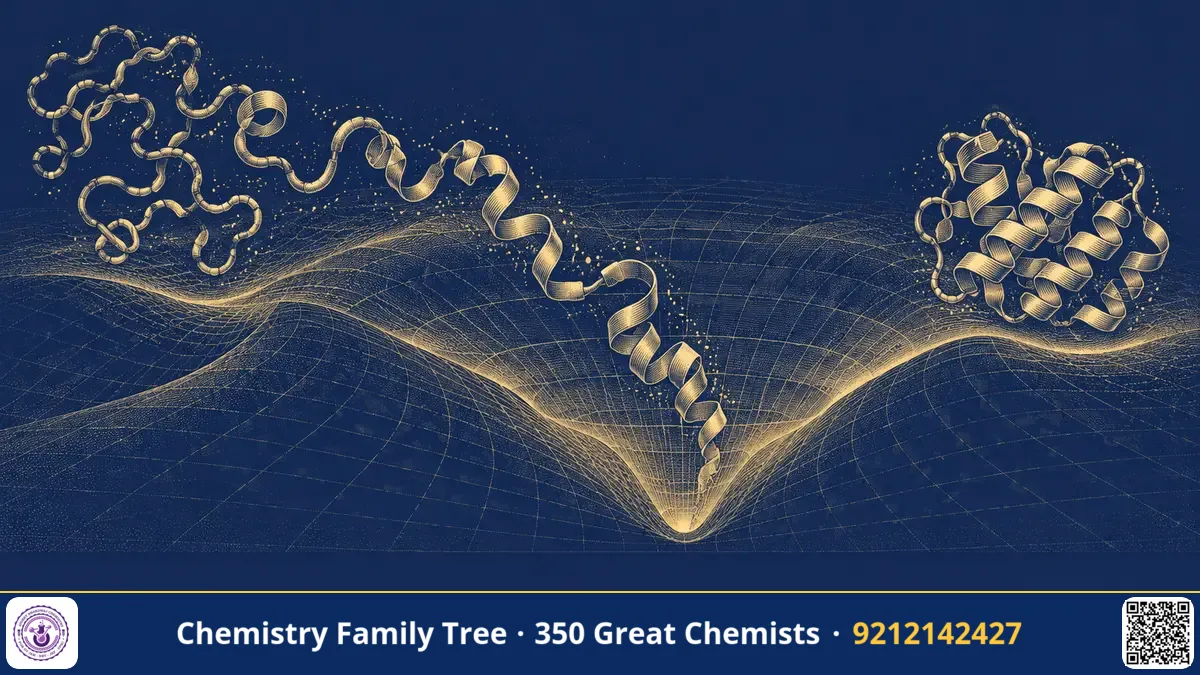
In the late 1960s, a young physicist from South Africa sat in front of a room-sized computer and asked a daring question: could we calculate the shape of a protein from the forces between its atoms? Michael Levitt, then working with Shneior Lifson at the Weizmann Institute in Israel, wrote one of the first programs to minimise the energy of a protein. A few years later, with Arieh Warshel, he built simplified models that could actually "fold" a small protein on the computer, and they developed the multiscale idea that mixes quantum and classical physics. For this he shared the 2013 Nobel Prize in Chemistry with Martin Karplus and Warshel. This blog explains the core ideas in language for JAM, NET and GATE aspirants.
The Scientific Problem Before the Discovery
By the 1960s, John Kendrew and Max Perutz had solved the structures of myoglobin and haemoglobin by X-ray crystallography, and Christian Anfinsen had shown that a protein's amino acid sequence contains the information for its three-dimensional fold. This raised a famous question, often called the protein folding problem: can we predict the structure from the sequence alone?
The main difficulty was the size of the problem. A small protein with 100 residues has roughly 1,500 atoms. Each residue has rotatable bonds (the φ and ψ angles), and if each could take only three values, the number of conformations would be about 3²⁰⁰, far too many to test one by one. This is Levinthal's paradox: real proteins fold in microseconds to seconds, so they cannot be searching randomly. Meanwhile, computers of the time had tiny memory and speed compared with today's phone. A full quantum treatment of a protein was out of the question, and even classical atom-by-atom simulations were barely possible. Simplification was essential.
The Discovery: Step by Step
- Energy minimisation (1969). Levitt and Lifson developed a program to compute the potential energy of a protein or small molecule from a force field, and to adjust atomic coordinates until the energy was at a minimum. They tested it on myoglobin. This was one of the first ways to "refine" a protein structure with a computer.
- Force fields. Levitt and Lifson used a consistent set of parameters for bonds, angles, torsions and non-bonded forces, and showed that such a set could reproduce known molecular structures.
- Simplified protein model (1975). With Arieh Warshel, he published "Computer simulation of protein folding" in Nature. Rather than treating all atoms, each amino acid was reduced to two points: one for the backbone and one for the side chain. The model moved on a simplified energy surface, and the team showed that a small protein, bovine pancreatic trypsin inhibitor, could be folded from an extended chain towards a structure close to the real one.
- Multiscale idea (1976). In a landmark paper on the enzyme lysozyme, Warshel and Levitt used quantum mechanics for the atoms in the reacting centre, classical mechanics for the rest of the protein, and a model for the surrounding solvent. This was the first multiscale QM/MM description of an enzyme reaction, in which the effect of the enzyme's electric field on the reaction was included.
- Later work. At the Salk Institute and at Stanford University, Levitt extended these ideas to protein structure comparison, RNA and DNA modelling, and to the evaluation of protein structure predictions.
The Chemistry Behind It
A force field expresses the energy of a molecule as a sum of simple terms. For a protein we often write:
E = E(bond) + E(angle) + E(torsion) + E(van der Waals) + E(electrostatic)
where bond and angle terms are harmonic springs, torsion terms are periodic, the van der Waals term is the Lennard-Jones potential (repulsive r⁻¹², attractive r⁻⁶), and the electrostatic term is Coulomb's law between partial charges:
E(elec) = qi qj / (4π ε₀ r)
Energy minimisation finds the nearest local minimum on this energy surface. Folding is then described as a journey downhill on a funnel-shaped energy landscape. The unfolded chain has many conformations and high energy and entropy; as the chain folds, native contacts form (hydrophobic collapse, hydrogen bonds in α-helices and β-sheets) and the number of accessible states falls. The balance of enthalpy and entropy gives the free energy of folding:
ΔG(fold) = ΔH − TΔS
Multiscale modelling uses a different level of detail where it is needed. The reactive centre is described by quantum mechanics (electrons, bond breaking); the rest of the protein by atomic force fields; the distant surroundings by coarse-grained or continuum models (for example, treating water as a dielectric). Levitt's insight was that complexity should be matched to the question being asked: the right model is the simplest one that still captures the essential physics.
Applications Today
- Protein structure prediction. Ideas from simplified models and from structure comparison fed into methods for predicting 3D structures. Modern artificial-intelligence systems such as AlphaFold, introduced in 2020-2021, built on decades of data and ideas; Levitt took part in the community evaluations of prediction methods.
- Drug design. Docking and free-energy calculations use force fields and minimisation techniques descended from his early programs.
- Enzyme engineering. QM/MM models help to design enzymes that catalyse new reactions.
- Molecular machines. Coarse-grained models describe motors, ion channels and viruses that are too large for atomic simulation.
- Education. Programs for protein visualisation and modelling make molecules accessible to Indian students without costly laboratories.
Exam Corner
- Nobel Prize in Chemistry 2013: Karplus, Levitt and Warshel, for development of multiscale models for complex chemical systems.
- Levinthal's paradox: proteins cannot fold by random search; folding follows a funnel-like energy landscape.
- Force field energy terms: bond stretch, angle bend, torsion, van der Waals (Lennard-Jones 12-6) and Coulomb electrostatics.
- QM/MM: E(total) = E(QM) + E(MM) + E(QM/MM); used for enzyme mechanisms.
- Anfinsen's thermodynamic hypothesis: the native structure is the minimum free-energy state under physiological conditions.
Common Misconceptions
- "Computer simulation means a perfect copy of reality." Models are approximations; their value is in what they predict and explain.
- "Folding is solved by one equation." Folding involves many interactions, and predictions require force fields, sampling and often experimental data.
- "Only quantum mechanics is real chemistry." Classical force fields are fully legitimate tools for large systems where electrons do not rearrange.
Quick Revision Box
- 1969: Levitt and Lifson, energy minimisation of proteins.
- 1975: Levitt and Warshel, simplified (two-point-per-residue) model of protein folding.
- 1976: Warshel and Levitt, QM/MM description of lysozyme catalysis.
- Force field = sum of bonded and non-bonded energy terms.
- Multiscale idea: match model complexity to the problem.
- Nobel Prize in Chemistry 2013 (shared with Karplus and Warshel).
FAQ
What is Levinthal's paradox?
A protein has an astronomical number of possible conformations, yet it folds in a fraction of a second, so folding cannot be a random search.
What does "coarse-grained" mean?
A coarse-grained model represents groups of atoms as single particles, which saves computing time while keeping the main features of the structure.
How did early computers cope?
They used very simple models and lengthy calculations on machines with tiny memories, which is why simplification was essential.
Is this topic useful for exams?
Yes: force fields, minimisation, protein folding thermodynamics and QM/MM are standard topics in physical and biophysical chemistry.
Published by ABC Chemistry — IIT-JAM | CSIR-NET | GATE Chemistry Coaching. Visit abcchemistry.com

About the chemist
Michael Levitt
1947- · United States · Nobel Chemistry 2013
Multiscale computational modeling of macromolecules