The discovery, explained · Chemist no. 222 of 350
Quantum Dot Synthesis: How Moungi Bawendi Learned to Cook Nanocrystals to Perfection
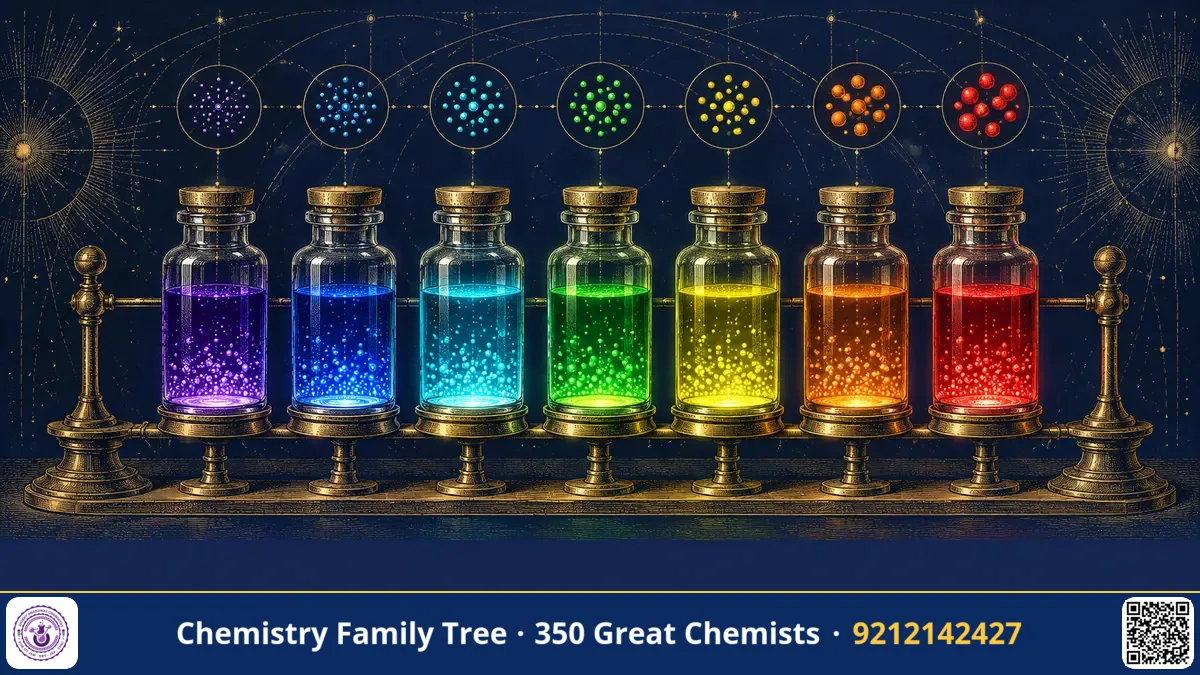
Take a flask containing a hot solvent and quickly inject two chemical precursors. Within seconds, tiny crystals only a few nanometres across appear. Let them grow a little more and they glow green; stop earlier and they glow blue; grow longer and they glow red. The compound is the same, cadmium selenide (CdSe), and only the size changes. In 1993, Moungi Bawendi and his students at the Massachusetts Institute of Technology (MIT) published a method that made such quantum dots with a narrow size distribution and high quality. This "hot-injection" method turned a laboratory curiosity into a material that could be used in displays, solar cells and medical imaging. In 2023, Bawendi, Louis Brus and Alexei Ekimov shared the Nobel Prize in Chemistry "for the discovery and synthesis of quantum dots".
This post explains why quantum dots needed a good synthesis, how the hot-injection method works, and the physics and chemistry behind the colours.
The Scientific Problem Before the Discovery
By the early 1980s, Alexei Ekimov had observed size-dependent colour in tiny crystals grown in glass, and Louis Brus had explained the effect in colloidal solutions. The theory said that when a semiconductor crystal becomes smaller than the natural size of an electron-hole pair (the exciton Bohr radius), its electrons are confined and the energy levels become discrete and size-dependent. This is the quantum confinement effect.
But experiments were frustrated by poor samples. Methods based on precipitation in water or in micelles gave crystals with a wide range of sizes, with irregular shapes and with many surface defects. A mixture of sizes gives a mixture of colours and broad, blurred spectra. To test theory, and to use dots in technology, chemists needed samples that were uniform in size (monodisperse), crystalline, and with clean surfaces.
The Discovery / Experiment
Bawendi, who had worked with Brus at Bell Labs as a postdoctoral researcher, started his own group at MIT in 1990. With graduate students Christopher Murray and David Norris, he developed the following procedure, published in the Journal of the American Chemical Society in 1993:
- Heat a coordinating solvent, a mixture of trioctylphosphine oxide (TOPO) and trioctylphosphine (TOP), to a high temperature, about 300 degrees C, under an inert atmosphere.
- Rapidly inject a cold solution of the precursors: dimethylcadmium (Cd(CH3)2) and trioctylphosphine selenide (TOP=Se).
- The sudden mixing creates a very high supersaturation. A burst of nucleation produces many small crystal seeds at once, and the temperature drops slightly.
- The temperature is then held a little lower so that growth continues without new nuclei forming. The nanocrystals grow by adding monomers.
- Samples are removed at different times. Small crystals appear at early times, and larger ones at later times. Size-selective precipitation (adding a non-solvent like methanol) can further narrow the size distribution.
Cd(CH3)2 + TOP=Se --(TOPO, ~300 °C)--> CdSe nanocrystals (capped with TOPO)
The key principle is the separation of nucleation and growth, explained by the LaMer model. If all nuclei form at the same time and then grow at the same rate, they end up the same size. The TOPO ligand binds to the surface cadmium atoms, controls the growth, prevents the particles from sticking together, and passivates the surface, which improves fluorescence and keeps the particles dissolved in organic solvents.
The result: nanocrystals with sizes between about 1.2 and 11 nm, with sharp absorption peaks, bright fluorescence and a well-ordered crystal structure, which could even be examined by X-ray diffraction and electron microscopy.
The Chemistry Behind It
Quantum confinement. In a bulk semiconductor, electrons occupy continuous bands separated by a band gap. When a photon with energy greater than the band gap is absorbed, an electron is promoted to the conduction band, leaving a hole, together an exciton. In a very small crystal the exciton is squeezed. The particle-in-a-box model predicts that energy levels rise as the box gets smaller, roughly as 1/R^2. Therefore the effective band gap increases as the dot shrinks:
E(dot) ≈ E(bulk) + (h²/8R²)(1/m_e + 1/m_h) − Coulomb term
This is a simplified form of the Brus equation. A larger band gap means higher-energy (bluer) light is emitted. For CdSe, the bulk band gap is about 1.74 eV (near-infrared, about 710 nm), but a 2 nm dot emits blue-green light and a 6 nm dot emits red.
| Dot size (CdSe) | Band gap | Colour of emission |
|---|---|---|
| Small (about 2 nm) | Larger | Blue / green |
| Medium (about 4 nm) | Intermediate | Yellow / orange |
| Large (about 6 nm) | Smaller | Red |
Later, Bawendi and others added a shell of a wider-gap material, such as zinc sulfide (ZnS), around the CdSe core. This core-shell structure removes surface traps and boosts brightness and stability. Further research has developed cadmium-free quantum dots, for example InP, as well as perovskite nanocrystals.
Applications Today
- Displays. Quantum dots convert blue LED light into very pure red and green, giving television screens a wider colour range. They are marketed as QLED or quantum-dot displays.
- Biomedical imaging. Dots are used as bright, photostable fluorescent labels for cells and tissues, and in guiding surgery in research settings.
- Solar cells and photodetectors. Tuning the band gap by size lets researchers harvest different parts of the solar spectrum.
- Lighting and lasers. Quantum dots improve the colour quality of LED lights and are being studied for tunable lasers.
- Research in India. Many Indian laboratories at IITs and IISc study quantum dots and carbon dots for sensing and solar applications, and students meet the topic in nanomaterials courses.
Exam Corner
- Quantum dots are semiconductor nanocrystals of about 2-10 nm, in which quantum confinement makes the band gap size-dependent.
- Smaller dot means a larger band gap, blue-shifted absorption and emission.
- Hot-injection separates nucleation from growth, giving monodisperse particles (LaMer mechanism).
- TOPO is a capping (coordinating) ligand that stabilises nanocrystals.
- 2023 Nobel Prize in Chemistry: Bawendi, Brus, Ekimov.
Common Misconceptions
- "Different dot colours need different elements." The same material gives different colours simply by changing size.
- "Quantum dots are single atoms." Each dot contains hundreds to thousands of atoms.
- "All quantum dots contain toxic cadmium." Cadmium-free versions, such as InP-based dots, are widely commercialised.
Quick Revision Box
- 1993: Murray, Norris and Bawendi hot-injection synthesis of CdSe at MIT.
- Precursors: dimethylcadmium and TOP-selenide in hot TOPO/TOP.
- Principle: burst nucleation followed by slow, controlled growth.
- Colour depends on size: small is blue, large is red.
- Core-shell structures such as CdSe/ZnS improve brightness.
- Nobel Prize in Chemistry 2023 with Brus and Ekimov.
FAQ
What is a quantum dot?
It is a semiconductor crystal so small, typically a few nanometres, that quantum effects control its optical and electronic properties.
Why is dimethylcadmium rarely used now?
It is highly toxic, pyrophoric and dangerous. Later procedures use safer cadmium sources such as cadmium oxide with fatty acids.
What does "monodisperse" mean?
A sample is monodisperse when all the particles have nearly the same size.
What is the exciton Bohr radius?
It is the natural separation between the electron and hole in an exciton. Quantum confinement appears when crystal size is comparable to or smaller than this radius.
Published by ABC Chemistry — IIT-JAM | CSIR-NET | GATE Chemistry Coaching. Visit abcchemistry.com
About the chemist
Moungi Bawendi
1961- · United States · Nobel Chemistry 2023
Synthesis of quantum dots