The discovery, explained · Chemist no. 290 of 350
Nevil Sidgwick: How the Chemical Bond Became Electrons, Lone Pairs and Shapes
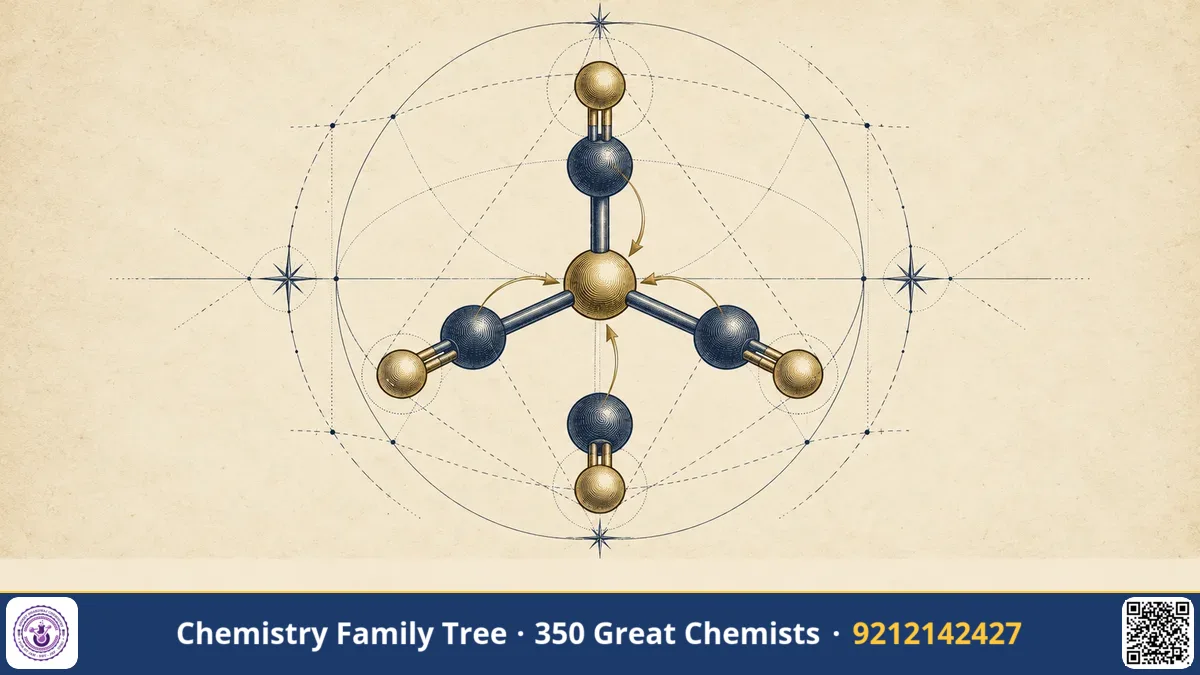
Why does ammonia bond to boron trifluoride? Why does Fe(CO)₅ exist but not Fe(CO)₆? Why do lead and thallium prefer lower oxidation states than their group number suggests? Behind answers to each of these questions stands Nevil Vincent Sidgwick, a British chemist at Oxford. Sidgwick took the electron-pair bond of G. N. Lewis and the quantum-mechanical ideas of the 1920s and turned them into working rules for inorganic and organic chemists. He promoted the coordinate (dative) covalent bond, the effective atomic number rule for complexes, the term inert pair effect, and, with Herbert Powell, the lone-pair rule for molecular shapes that evolved into VSEPR theory. These ideas fill the inorganic chemistry sections of JAM, NET and GATE.
The Scientific Problem Before the Discovery
After J. J. Thomson discovered the electron (1897), and Rutherford and Bohr described the atom, chemists wanted to explain valency in electronic terms. In 1916 Lewis proposed that a covalent bond is a shared pair of electrons, and Kossel proposed ionic bonding through electron transfer. These ideas worked well for simple molecules such as H₂O, CH₄ and NaCl. But many compounds remained puzzling:
- Coordination compounds such as [Co(NH₃)₆]³⁺, which Alfred Werner had explained with secondary valency but not in electronic terms.
- Molecules like NH₃·BF₃ in which neither partner appeared to have an unpaired electron to donate.
- Why molecules of the same formula type have different shapes (NH₃ is pyramidal, BF₃ is planar).
- Why heavy p-block elements often show an oxidation state two less than the group maximum.
The Discovery / Experiment
Sidgwick's contribution was not a single experiment but a series of syntheses and correlations of known data, published in his books The Electronic Theory of Valency (1927) and The Covalent Link in Chemistry (1933), and in lectures such as his Bakerian Lecture of 1936. His main proposals were:
1. The coordinate (dative) bond. A covalent bond in which both electrons come from one atom. The donor has a lone pair; the acceptor has an empty orbital.
H₃N: + BF₃  →  H₃N→BF₃
[Cu(NH₃)₄]²⁺: four N lone pairs donated to Cu²⁺
Ni + 4 CO → Ni(CO)₄  (CO donates a lone pair from carbon)
2. Effective atomic number (EAN) rule. In a stable complex, the metal tends to acquire the electron count of the next noble gas.
EAN = (atomic number of metal) – (oxidation state) + 2 × (number of ligands)
Ni(CO)₄: 28 – 0 + 8 = 36 (Kr)
Fe(CO)₅: 26 – 0 + 10 = 36 (Kr)
[Fe(CN)₆]⁴⁻: 26 – 2 + 12 = 36 (Kr)
3. Inert pair effect. Heavy p-block elements often keep their ns² pair and show an oxidation state two lower: Tl⁺, Pb²⁺, Bi³⁺ instead of Tl³⁺, Pb⁴⁺, Bi⁵⁺.
4. Lone-pair repulsion and shape (Sidgwick–Powell, 1940). The shape of a molecule is determined by the total number of electron pairs, both bonding and lone, around the central atom, which arrange themselves to minimise repulsion.
The Chemistry Behind It
Dative bonds. Once formed, a dative bond is no different from any other covalent bond; its origin is only a bookkeeping matter. Formal charges appear: in H₃N→BF₃ the nitrogen carries +1 and boron –1. The Lewis acid–base definition (acid = electron pair acceptor, base = electron pair donor) fits perfectly. Sidgwick extended this to hydrogen bonding and chelation, for example the intramolecular hydrogen bond in o-nitrophenol that makes it steam volatile, unlike p-nitrophenol.
EAN rule. It works especially well for low-oxidation-state organometallic compounds such as metal carbonyls, where strong-field π-acceptor ligands push metals toward 18 valence electrons. It is less useful for high-spin complexes of first-row metals, e.g. [Co(NH₃)₆]³⁺ has EAN = 27 – 3 + 12 = 36, a match, but [Cr(NH₃)₆]³⁺ has 24 – 3 + 12 = 33, not a match, yet the compound is stable. Modern ligand field theory and the 18-electron rule explain the pattern better, but the EAN count remains a quick check.
Shape rule. Sidgwick and Powell classified molecules by the number of pairs:
2 pairs: linear (BeCl₂)       3 pairs: trigonal planar (BF₃)
4 pairs: tetrahedral (CH₄, NH₃, H₂O – shape differs by number of lone pairs)
5 pairs: trigonal bipyramidal (PCl₅)       6 pairs: octahedral (SF₆)
Gillespie and Nyholm (1957) later refined this into the VSEPR model, adding that lone pair–lone pair repulsion exceeds lone pair–bond pair, which exceeds bond pair–bond pair. Hence bond angles: CH₄ 109.5°, NH₃ 107°, H₂O 104.5°.
Inert pair effect. Down group 13 and 14, the ns² electrons become harder to remove because of poor shielding by d and f electrons and relativistic stabilisation of the s orbital. So Tl(I) is more stable than Tl(III), and Pb(II) more stable than Pb(IV); PbO₂ is a strong oxidising agent.
Applications Today
- Catalysis: Organometallic catalysts in industry (Wilkinson's catalyst, hydroformylation, the Mond process for nickel purification using Ni(CO)₄) are understood by electron counting.
- Drug design: Dative bonding explains how metal-based drugs such as cisplatin bind to nitrogen donors in DNA.
- Materials: Lewis acid–base adducts such as amine-boranes are studied for hydrogen storage.
- Predicting shapes: VSEPR, descended from the Sidgwick–Powell rule, is used daily to predict geometries, dipole moments and spectroscopy.
- Analytical chemistry: EDTA complexometric titrations of hardness in water rely on chelation by dative bonds.
Exam Corner
- EAN = Z – (oxidation state) + 2 × (number of ligands); stable complexes often have EAN equal to a noble gas atomic number (36, 54, 86).
- Ni(CO)₄ and Fe(CO)₅ both have EAN 36; Cr(CO)₆ has 24 + 12 = 36.
- Coordinate bond: both electrons from the donor; arrow from donor to acceptor.
- Inert pair effect: stability of lower oxidation state increases down the group (Tl⁺, Pb²⁺, Bi³⁺).
- Sidgwick–Powell shapes are determined by total electron pairs; lone pairs distort bond angles.
Common Misconceptions
- "A dative bond is weaker than a normal covalent bond." Not necessarily; many are very strong, and after formation they cannot be distinguished from other bonds.
- "EAN rule must always be obeyed." It is a guide with many exceptions, especially for high oxidation states and first-row complexes with weak-field ligands.
- "The inert pair is chemically inert." It is reluctant to take part in bonding but can be involved, for example in lone pair stereochemistry.
Quick Revision Box
- Sidgwick wrote The Electronic Theory of Valency (1927) and The Covalent Link in Chemistry (1933).
- Coordinate bond: donor lone pair into acceptor empty orbital.
- EAN rule: metal achieves noble gas electron count.
- Inert pair effect: Tl⁺, Pb²⁺, Bi³⁺ more stable than higher states.
- Sidgwick–Powell rule (1940) led to VSEPR.
- Bond angles: CH₄ 109.5°, NH₃ 107°, H₂O 104.5°.
FAQ
What is the effective atomic number of Fe in Fe(CO)₅?
26 (Z) – 0 (oxidation state) + 10 (five CO ligands × 2 electrons) = 36, the atomic number of krypton.
What is the difference between Sidgwick–Powell theory and VSEPR?
Sidgwick–Powell proposed that electron pair number decides shape. VSEPR, by Gillespie and Nyholm, added the ordering of repulsions among lone pairs and bond pairs and made more quantitative predictions.
Why does Tl prefer +1 over +3?
Because its 6s² pair is held tightly and is reluctant to take part in bonding, the inert pair effect.
Is NH₃·BF₃ an ionic compound?
No. It is a molecular adduct held by a dative covalent bond from N to B.
Published by ABC Chemistry — IIT-JAM | CSIR-NET | GATE Chemistry Coaching. Visit abcchemistry.com

About the chemist
Nevil Sidgwick
1873-1952 · United Kingdom
Electronic theory of valency; coordinate bond