The discovery, explained · Chemist no. 144 of 350
Paul Flory: Turning Plastics into a Science
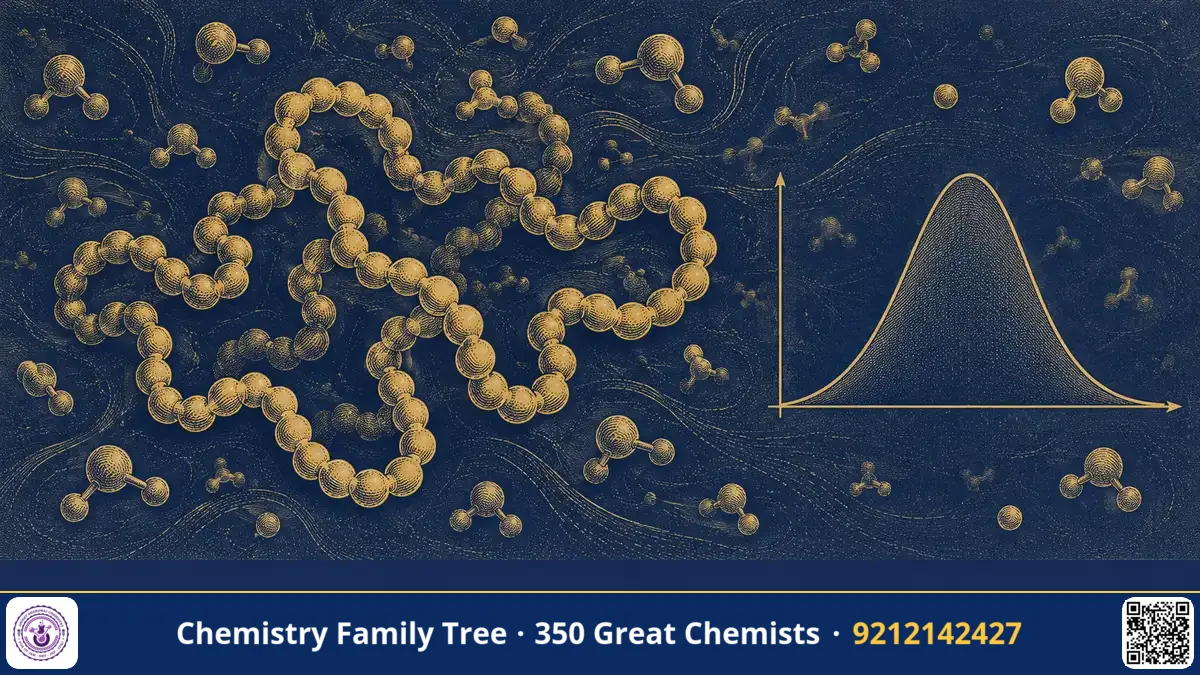
Nylon, polyethylene, rubber, PVC, polystyrene - the modern world is made of polymers. Yet before the 1930s many chemists doubted that such giant molecules even existed. Paul J. Flory (1910-1985) helped to turn polymer science from a craft into a quantitative branch of physical chemistry. He explained how chain length is controlled in step-growth and chain-growth reactions, how molecular weight distributions arise, and how long chains behave in solution and in the bulk. His theories - equal reactivity of functional groups, the Flory-Huggins theory of solutions, the random-coil model and the theta temperature - appear in every polymer chemistry syllabus. In 1974 he received the Nobel Prize in Chemistry for fundamental achievements, theoretical and experimental, in the physical chemistry of macromolecules.
The Scientific Problem Before the Discovery
Early in the twentieth century, many scientists believed that substances such as rubber, cellulose and starch were small molecules held together in aggregates, or colloids. Hermann Staudinger argued in the 1920s that they were true long-chain molecules held by ordinary covalent bonds. Wallace Carothers at DuPont proved it by building polyesters and polyamides step by step, leading to nylon.
But making polymers was not enough. A polymer sample is not a single compound; it is a mixture of chains of different lengths. How is the average length related to the reaction conditions? Does a longer chain react more slowly than a short one? How does a very long, flexible chain behave in a solvent, when it can twist in countless ways? Without answers to these questions, polymer properties could not be predicted or controlled.
The Discovery and Contributions
- Principle of equal reactivity (1930s). Working with Carothers at DuPont, Flory argued that the reactivity of an end group does not depend on the length of the chain to which it is attached. This simplified polymer kinetics enormously and let him treat polymerisation statistically.
- Molecular weight distributions. He derived the most probable distribution of chain lengths in step-growth polymerisation and in chain-growth with termination by disproportionation or transfer. This is called the Flory distribution (or Schulz-Flory distribution).
- Chain transfer. He introduced the concept of chain transfer in free-radical vinyl polymerisation, explaining why chains stop growing and why average molecular weights are lower than expected.
- Branching and gelation. He worked out the theory of three-dimensional network formation, predicting the point at which a gel forms.
- Solution thermodynamics. Independently of Maurice Huggins, he derived the lattice theory of polymer solutions (Flory-Huggins theory).
- Chain conformation. He introduced the excluded volume effect and the idea of the theta condition, in which a real chain behaves as an ideal random coil.
The Chemistry Behind It
Degree of polymerisation: the Carothers equation
For step-growth polymerisation with equimolar functional groups, with p as the fraction of groups reacted:
X̄n = 1 / (1 - p)
To get a chain of 100 units, p must be 0.99, which is why high conversion and very pure monomers are needed for good nylon or polyester. In Flory's statistical treatment the weight-average is X̄w = (1 + p)/(1 - p) and the polydispersity index X̄w / X̄n = 1 + p, which approaches 2 at high conversion.
Flory-Huggins theory
The polymer solution is modelled on a lattice in which each solvent molecule occupies one site and each polymer chain occupies many connected sites. The free energy of mixing is:
ΔG(mix)/RT = n₁ ln φ₁ + n₂ ln φ₂ + χ n₁ φ₂
where φ₁ and φ₂ are volume fractions of solvent and polymer and χ is the interaction parameter. Because a polymer chain counts as one molecule even though it occupies many sites, the entropy of mixing is much smaller than for small molecules. This explains why polymers dissolve slowly and why small changes in temperature or solvent quality can make them precipitate. Solvent quality is good when χ < 0.5, and poor when χ > 0.5.
Random coil and theta condition
An ideal chain with n bonds of length l has mean-square end-to-end distance ⟨r²⟩ = n l² for a freely jointed chain. Real chains cannot cross themselves, so they swell (the excluded volume effect). At a particular temperature (the theta temperature) in a particular solvent (a theta solvent), this swelling is exactly cancelled by attractions between segments, and the chain follows ideal behaviour. At theta conditions the second virial coefficient of the osmotic pressure is zero, and χ = 0.5.
Rubber elasticity
Flory also developed the statistical theory of rubber elasticity. The retractive force of stretched rubber arises mainly from entropy: stretching reduces the number of conformations available to the chains, so the chains return to the coiled state spontaneously. Stress is proportional to temperature, which is a surprising property that students often meet in exams. The equilibrium swelling of crosslinked networks is described by the Flory-Rehner equation.
Glass transition
The Flory-Fox equation relates the glass transition temperature to number-average molecular weight: Tg = Tg,∞ - K / Mn. Short chains have more chain ends and more free volume, so Tg is lower.
Applications Today
- Industrial polymers. Control of chain length through conversion, stoichiometry and chain transfer agents lets industry make nylon-6,6, PET and polyurethanes with desired properties. India's large PET bottle and polyester fibre industry uses these principles.
- Characterisation. Osmometry, viscometry, light scattering and gel permeation chromatography give molecular weights and are interpreted using Flory's theories.
- Rubber and tyre technology. Crosslink density and elasticity are tuned using rubber elasticity theory and Flory-Rehner swelling.
- Biopolymers. Concepts of random coils and excluded volume describe unfolded proteins and DNA.
- Drug delivery and gels. Hydrogel swelling follows Flory-Huggins and Flory-Rehner thermodynamics.
Exam Corner
- Carothers equation: X̄n = 1/(1 - p); polydispersity index approaches 2 for step-growth.
- Principle of equal reactivity: end-group reactivity is independent of chain length.
- Flory-Huggins χ parameter: χ = 0.5 at theta conditions; good solvent has χ < 0.5.
- Rubber elasticity is entropic; a stretched rubber band heats up on stretching and retracts more strongly at higher temperature.
- Mn, Mw, Mz order: Mw is always greater than or equal to Mn; PDI = Mw/Mn.
Common Misconceptions
- "Polymers have a single molecular weight." They have a distribution; we report averages.
- "Rubber elasticity is due to bond stretching." It is mainly due to entropy change of the chains, not to bond stretching.
- "Theta solvent means no interaction." It means the net effect of excluded volume and segment-solvent interactions cancel, giving ideal-chain dimensions.
Quick Revision Box
- Nobel Prize in Chemistry, 1974: physical chemistry of macromolecules.
- Equal reactivity principle; Carothers equation X̄n = 1/(1 - p).
- Flory-Huggins: ΔG(mix)/RT = n₁lnφ₁ + n₂lnφ₂ + χn₁φ₂.
- Theta temperature: second virial coefficient zero, chain behaves ideally.
- Rubber elasticity arises from entropy.
- Flory-Fox: Tg depends on 1/Mn.
FAQ
What is the Flory-Huggins theory?
It is a lattice model for the thermodynamics of polymer solutions that includes the small entropy of mixing for long chains and an interaction parameter χ.
Why did Flory win the Nobel Prize?
He received the 1974 Nobel Prize in Chemistry for his fundamental achievements in the physical chemistry of macromolecules, both theory and experiment.
What is a theta solvent?
A solvent, at a given temperature, in which a polymer chain has unperturbed dimensions, since excluded volume and attractions balance. It is used to test ideal chain theories.
Is Flory important for JAM, NET and GATE?
Yes. Average molecular weights, Carothers equation, polymer solution thermodynamics and rubber elasticity appear in physical chemistry sections.
Published by ABC Chemistry — IIT-JAM | CSIR-NET | GATE Chemistry Coaching. Visit abcchemistry.com

About the chemist
Paul Flory
1910-1985 · United States · Nobel Chemistry 1974
Physical chemistry of macromolecules