The discovery, explained · Chemist no. 336 of 350
Paul Héroult: Electrolysis of Aluminium and the Electric Arc Furnace
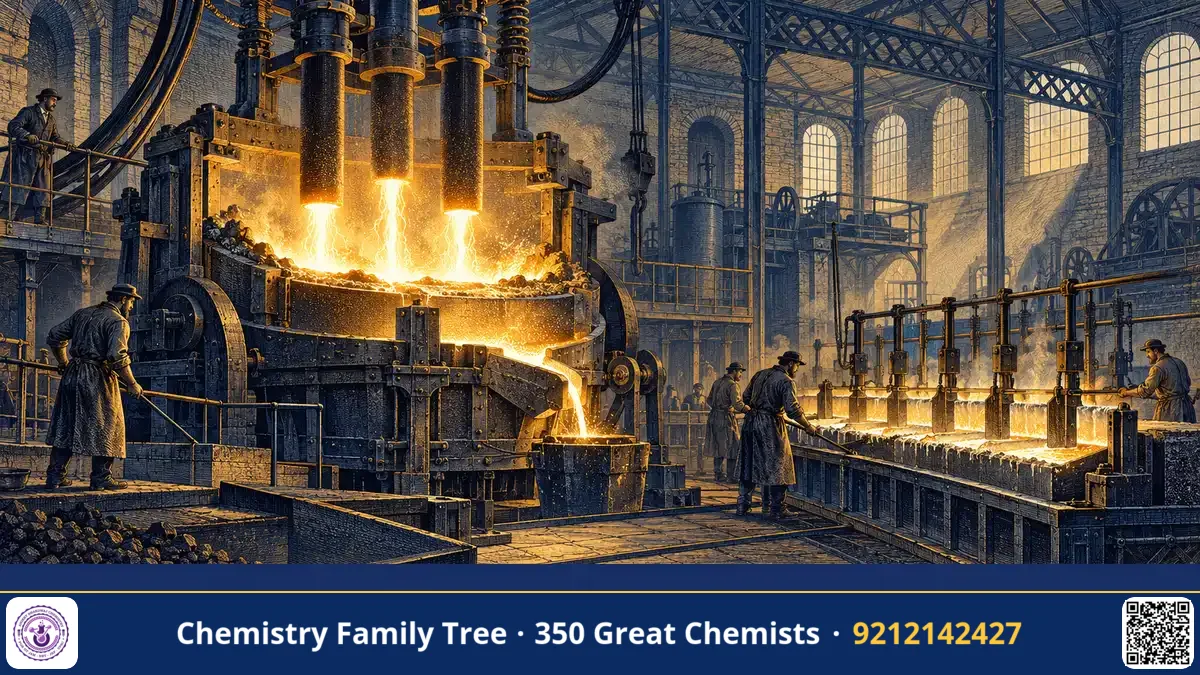
Paul Louis Toussaint Héroult, a young Frenchman, discovered in 1886 that aluminium oxide dissolved in molten cryolite can be electrolysed to give the metal. In the same year Charles Martin Hall in the United States found the same method independently, and the process carries both names. Héroult did not stop there. He also developed an electric arc furnace for making steel, which is a technology in use in every country today, including India. Two of the pillars of modern materials, aluminium and recycled steel, therefore rest on his work.
The Scientific Problem Before the Discovery
When Héroult was a student, aluminium was already known to be a very useful metal, light, resistant to corrosion and a good conductor. But it was made by the Deville chemical process, in which aluminium chloride was reduced by metallic sodium, and it was costly. Electrolysis seemed the obvious route, as shown for sodium and potassium by Humphry Davy, but aluminium oxide has a melting point above 2000 °C, and electrolysis of aqueous salts gives hydrogen. Attempts to electrolyse molten aluminium chloride or double chlorides had been tried but gave poor results. Electric power was also available only in small amounts until dynamos became practical in the 1880s.
For steel, the problem was different. Furnaces in the nineteenth century used coal or coke, which brought sulphur and other impurities into the metal. A clean, controllable source of high temperature was needed.
The Discovery: Step by Step
- Step 1: Choose a solvent. Héroult knew that a flux could lower the melting point of an oxide. He found that cryolite, Na₃AlF₆, a mineral long known from Greenland, dissolves alumina well when molten.
- Step 2: Electrolyse. Using carbon electrodes and a strong direct current from a dynamo, he passed the current through the molten mixture and obtained aluminium at the cathode.
- Step 3: Patent (1886). He filed a French patent in April 1886. In the same year, Hall in Ohio succeeded in making aluminium by the same route.
- Step 4: Industry. In Switzerland, at Neuhausen near the Rhine Falls, he took part in founding a company (the Aluminium Industrie AG) that used hydroelectric power. This made production practical and cheap in the 1888–1890 period.
- Step 5: Arc furnace for steel (c. 1900). Héroult developed a direct-arc electric furnace in which an arc between graphite electrodes and the metal charge melts scrap. A commercial installation was built in the early 1900s in France and elsewhere.
The Chemistry Behind It
Aluminium electrolysis. The cell reactions are:
Cathode:  Al³⁺ + 3e⁻ → Al(l)
Anode:    2O²⁻ + C → CO₂ + 4e⁻   (CO also formed)
Overall:  2Al₂O₃ + 3C → 4Al + 3CO₂        (T about 950 °C)
Cryolite lowers the melting point of the bath, dissolves alumina, and conducts electricity (it is ionic when molten). Faraday's first law applies directly: mass deposited = (M × I × t) / (n × F), with M = 27 g/mol and n = 3. So, one ampere-hour deposits 0.335 g of aluminium in an ideal cell.
Arc furnace for steel. An electric arc is a discharge between electrodes, in which the temperature is over 3000 °C. In a Héroult-type furnace, graphite electrodes (three, with three-phase AC) are lowered into a charge of scrap steel with lime. The electrical energy melts the metal and the slag removes impurities.
Oxidation of impurities:  2Fe + O₂ → 2FeO;   FeO + C → Fe + CO
Dephosphorisation:        2P + 5FeO + 3CaO → Ca₃(PO₄)₂ + 5Fe
Desulphurisation:         FeS + CaO + C → CaS + Fe + CO
| Feature | Blast furnace + BOF | Electric arc furnace |
|---|---|---|
| Main charge | Iron ore, coke, limestone | Scrap steel, sponge iron |
| Heat source | Burning coke | Electric arc |
| CO₂ emission per tonne of steel | High | Lower, depending on electricity source |
| Best for | Large primary production | Recycling, alloy steels |
Applications Today
- Aluminium. Nearly all primary aluminium, used in aircraft, vehicles, cables and packaging, is made by the Hall-Héroult process.
- Recycled steel. A large fraction of global steel, and of Indian steel, is produced in electric arc furnaces. India is the world's largest producer of sponge iron (DRI), which is a major feedstock for such furnaces.
- Alloy and stainless steels. The arc furnace gives close control of composition.
- Indian smelters. NALCO, Hindalco and other companies run aluminium plants using the same principle.
- Future. Research in inert anodes, green hydrogen-based steelmaking and renewable-powered arc furnaces continues to build on his ideas.
Exam Corner
- Hall-Héroult: electrolysis of Al₂O₃ in molten cryolite with carbon electrodes at about 950 °C.
- Add AlF₃ and CaF₂ to lower the melting point and improve conductivity.
- Faraday's law: 1 mol of Al needs 3 F of charge.
- Cryolite is Na₃AlF₆; fluorspar is CaF₂; bauxite is Al₂O₃·xH₂O.
- Electric arc furnaces melt scrap and give clean steel; basic lining with lime removes phosphorus.
Common Misconceptions
- "Héroult copied Hall." Both worked independently, and their results were reached within weeks of each other.
- "The arc furnace is a type of induction furnace." It is not. The arc furnace heats by the electric arc and the induction furnace by eddy currents.
- "Electrolysis produces aluminium directly from bauxite." Bauxite is first purified to alumina by the Bayer process.
Quick Revision Box
- 1886: Héroult's French patent for aluminium electrolysis.
- Electrolyte: alumina dissolved in cryolite.
- Overall: 2Al₂O₃ + 3C → 4Al + 3CO₂.
- Neuhausen, Switzerland: early hydroelectric aluminium plant.
- Héroult arc furnace for steel developed about 1900.
- Arc furnaces melt scrap with a three-phase arc.
FAQ
Why are Hall and Héroult both credited?
They made the discovery independently in 1886. The process is named after both of them.
Why is aluminium made near hydroelectric plants?
The process needs a very large amount of electricity, and cheap power determines the cost of the metal.
Is the arc furnace used in India?
Yes, many steel mills use electric arc furnaces, especially with scrap and sponge iron.
What is the role of cryolite?
It acts as solvent and electrolyte, lowers the melting point of the bath, and allows operation near 950 °C.
Published by ABC Chemistry — IIT-JAM | CSIR-NET | GATE Chemistry Coaching. Visit abcchemistry.com

About the chemist
Paul Héroult
1863-1914 · France
Hall-Héroult aluminium electrolysis