Biography · Chemist no. 40 of 350
Peter Debye: The Physical Chemist Who Measured the Shape of Molecules
Introduction
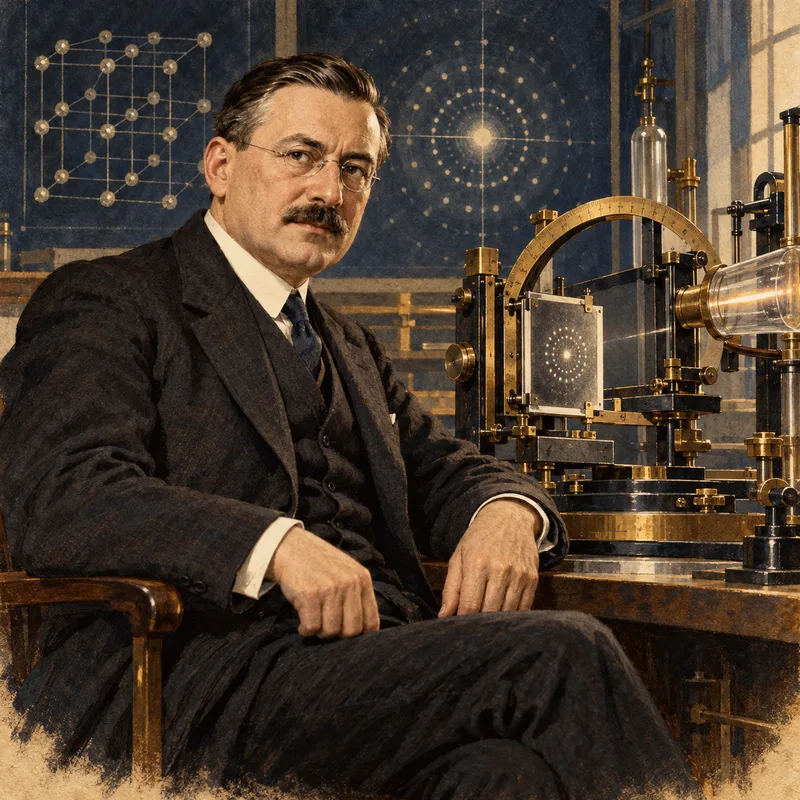
Peter Joseph William Debye (1884-1966) was a Dutch-born physicist and physical chemist who later became an American citizen. His name is attached to the dipole moment unit, the Debye-Hückel theory of electrolytes, the Debye-Scherrer X-ray method and the Debye model of heat capacity. He won the Nobel Prize in Chemistry in 1936. If you study physical chemistry for B.Sc., IIT-JAM, CSIR-NET or GATE, you meet Debye on almost every page, from polarity to conductance.
One-line legacy: he turned molecular polarity and the behaviour of ions in solution into measurable, mathematical science.
Early Life & Family
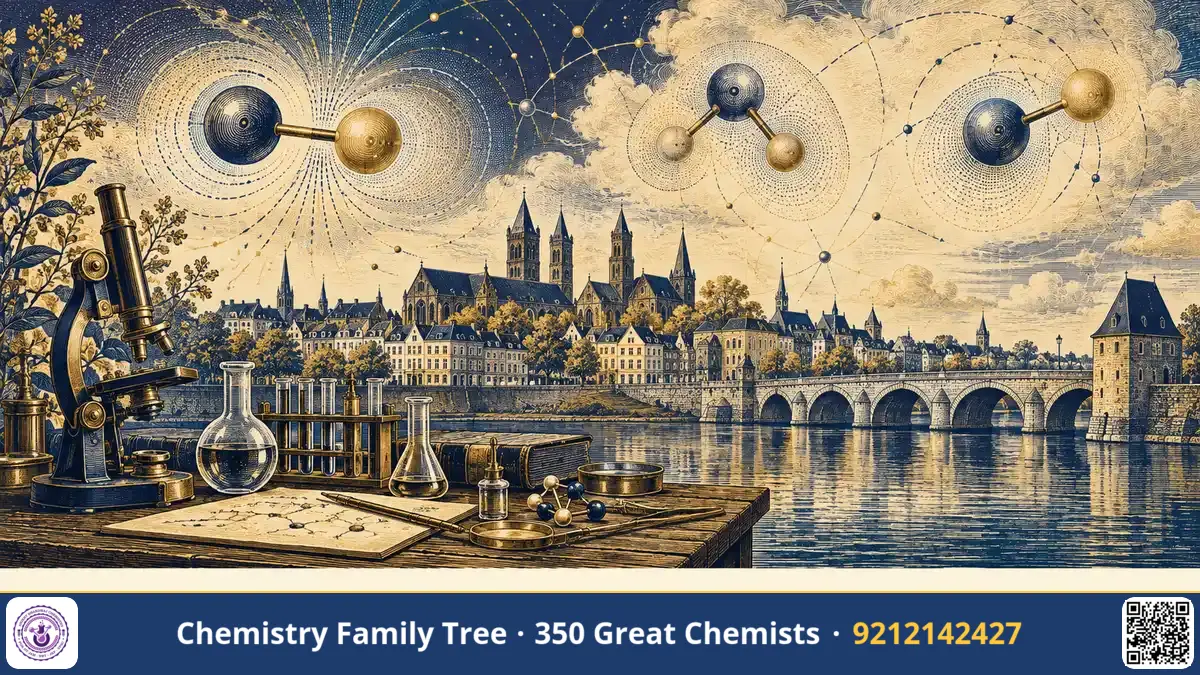
Debye was born on 24 March 1884 in Maastricht, a city in the south of the Netherlands. His name was spelt "Debije" in Dutch, and he later adopted the simpler form "Debye" so that people abroad could pronounce it. He grew up in an ordinary, modest family and showed an early talent for mathematics. He attended school in Maastricht, where he did well in science and mathematics. Rather than studying at a Dutch university, he crossed the border into Germany for technical education, a decision that shaped his whole career.
Education & Mentors
Debye studied electrical engineering at the Technische Hochschule in Aachen. There he came under the influence of the theoretical physicist Arnold Sommerfeld, who recognised his exceptional mathematical ability. When Sommerfeld moved to the University of Munich in 1906, Debye followed him as an assistant. He earned his doctorate at Munich in 1908 and completed his habilitation there in 1910. Sommerfeld's school of theoretical physics, which also trained Pauli, Heisenberg and many others, gave Debye the mathematical tools he used throughout his life. His doctoral work dealt with radiation pressure on a sphere, a physics problem far from chemistry.
Career Timeline
| Year | Event |
|---|---|
| 1884 | Born in Maastricht, the Netherlands |
| 1908 | Doctorate at the University of Munich under Sommerfeld |
| 1911 | Professor of theoretical physics at the University of Zurich (succeeding Einstein) |
| 1912 | Debye model of specific heat of solids; introduces dipole moment ideas; moves to Utrecht |
| 1914 | Professor at Göttingen |
| 1916 | Debye-Scherrer powder diffraction method with Paul Scherrer |
| 1920 | Professor at ETH Zurich |
| 1923 | Debye-Hückel theory of strong electrolytes with Erich Hückel |
| 1927 | Professor at Leipzig |
| 1935-1939 | Director of the Kaiser Wilhelm Institute for Physics, Berlin |
| 1936 | Nobel Prize in Chemistry |
| 1940 | Leaves Germany for the United States; becomes professor at Cornell University |
| 1946 | Becomes a US citizen |
| 1966 | Dies in Ithaca, New York |
Major Scientific Contributions
- Debye model (1912): treats a crystal as a set of elastic waves with a cut-off frequency. It explains why heat capacity of solids falls as T³ near absolute zero, improving on Einstein's model.
- Dipole moment and the Debye equation: links relative permittivity to molecular structure and lets chemists deduce bond angles and shapes.
- Debye-Scherrer method (1916): X-ray diffraction from powders, now routine for phase identification.
- Debye-Hückel theory (1923): the ionic atmosphere and the limiting law log γ± = −A|z₊z₋|√I.
- Light scattering from solutions: a method to find polymer molar masses, important in the post-war polymer industry.
- Debye-Sears effect (1932): diffraction of light by ultrasonic waves in liquids, with F. W. Sears.
For the full chemistry, with equations and exam points, read our companion article on Debye's dipole moment and ionic atmosphere.
Awards, Honours & Nobel Prize
Debye received the Nobel Prize in Chemistry in 1936 "for his contributions to our knowledge of molecular structure through his investigations on dipole moments and on the diffraction of X-rays and electrons in gases." He was awarded the Rumford Medal of the Royal Society (1930), the Lorentz Medal (1935), the Franklin Medal (1937), the Willard Gibbs Award (1949) and the Priestley Medal of the American Chemical Society (1963), among many other honours. Several honorary doctorates from universities across Europe and America also followed.
Personality, Struggles & Lesser-Known Facts
- Engineer by training. He began as an electrical engineering student and became a theorist; this practical background helped him think in terms of physical models rather than only abstract mathematics.
- A job at Einstein's old post. In 1911 he took the chair of theoretical physics at Zurich that Einstein had vacated.
- Trusted collaborators. His co-workers Paul Scherrer, Erich Hückel and Lars Onsager all became famous names in their own right. Onsager, as a young engineer from Norway, famously pointed out an error in the Debye-Hückel treatment of conductance in 1926 and fixed it, and Debye hired him in Zurich.
- Wartime controversy. As director of the Kaiser Wilhelm Institute for Physics in Berlin in the 1930s, his conduct under the Nazi regime has been discussed and criticised by historians, and debate about it continued long after his death. He left Germany in early 1940 on a lecture visit to the United States and did not return.
- Name change. The Dutch spelling "Debije" became "Debye" in his scientific publications, which is why you see the shorter form in textbooks.
Legacy & Influence on Modern Chemistry
Debye's ideas are built into everyday chemistry. Every time you compute an activity coefficient, judge whether a molecule is polar, or index an XRD pattern, you use his work. The Debye length is central to colloid science and to the physics of plasmas and semiconductors. At Cornell he headed the Department of Chemistry from 1940 to 1950 and helped build it into a leading centre of physical chemistry. The Debye unit of dipole moment remains in use all over the world, even though it is not an SI unit.
Lessons for Students
- Learn the maths. Debye's results came from solving equations, not only from experiments.
- Cross subject boundaries. He moved freely between physics, chemistry and engineering.
- Work with good people. Many of his best ideas came from collaboration.
- Be ready to be corrected. Accepting Onsager's improvement made the theory better.
Quick Facts Box
- Born: 24 March 1884, Maastricht, Netherlands
- Died: 2 November 1966, Ithaca, New York, USA
- Nationality: Dutch; became a US citizen in 1946
- Field: Physical chemistry and theoretical physics
- Famous for: Dipole moment, Debye-Hückel theory, Debye-Scherrer method, Debye model
- Nobel: Chemistry, 1936
FAQ
Was Peter Debye a chemist or a physicist?
Both. He was trained as an engineer and theoretical physicist but won the Nobel Prize in Chemistry for work on molecular structure.
What is the unit named after Debye?
The debye (D), a unit of electric dipole moment equal to 3.336 × 10⁻³⁰ C·m.
Who was Erich Hückel?
A German physicist and chemist who worked with Debye in Zurich on strong electrolyte theory. He is also known for Hückel molecular orbital theory and the 4n+2 rule for aromaticity.
Where did Debye spend his last years?
At Cornell University in Ithaca, New York, where he remained until his death in 1966.
Published by ABC Chemistry — IIT-JAM | CSIR-NET | GATE Chemistry Coaching. Visit abcchemistry.com
About the chemist
Peter Debye
1884-1966 · Netherlands · Nobel Chemistry 1936
Molecular dipole moments; X-ray diffraction