The discovery, explained · Chemist no. 166 of 350
Fullerenes: How Robert Curl Helped Discover the C60 Buckyball
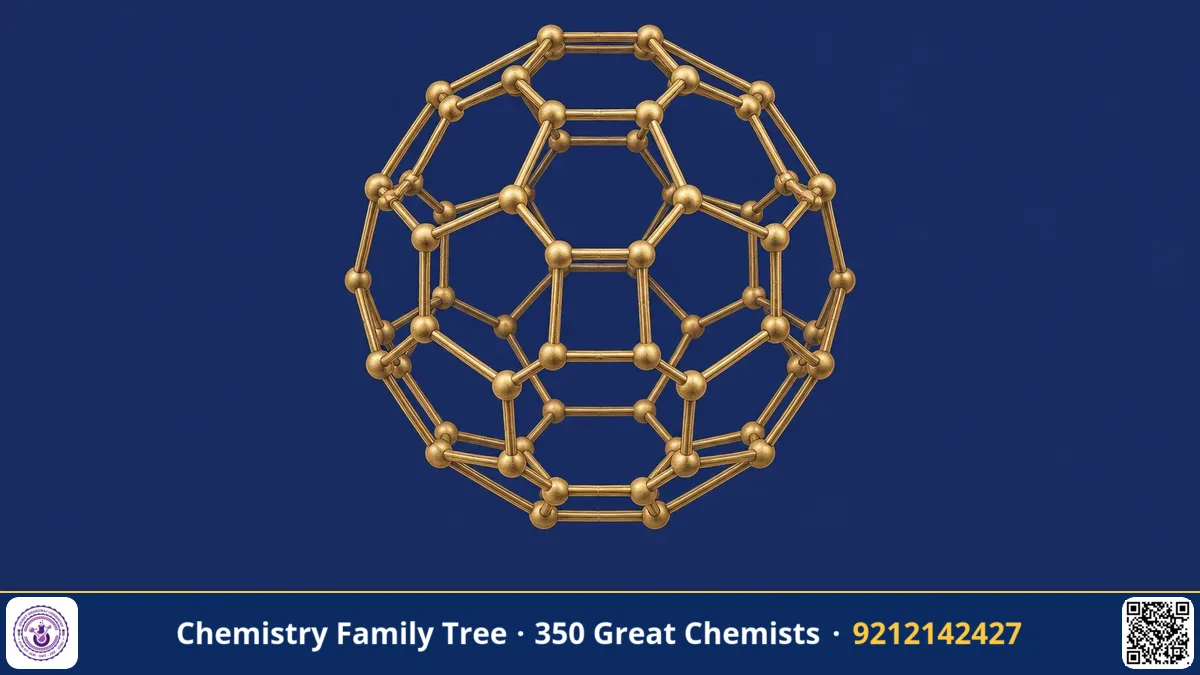
In September 1985, a group of chemists at Rice University in Houston, Texas, vaporised a piece of graphite with a laser and found a molecule that nobody had expected: a hollow cage of exactly sixty carbon atoms. The molecule was named buckminsterfullerene, or C60, and it looked like a tiny football. Robert Curl, together with Harold Kroto and Richard Smalley, received the 1996 Nobel Prize in Chemistry for this discovery. Before 1985, students were taught that carbon has only two well-known crystalline forms, diamond and graphite. After 1985, a whole new family of carbon molecules, the fullerenes, opened the way to carbon nanotubes, graphene research and nanotechnology. This post explains the problem, the experiment, the chemistry and the exam points.
The Scientific Problem Before the Discovery
Carbon is special because it can form long chains and rings. Chemists knew two main allotropes: diamond, where every carbon is sp3 hybridised and bonded to four neighbours, and graphite, where every carbon is sp2 hybridised and arranged in flat hexagonal sheets. Amorphous forms such as soot and charcoal were considered disordered mixtures of these units.
A different question came from astronomy. Radio astronomers had detected long carbon-chain molecules in interstellar space, such as HC5N and HC7N. Harold Kroto, a spectroscopist at the University of Sussex, wanted to know how such chains form around old carbon-rich red giant stars. Robert Curl was a specialist in microwave and infrared spectroscopy of small molecules, and Richard Smalley at Rice had built a laser-supersonic cluster beam machine that could make clusters of almost any element. Together, their skills could test whether long carbon chains could be made in the laboratory.
The Discovery: Experiment Step by Step
Kroto visited Rice in the first week of September 1985, and the experiments were run over about eleven days. The apparatus worked like this:
- A pulsed laser beam hit a rotating disc of graphite, vaporising carbon atoms from the surface.
- A burst of helium gas swept the hot carbon vapour through a narrow nozzle. In the helium, carbon atoms collided and joined to form clusters.
- The gas expanded into a vacuum, cooled strongly and formed a supersonic molecular beam.
- The clusters were ionised by another laser and sent to a time-of-flight mass spectrometer, which separates ions by their mass-to-charge ratio.
The mass spectrum showed clusters with many different numbers of carbon atoms. Clusters with an even number of atoms were common, but two peaks stood out very strongly: one at mass 720 and a smaller one at mass 840. Since the mass of one carbon atom is 12, these correspond to:
60 × 12 = 720   →  C60
70 × 12 = 840   →  C70
When the team changed the helium pressure and the conditions in the cluster chamber, the C60 peak could be made to dominate the whole spectrum. A molecule with such special stability had to have a special structure. The group had to propose a structure with no dangling bonds, because dangling bonds would make a cluster reactive. The answer was a closed, hollow cage.
The team recalled the geodesic domes designed by the architect Richard Buckminster Fuller. They worked with paper and models to find a structure with sixty vertices, and found the truncated icosahedron: the shape of a modern football. The molecule was therefore named buckminsterfullerene, and the family was called fullerenes. The results were published in the journal Nature in November 1985 by Kroto, Heath, O'Brien, Curl and Smalley. Curl's role included the spectroscopic thinking and the interpretation of the results, and he was one of the key people who brought Kroto and Smalley together.
The Chemistry Behind It
Structure of C60
C60 has 60 vertices (carbon atoms), 90 edges and 32 faces. Of the faces, 12 are pentagons and 20 are hexagons. This follows Euler's formula for polyhedra:
V − E + F = 2
60 − 90 + 32 = 2
Each carbon is bonded to three others, so it is roughly sp2 hybridised. However, the sheet is curved, so the hybridisation is slightly pyramidal and has a little sp3 character. Every pentagon is surrounded by five hexagons, and no two pentagons touch each other. This is called the isolated pentagon rule, and it explains why C60 is more stable than other cages of similar size. Two pentagons next to each other would add strain.
There are two types of C–C bonds. The bonds at the fusion of two hexagons (6:6 bonds) are shorter, about 1.38 Å, and have more double-bond character. The bonds between a hexagon and a pentagon (6:5 bonds) are longer, about 1.45 Å. So C60 behaves less like a fully aromatic molecule and more like an electron-poor alkene system. It has icosahedral symmetry, point group Ih, which is the highest symmetry of any molecule and a favourite topic in group theory questions.
Reactions
Because C60 is electron-poor, it easily accepts electrons. It can take up to six electrons in solution. Alkali-metal-doped compounds such as K3C60 become superconductors at about 18 K. C60 also undergoes addition reactions at the 6:6 double bonds, for example hydrogenation, halogenation and Diels–Alder reactions. A well-known derivative is the soluble compound PCBM, used in organic solar cells.
Bulk production
In 1990, Wolfgang Krätschmer and Donald Huffman produced gram quantities of C60 by striking an electric arc between graphite rods in a helium atmosphere. The soot was extracted with benzene or toluene to give a red-brown solution of C60 and C70, which were then separated by chromatography. This made fullerene chemistry possible in ordinary laboratories.
Applications Today
- Materials science: Fullerene derivatives are used as electron acceptors in organic photovoltaic research.
- Nanotechnology: The discovery of fullerenes led directly to interest in carbon nanotubes (reported by Sumio Iijima in 1991) and later to graphene.
- Medicine research: Functionalised fullerenes are studied as antioxidants, as carriers for drug delivery and as contrast agents.
- Lubricants and composites: Fullerene-based additives are tested to improve the properties of polymers and coatings.
- India context: Indian research groups in IITs and CSIR laboratories work on fullerene and carbon nanomaterials, and these topics appear regularly in M.Sc. nanochemistry syllabi.
Exam Corner
- C60 has 12 pentagons and 20 hexagons; total faces 32, edges 90, vertices 60. Be ready to verify Euler's formula.
- The point group of C60 is Ih. Remember it has 120 symmetry operations.
- Fullerenes are the third crystalline allotrope of carbon after diamond and graphite; C60 is soluble in benzene and toluene, but diamond and graphite are not.
- The Nobel Prize in Chemistry 1996 was shared by Curl, Kroto and Smalley. A frequent question asks which three scientists won it.
- Doped K3C60 is a superconductor. C60 itself is an insulator or semiconductor, and it is not a conductor of electricity in the pure state.
Common Misconceptions
- "C60 is fully aromatic like benzene." It is not. The curvature and the pentagons reduce delocalisation, so the 6:6 bonds behave more like localised double bonds.
- "The ball is named after a football player." The name honours the architect Buckminster Fuller, whose geodesic domes have a similar structure. The nickname "buckyball" came later.
- "Fullerenes were first found in a laboratory." Fullerenes were later detected in natural soot and in some mineral samples, and astronomers have also reported them in space. The 1985 work was the first clear identification, not the first appearance in nature.
Quick Revision Box
- Discovered in September 1985 at Rice University by Kroto, Heath, O'Brien, Curl and Smalley.
- Method: laser vaporisation of graphite in helium, followed by time-of-flight mass spectrometry.
- C60: truncated icosahedron, 60 vertices, 90 edges, 12 pentagons, 20 hexagons.
- Isolated pentagon rule gives stability; point group Ih.
- Bulk synthesis by Krätschmer and Huffman in 1990 using an arc between graphite rods.
- Nobel Prize in Chemistry 1996: Curl, Kroto, Smalley.
FAQ
Which part did Robert Curl play in the discovery?
Curl was an expert spectroscopist at Rice. He helped arrange the collaboration between Kroto and Smalley and took part in the experiments and in interpreting the results. All five authors of the 1985 paper contributed, but only Curl, Kroto and Smalley shared the Nobel Prize.
Why is C60 so stable?
Every carbon atom is bonded in a closed cage with no dangling bonds, the pentagons are isolated from each other, and the strain is spread evenly across the sphere. This makes C60 the dominant peak in the mass spectrum.
Is C60 harder than diamond?
No. Individual C60 molecules are held together in the solid by weak van der Waals forces, so crystalline C60 is soft. Diamond has a network of strong covalent bonds.
Is fullerene a topic for IIT-JAM and GATE?
Yes. Questions on allotropes of carbon, counting faces and edges, hybridisation, symmetry and the Nobel Prize appear in inorganic chemistry sections of JAM, CSIR-NET and GATE.
Published by ABC Chemistry — IIT-JAM | CSIR-NET | GATE Chemistry Coaching. Visit abcchemistry.com
About the chemist
Robert Curl
1933-2022 · United States · Nobel Chemistry 1996
Co-discovery of fullerenes