The discovery, explained · Chemist no. 307 of 350
Robert Parr and Density Functional Theory: Chemistry from the Electron Density
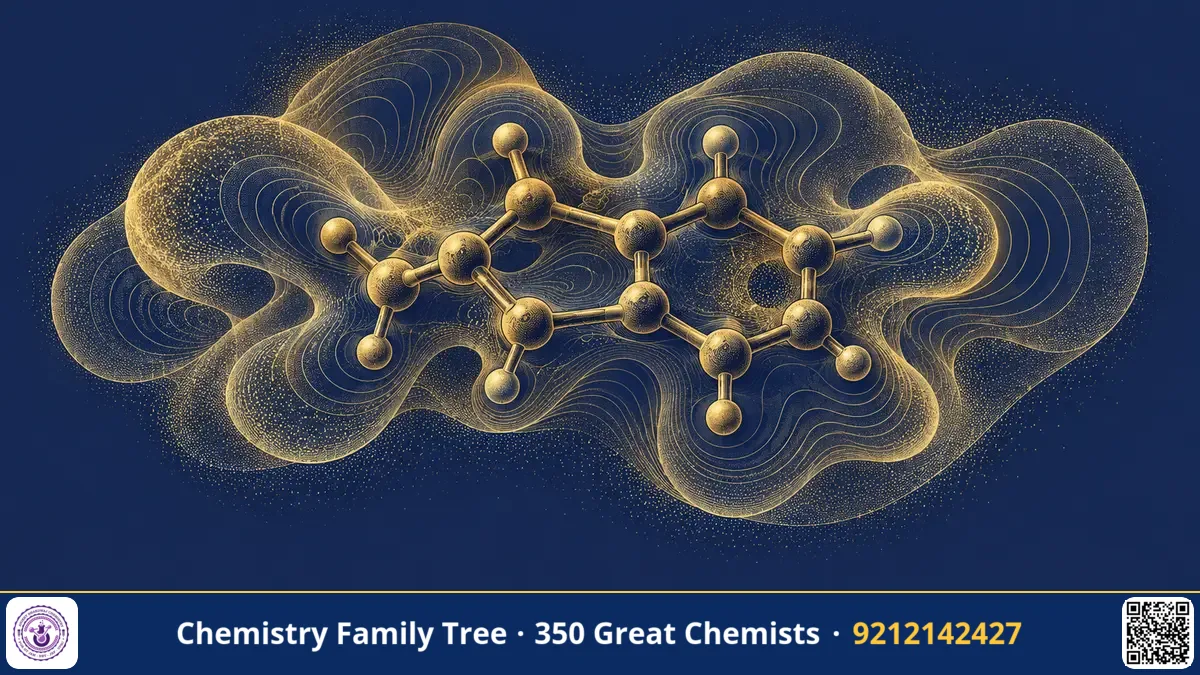
If you ask a modern computational chemist how they calculate the structure of a drug molecule, a catalyst or a battery material, the answer will probably be "DFT". Density functional theory has become the most widely used method in quantum chemistry. Robert G. Parr, an American theoretical chemist, was a leading figure in bringing DFT to chemistry. In 1988 he co-authored the LYP correlation functional (Lee, Yang and Parr), and with his co-workers he developed the chemical concepts of electronegativity as a chemical potential and hardness that can be derived from DFT. His 1989 book "Density-Functional Theory of Atoms and Molecules", with Weitao Yang, is still a standard reference.
The Scientific Problem Before the Discovery
Solving the Schrödinger equation for a molecule with N electrons requires a wavefunction Ψ(r₁, r₂ … rN) that depends on 3N coordinates (ignoring spin). A molecule with 100 electrons needs a function of 300 variables. Hartree–Fock theory reduces the difficulty but misses electron correlation, and the methods that include correlation (configuration interaction, coupled cluster) scale steeply with system size, often as N⁵ to N⁷.
Another difficulty was conceptual. Chemists use ideas such as electronegativity, hardness and softness, which have no obvious place in wavefunction theory. These ideas worked well in practice but did not have a rigorous quantum-mechanical definition. The question arose: could a much simpler quantity, such as the electron density ρ(r), which depends on only three spatial coordinates, contain all the information?
The Discovery: Step by Step
Step 1: The Hohenberg–Kohn theorems (1964)
Pierre Hohenberg and Walter Kohn proved two key results:
- The ground-state electron density ρ(r) uniquely determines the external potential (and hence all properties) of the system. In other words, energy is a functional of density: E = E[ρ].
- A variational principle holds: the true ground-state density minimises E[ρ].
Step 2: The Kohn–Sham equations (1965)
Kohn and Lu Sham introduced a clever practical scheme. They imagined a fictitious system of non-interacting electrons that has the same density as the real system. The energy is written as:
E[ρ] = T_s[ρ] + ∫ v(r)ρ(r)dr + J[ρ] + E_xc[ρ]
Here T_s is the kinetic energy of the non-interacting electrons, the second term is the attraction to the nuclei, J is the classical Coulomb repulsion of the density with itself, and E_xc is the exchange-correlation energy, which contains everything not otherwise included. The orbitals are found by solving one-electron equations self-consistently, as in Hartree–Fock, but with an effective potential that includes v_xc = δE_xc/δρ. If E_xc were known exactly, DFT would give the exact answer. In practice it must be approximated.
Step 3: Parr's contribution — functionals and concepts
Parr worked on both fronts.
- Better functionals. In 1988, Chengteh Lee, Weitao Yang and Parr published a correlation functional derived from a formula by Colle and Salvetti. Combined with Becke's exchange functional, it gives BLYP, and in the hybrid form with some exact exchange, B3LYP, which was for many years the most commonly used functional in chemistry.
- Chemical potential and electronegativity. Parr and co-workers (Donnelly, Levy and Palke, 1978) showed that the Lagrange multiplier in DFT is the chemical potential μ = (∂E/∂N)ᵥ, and that μ = −χ, where χ is the electronegativity. This gives a firm basis to Mulliken's idea χ = (I + A)/2, and explains electronegativity equalisation: when atoms form a molecule, electrons flow until the chemical potential is the same everywhere.
- Hardness and softness. With Ralph Pearson (1983), he defined η = ½(∂²E/∂N²) ≈ (I − A)/2 and softness S = 1/(2η). The 1984 work of Parr and Yang on the Fukui function, f(r) = (∂ρ(r)/∂N)ᵥ, tells where on a molecule an electrophile or nucleophile will attack.
- Electrophilicity index. In 1999, Parr, Szentpály and Liu proposed ω = μ²/(2η), a numerical measure of the ability of a species to accept electrons.
The Chemistry Behind It
| Concept | Definition | Meaning |
|---|---|---|
| Chemical potential μ | (∂E/∂N)ᵥ ≈ −(I + A)/2 | Escaping tendency of electrons; equals −χ |
| Hardness η | (I − A)/2 | Resistance to charge transfer |
| Softness S | 1/(2η) | Ease of polarisation |
| Fukui function f(r) | (∂ρ/∂N)ᵥ | Reactive site indicator |
| Electrophilicity ω | μ²/(2η) | Electron-accepting power |
The levels of approximation for E_xc are often drawn as "Jacob's ladder": local density approximation (LDA), generalised gradient approximation (GGA, such as BLYP, PBE), meta-GGA, hybrid functionals (B3LYP, PBE0) and so on. Each rung adds more physical information but also more cost. DFT scales roughly as N³ to N⁴, much cheaper than coupled cluster. This is why molecules with hundreds of atoms can be studied.
Limitations are also important. Standard functionals fail for dispersion (van der Waals) forces, charge-transfer excitations and strongly correlated systems. Empirical dispersion corrections such as Grimme's D3 are commonly added.
Applications Today
- Drug discovery: Calculating binding energies and reactivity of drug candidates.
- Catalysis: Mechanisms on metal surfaces, for example the Haber–Bosch process and hydrogen evolution catalysts.
- Batteries and solar materials: Predicting lithium-ion battery cathodes, perovskite band gaps and photovoltaic materials, fields of strong interest in India's energy research.
- Spectroscopy: Predicting IR, NMR and UV spectra to support experiments.
- Reactivity prediction in teaching: Hardness, softness, Fukui functions and electrophilicity are used to rationalise HSAB and organic reactivity.
Exam Corner: 5 Likely Points
- DFT uses the electron density ρ(r), a function of 3 variables, in place of the many-electron wavefunction.
- Hohenberg–Kohn: ρ₀ determines everything; E[ρ] is minimised by the true density.
- Kohn–Sham: non-interacting reference system; E_xc is the unknown part.
- Electronegativity χ = −μ = (I + A)/2; hardness η = (I − A)/2; softness S = 1/(2η).
- B3LYP is a hybrid functional: Becke exchange mixed with Hartree–Fock exchange, plus LYP correlation.
Common Misconceptions
- "DFT is exact." It is exact in principle, but E_xc is unknown, so practical DFT is approximate.
- "DFT is an ab initio method just like Hartree–Fock." It is first-principles, but results depend on the chosen functional, which is often partly empirical.
- "Kohn–Sham orbitals are real orbitals." They are mathematical constructs to produce the correct density, though they are often useful for interpretation.
Quick Revision Box
- Hohenberg–Kohn (1964) and Kohn–Sham (1965) are the foundation of DFT.
- Lee–Yang–Parr (1988) correlation functional gives BLYP and B3LYP.
- μ = (∂E/∂N)ᵥ = −χ; η = ½(∂²E/∂N²)ᵥ ≈ (I − A)/2.
- Fukui function f(r) = (∂ρ/∂N)ᵥ predicts reactive sites.
- Electrophilicity ω = μ²/(2η).
- Walter Kohn shared the 1998 Nobel Prize in Chemistry for DFT.
FAQ
What is a functional?
A functional is a function of a function. The energy depends on the whole electron density function ρ(r), not just on a number.
Why is DFT popular in chemistry?
It gives reasonable accuracy for molecules at a much lower cost than wavefunction methods that include correlation.
What does LYP stand for?
Lee, Yang and Parr, the authors of the 1988 correlation functional.
Did Robert Parr win a Nobel Prize?
No. Walter Kohn received the 1998 Nobel Prize in Chemistry for DFT, shared with John Pople, but Parr's work was central in applying DFT to chemistry.
Published by ABC Chemistry — IIT-JAM | CSIR-NET | GATE Chemistry Coaching. Visit abcchemistry.com

About the chemist
Robert Parr
1921-2017 · United States
Density functional theory of atoms and molecules