Biography · Chemist no. 69 of 350
Rosalind Franklin: The Brilliant Experimentalist Behind Photo 51
Rosalind Elsie Franklin (1920-1958) was a British physical chemist and X-ray crystallographer whose precise experiments were central to the discovery of the structure of DNA. She also made major contributions to the chemistry of coal and carbon and to the structure of viruses. She died of ovarian cancer at only 37 years of age. Her legacy in one line: she showed that careful, honest measurement can reveal the shape of life.
Early Life and Family
Rosalind Franklin was born on 25 July 1920 in Notting Hill, London, into a prosperous and well-respected Jewish family known for banking and public service. Her father, Ellis Franklin, was a merchant banker who also taught at a working men's college, and her mother was Muriel Waley. The family was educated and charitable, and during the 1930s they helped refugee children arriving from Europe. From her early school years Rosalind was exceptionally good at mathematics and science. Her father was reluctant about a daughter becoming a scientist, but she was determined and had a clear sense of her goal.
Education and Mentors
She studied at St Paul's Girls' School in London, which had strong science teaching, and in 1938 went to Newnham College, Cambridge, to read natural sciences, specialising in chemistry. She completed her studies in 1941 and then began research under R. G. W. Norrish. After a disagreement she moved to the British Coal Utilisation Research Association, where she studied the structure of coal, and she earned her PhD from Cambridge in 1945 for her study of the porosity of coal. In 1947 she moved to Paris and worked with Jacques Mering at the Laboratoire central des services chimiques de l'État, where she learned advanced X-ray diffraction methods. She loved her time in Paris and spoke French fluently.
Career Timeline
| Year | Event |
|---|---|
| 1920 | Born in London |
| 1938 | Enters Newnham College, Cambridge |
| 1942 | Joins British Coal Utilisation Research Association |
| 1945 | Receives PhD from Cambridge |
| 1947 | Works in Paris on carbon structure |
| 1951 | Joins King's College London to work on DNA |
| 1952 | Takes Photo 51 of B-DNA |
| 1953 | Moves to Birkbeck College; DNA papers appear in Nature |
| 1955 | Publishes the structure of tobacco mosaic virus |
| 1958 | Dies in London on 16 April |
Major Scientific Contributions
Franklin's first major work was on carbon. She showed that carbons fall into two groups, graphitising and non-graphitising, depending on how easily they rearrange into the layered structure of graphite when heated. At King's College she produced the clearest X-ray photographs of DNA, discovered the A and B forms, and concluded that the phosphate backbone is on the outside. At Birkbeck, in the laboratory of J. D. Bernal, she studied tobacco mosaic virus and showed that the RNA is embedded in the protein coat and that the rod is hollow. She also started work on polio virus. For the chemistry behind these results, see our discovery post.
Awards, Honours and Nobel Prize
Franklin received few honours during her lifetime. She did not win a Nobel Prize, and she could not have received the 1962 prize for DNA because she had died four years earlier. Nobel Prizes are not awarded posthumously. Recognition came later:
- Many institutions have named buildings, scholarships and awards for her, including Franklin-Wilkins Building at King's College London.
- The Royal Society named a prize in her honour, the Rosalind Franklin Award, for excellence in science, technology, engineering or mathematics.
- The European Space Agency named its Mars rover "Rosalind Franklin".
Personality, Struggles and Lesser-Known Facts
- Direct and exacting: She was known for high standards and straightforward speech. These traits sometimes caused friction at King's, where roles between her and Maurice Wilkins were unclear.
- Misunderstanding about her role: She had been told she would lead the DNA project, while Wilkins thought she was his assistant. This confusion led to tension.
- Photo 51 shared without her knowledge: Wilkins showed Photo 51 to Watson in early 1953, and the group also saw a King's College report with her data. Franklin did not know at the time.
- Love of outdoors: She loved hiking in mountains and travelling in Europe, and she was a skilled cook and a lively friend.
- Illness: She was diagnosed with ovarian cancer in 1956 and worked on through surgery and chemotherapy, publishing and leading her group until shortly before she died.
- Continuing support: Her student Aaron Klug carried on the virus work and received the Nobel Prize in Chemistry in 1982.
Legacy and Influence on Modern Chemistry
The story of Rosalind Franklin has become a reminder of how women scientists were treated in the twentieth century, but it is also a story of excellent science. Her photographs gave the quantitative data that decided the DNA structure, and her carbon work remains textbook material. Structural virology, which is used in the design of vaccines, grew from her TMV studies. She is now widely celebrated as an icon of scientific rigour, and universities around the world encourage young women to study chemistry and physics in her name.
Lessons for Students
- Good data is the foundation of good theory; do experiments carefully and report honestly.
- Be clear about roles and credit when you collaborate.
- Courage and determination matter, especially when you work in an environment that does not give you full support.
- Keep working on what you love, even in difficult times.
Quick Facts Box
- Born: 25 July 1920, London, England
- Died: 16 April 1958, London, England
- Nationality: British
- Field: Physical chemistry, X-ray crystallography
- Famous for: Photo 51 of DNA; carbon and virus structure
- Nobel: None (died before the 1962 prize)
FAQ
What is Photo 51?
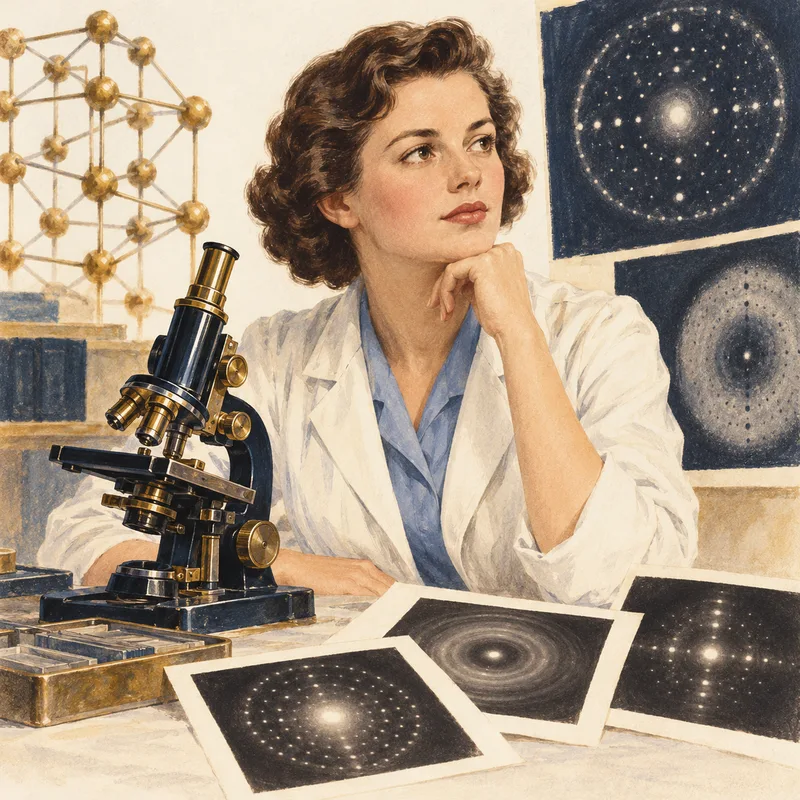
It is an X-ray diffraction image of B-form DNA, taken in 1952 by Franklin and her student Raymond Gosling. Its X-shaped pattern indicates a helix.
Where did Franklin study?
She studied at Newnham College, Cambridge, worked in Paris, and later held research posts at King's College London and Birkbeck College.
What else did she study besides DNA?
Coal and carbon structure, tobacco mosaic virus and polio virus.
Why did she not receive a Nobel Prize?
She died in 1958, and the 1962 Nobel Prize for the structure of DNA went to the three living scientists. The Nobel Prize is not awarded after death.
Published by ABC Chemistry — IIT-JAM | CSIR-NET | GATE Chemistry Coaching. Visit abcchemistry.com
About the chemist
Rosalind Franklin
1920-1958 · United Kingdom
X-ray diffraction of DNA (Photo 51)