The discovery, explained · Chemist no. 292 of 350
Neighbouring Group Participation: Saul Winstein and the Hidden Helpers in Reactions
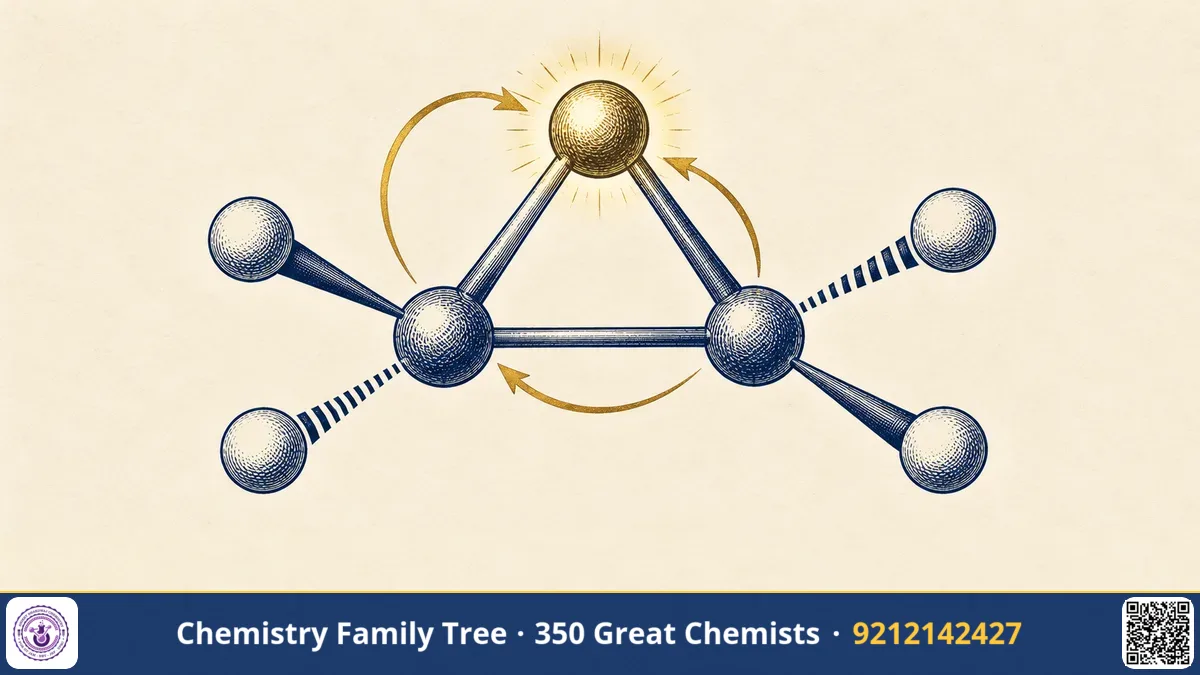
Some reactions refuse to follow the simple SN1 or SN2 script. A substitution that should invert a stereocentre gives retention instead; a reaction runs thousands of times faster than expected. The American chemist Saul Winstein (1912-1969) explained many such puzzles with one powerful idea: a nearby group within the same molecule can reach out, push out the leaving group and temporarily bond to the reacting carbon. He called this anchimeric assistance, today better known as neighbouring group participation (NGP). Along with his work on ion pairs, solvent effects and non-classical carbocations, this idea reshaped how chemists think about reaction mechanisms.
The Scientific Problem Before the Discovery
In the 1930s the mechanisms of nucleophilic substitution had been laid out by Hughes and Ingold: SN2 gives inversion, SN1 gives racemisation (more or less). These rules explained many reactions, but not all. Some observations did not fit:
- Certain substitutions gave retention of configuration, even though a direct SN2 attack would give inversion.
- Some substrates reacted much faster than similar molecules without a neighbouring heteroatom or π bond.
- Products were sometimes rearranged skeletons that classical ions could not easily explain.
Without a new concept, chemists could only list these as exceptions.
The Discovery: Step-by-Step Logic
Winstein was trained at Caltech and became a professor at UCLA, where he developed a research group that studied solvolysis reactions (substitution where the solvent is the nucleophile) with great care. He studied the acetolysis (reaction in acetic acid) of trans-2-acetoxycyclohexyl brosylate and compared it with the cis isomer. The trans isomer reacted much faster and gave the trans diacetate with retention of configuration.
His explanation had three steps:
- First inversion (intramolecular): The carbonyl oxygen of the neighbouring acetoxy group attacks the carbon bearing the leaving group from the back side, displacing the brosylate and forming a cyclic acetoxonium (dioxolanium) ion.
- Second inversion (intermolecular): The external nucleophile (acetic acid or acetate) opens this ring at the carbon that originally held the leaving group, again from the back side.
- Net result: Two inversions give an overall retention of configuration.
In a simple scheme:
R-X (with neighbouring Z:)  →  [cyclic Z+ bridged ion]  +  X⁻
[cyclic ion]  +  Nu⁻  →  R-Nu   (net retention)
A well-known textbook example is the reaction of threo-3-bromo-2-butanol with HBr, which gives retention. The neighbouring -OH (after protonation and loss of water) is replaced via a cyclic bromonium ion, and the stereochemistry is preserved by double inversion.
The Chemistry Behind It
Good neighbouring groups have lone pairs or π electrons: -OCOR, -OR, -SR, -NR₂, -Br, -I, -Cl (weaker), -COO⁻, and phenyl or C=C groups. Sulfur is a particularly strong participant, as in mustard gas (ClCH₂CH₂)₂S, whose toxicity arises from an episulfonium ion formed by internal displacement.
Rate effects. Participation lowers the free energy of the transition state, since the neighbour begins to bond before the leaving group is fully gone. This is an intramolecular process with a favourable entropy, so the rate rises sharply, especially for formation of three-, five- and six-membered rings.
Stereochemical signature. Retention of configuration, together with a rate faster than the model compound, is the classical sign that NGP is operating.
Ion pairs and solvent effects
Winstein also proposed that solvolysis passes through a series of ion-pair stages: a tight (intimate) ion pair, a solvent-separated ion pair, and finally free ions. This explained the "special salt effect" and why partial racemisation or return of the leaving group is often seen. With Ernest Grunwald he developed the Grunwald-Winstein equation:
log (k / k₀) = m Y
Here Y measures the ionising power of the solvent (defined using tert-butyl chloride, with Y = 0 for 80% ethanol) and m measures the sensitivity of the substrate. An m close to 1 suggests an SN1-like transition state.
Non-classical ions and homoaromaticity
Winstein championed the idea of non-classical carbocations, such as the 2-norbornyl cation, in which a σ bond helps delocalise positive charge over three carbons. He pointed to the faster solvolysis of exo-2-norbornyl brosylate compared with the endo isomer, and to the exo-rich product. This idea led to a famous and long debate with H. C. Brown, who preferred rapidly equilibrating classical ions. Later spectroscopic studies by George Olah and crystal evidence in recent decades support a bridged, non-classical structure. Winstein also introduced the concept of homoaromaticity, where cyclic conjugation is interrupted by a single sp³ centre, as in the homotropylium cation.
Applications Today
- Synthesis planning: Chemists use neighbouring groups (acetate, benzoate and other acyl groups) on sugar C-2 to direct glycosylation to give 1,2-trans glycosides. This is essential in carbohydrate chemistry.
- Medicine and toxicology: Nitrogen mustards, used as anticancer drugs such as chlorambucil and cyclophosphamide, alkylate DNA through aziridinium ions formed by NGP.
- Peptide and protein chemistry: Neighbouring carboxylate and amide groups influence hydrolysis rates and enzyme mechanisms.
- Industrial solvent choice: The Grunwald-Winstein approach guides solvent selection in manufacturing.
- Teaching: Retention-of-configuration puzzles are standard stereochemistry questions in Indian university exams.
Exam Corner
- Neighbouring group participation causes retention of configuration through two successive inversions and a rate enhancement (anchimeric assistance).
- Typical participating groups: -OCOCH₃, -SR, -NR₂, -Br, -COO⁻, phenyl. Sulfur mustard works through an episulfonium ion.
- Grunwald-Winstein equation: log(k/k₀) = mY; Y = 0 for 80% ethanol-water; m near 1 for SN1.
- Ion-pair sequence: intimate ion pair, solvent-separated ion pair, free ions.
- 2-Norbornyl cation is the best-known non-classical carbocation; exo isomer solvolyses faster than endo.
Common Misconceptions
- "Retention means SN2 happened with retention." No. It means two inversions occurred, giving a net retention.
- "NGP only needs lone pairs." π bonds (alkenes, aryl rings) and even σ bonds can also participate.
- "A non-classical ion is just a resonance structure." It is a real delocalised structure with a three-centre two-electron bond, not a mixture of rapidly interconverting classical ions.
Quick Revision Box
- NGP = anchimeric assistance: an internal group helps the leaving group depart.
- Signs: faster rate than expected plus retention of configuration.
- Mechanism: internal attack (inversion) then external attack (inversion).
- Grunwald-Winstein: log(k/k₀) = mY, with Y based on t-BuCl in 80% EtOH.
- Winstein ion pairs: intimate, solvent-separated, free ions.
- Also known for non-classical carbocations and homoaromaticity.
FAQ
What does anchimeric assistance mean?
The word comes from Greek roots meaning "neighbouring parts". It describes the rate increase when a group within the same molecule helps displace a leaving group.
Why does NGP give retention of configuration?
The neighbour attacks from the back side (inversion), and the external nucleophile then opens the ring from the back side again (second inversion), so the final configuration matches the original.
What does the m value in the Grunwald-Winstein equation mean?
It measures how sensitive a reaction is to the ionising power of the solvent. Reactions with an SN1-like transition state, such as solvolysis of tert-butyl chloride, have m close to 1.
What is a non-classical carbocation?
It is a carbocation in which the positive charge is shared through a bridging σ bond over three or more atoms, as in the 2-norbornyl cation, so no single classical Lewis structure fully describes it.
Published by ABC Chemistry — IIT-JAM | CSIR-NET | GATE Chemistry Coaching. Visit abcchemistry.com
About the chemist
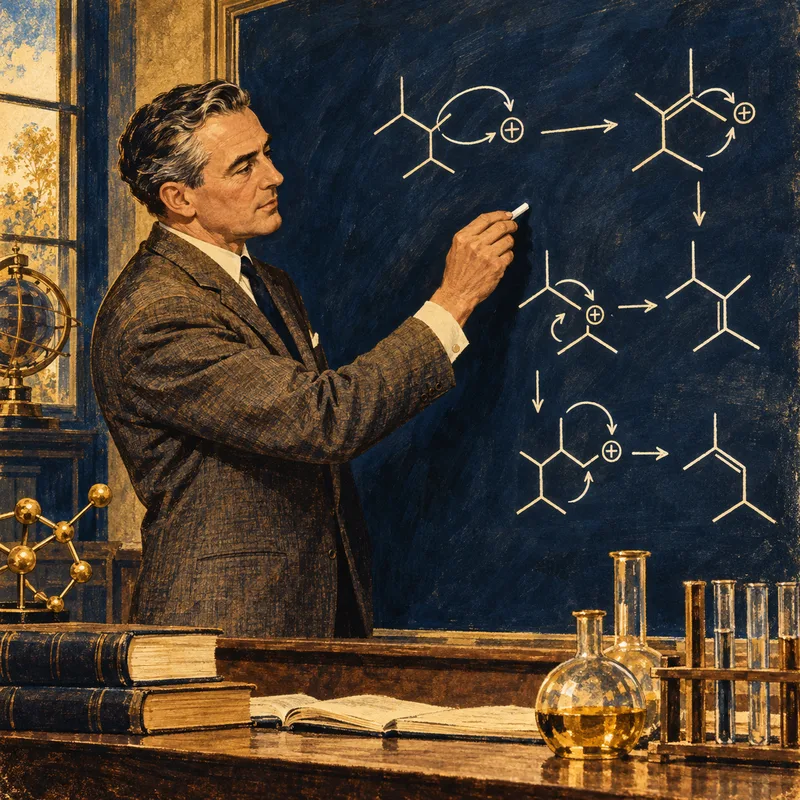
Saul Winstein
1912-1969 · United States
Neighbouring group participation; ion pairs