The discovery, explained · Chemist no. 160 of 350
Sidney Altman and RNase P: When RNA Became an Enzyme
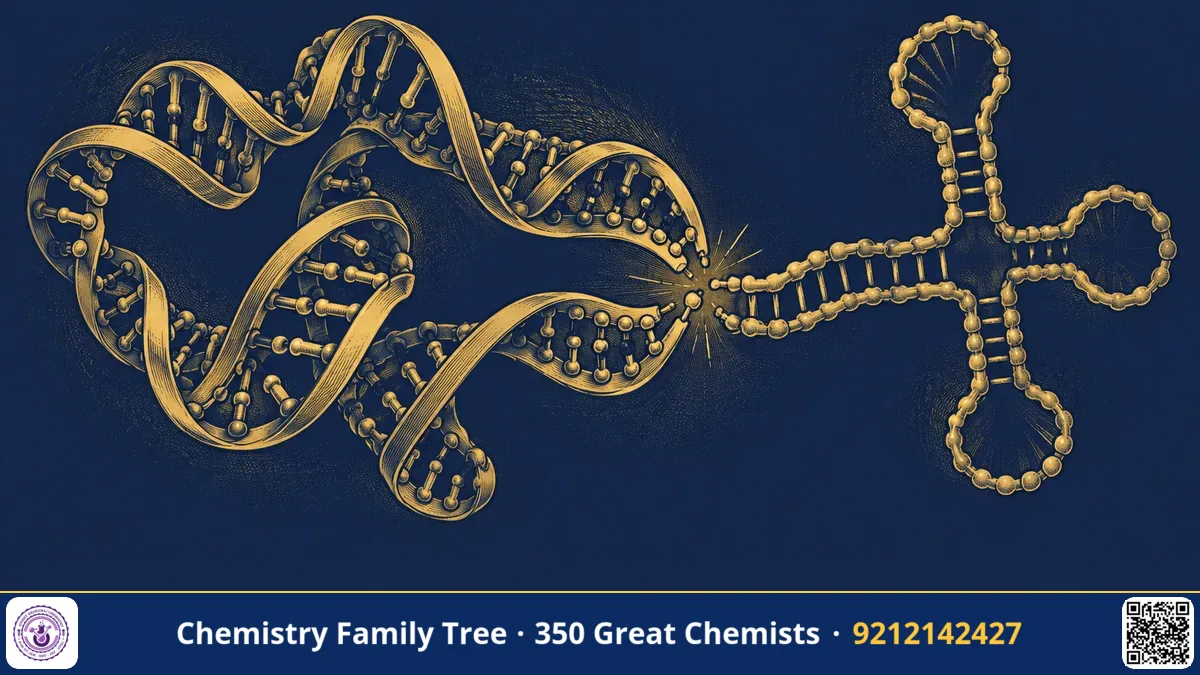
For most of the twentieth century every chemistry and biology textbook stated one rule without exception: enzymes are proteins. Nucleic acids store information; proteins do the chemistry. In the early 1980s two laboratories showed that this rule has exceptions. Sidney Altman, working at Yale with his colleagues, showed that in the enzyme ribonuclease P (RNase P), the RNA part alone can cut its substrate. Thomas Cech reached a similar conclusion independently from a different system. The two shared the 1989 Nobel Prize in Chemistry. The discovery of catalytic RNA, or ribozymes, changed our view of the chemistry of life and supports the idea that early life may have used an "RNA world."
The Scientific Problem Before the Discovery
Cells make transfer RNA (tRNA) molecules as longer precursors. Before a tRNA can work, extra nucleotides at its 5′ end (the "leader") must be removed. In bacteria, an enzyme called RNase P performs this cut. It was known to be a complex of an RNA of about 377 nucleotides (called M1 RNA in Escherichia coli) and a small protein of about 14 kDa (the C5 protein). Researchers had assumed that the protein was the true catalyst and that the RNA was a structural scaffold or a guide that helped to bind the substrate.
Several things made this puzzling. The RNA part was large and essential, since destroying it by ribonuclease stopped the activity. But general belief held that a nucleic acid with only four kinds of bases could not provide the variety of chemical groups needed for catalysis. Altman, who had begun working on tRNA processing in the 1970s, wished to understand which part carries out the cleavage.
The Discovery: Separating the RNA and the Protein
Altman's group, with Cecilia Guerrier-Takada as a key experimenter, in collaboration with Norman Pace's laboratory for the RNA preparations, carried out the decisive experiments. The logic proceeded in clear steps.
- Purify the two components. The M1 RNA and the C5 protein of E. coli RNase P were separated and purified.
- Test each alone under normal conditions. At low magnesium concentration, neither the RNA alone nor the protein alone could cut precursor tRNA. Only the mixture was active. This fits the old idea that the protein was needed.
- Change the ionic conditions. When the concentration of Mg²⁺ was raised (to around 100 mM) and the solution contained suitable monovalent salt, the M1 RNA alone cleaved the precursor tRNA correctly, at the same bond as the whole enzyme.
- Check the controls. The protein alone remained inactive under those conditions, and treatment with ribonuclease destroyed the activity of the RNA. The RNA preparation was proved free of protein contamination.
- Conclude. The RNA is the catalytic component; the protein helps under cell-like conditions by reducing the need for high ion concentration.
The reaction is the hydrolysis of a phosphodiester bond, producing a mature 5′ end with a 5′-phosphate and a leader fragment with a 3′-hydroxyl:
pre-tRNA (5′ leader–tRNA) + H₂O → 5′ leader–3′OH + 5′-phosphate–tRNA
The result was published in 1983. Altman then spent years studying how the RNA folds, how it binds substrate and how magnesium ions take part in the mechanism.
The Chemistry Behind It
The cleavage is a nucleophilic substitution at phosphorus. A hydroxide ion or water molecule, activated by a bound Mg²⁺, attacks the phosphorus atom of the phosphodiester bond, and the 3′-oxygen of the leader leaves. Metal ions help by neutralising negative charge on the phosphate, by positioning the nucleophile and by stabilising the leaving group.
| Feature | Protein enzymes | RNA enzymes (ribozymes) |
|---|---|---|
| Building blocks | 20 amino acids | 4 nucleotides |
| Typical reactions | Many types | Mostly phosphoryl transfer and peptide bond formation |
| Metal ions | Often present as cofactors | Mg²⁺ commonly essential |
| Examples | Trypsin, lipase | RNase P RNA, group I intron, ribosomal RNA |
Since RNA is both a carrier of genetic information and a catalyst, it could, in principle, have supported both heredity and metabolism in early life. This is the basis of the RNA world hypothesis. The ribosome, in which ribosomal RNA performs peptide bond formation, is another striking example.
Applications Today
- Gene regulation research: Engineered ribozymes and RNase P-based "external guide sequences" have been explored for targeting unwanted RNA.
- Understanding the ribosome: Recognition that RNA catalyses peptide bond formation links back to catalytic RNA.
- Origin-of-life chemistry: Laboratories test whether RNA can copy itself.
- RNA therapeutics: Knowledge of RNA structure and catalysis supports the design of RNA-based medicines and diagnostics.
- Teaching: The result is a standard example of how an established idea is overturned by careful controls.
Exam Corner
- The 1989 Nobel Prize in Chemistry was shared by Sidney Altman and Thomas Cech for the catalytic properties of RNA.
- RNase P cuts the 5′ leader of precursor tRNA; its RNA subunit is catalytic in bacteria.
- Ribozyme: an RNA molecule with catalytic activity.
- Mg²⁺ ions are important for ribozyme folding and catalysis.
- RNA world hypothesis: early life used RNA for both information storage and catalysis.
Common Misconceptions
- "All enzymes are RNA." The great majority of enzymes are still proteins; ribozymes are a small but important group.
- "The protein in RNase P is useless." Under cell conditions it improves the reaction and helps the RNA bind its substrate.
- "Altman and Cech studied the same enzyme." They worked on different systems: RNase P and a self-splicing intron.
Quick Revision Box
- RNase P = RNA (M1 RNA, ~377 nucleotides) + protein (C5).
- Function: cuts the 5′ leader from precursor tRNA.
- With high Mg²⁺, M1 RNA alone is catalytic (1983).
- Controls: ribonuclease destroys the activity; protein alone is inactive.
- Nobel Prize in Chemistry 1989: Altman and Cech.
- Supports the RNA world hypothesis.
FAQ
What is a ribozyme?
A ribozyme is an RNA molecule that acts as an enzyme and catalyses a chemical reaction.
Why did people not believe RNA could be a catalyst?
Because RNA has only four bases with limited chemical groups, and enzymes had always been shown to be proteins.
Is Altman's Nobel in Chemistry or Medicine?
Chemistry. Both Altman and Cech received the 1989 Nobel Prize in Chemistry.
Where do I see this in exams?
Biochemistry sections in CSIR-NET and GATE ask about ribozymes, tRNA processing and the role of metal ions.
Published by ABC Chemistry — IIT-JAM | CSIR-NET | GATE Chemistry Coaching. Visit abcchemistry.com

About the chemist
Sidney Altman
1939-2022 · Canada · Nobel Chemistry 1989
Catalytic RNA, RNase P