The discovery, explained · Chemist no. 170 of 350
Walter Kohn and Density Functional Theory: Replacing the Wavefunction with Density
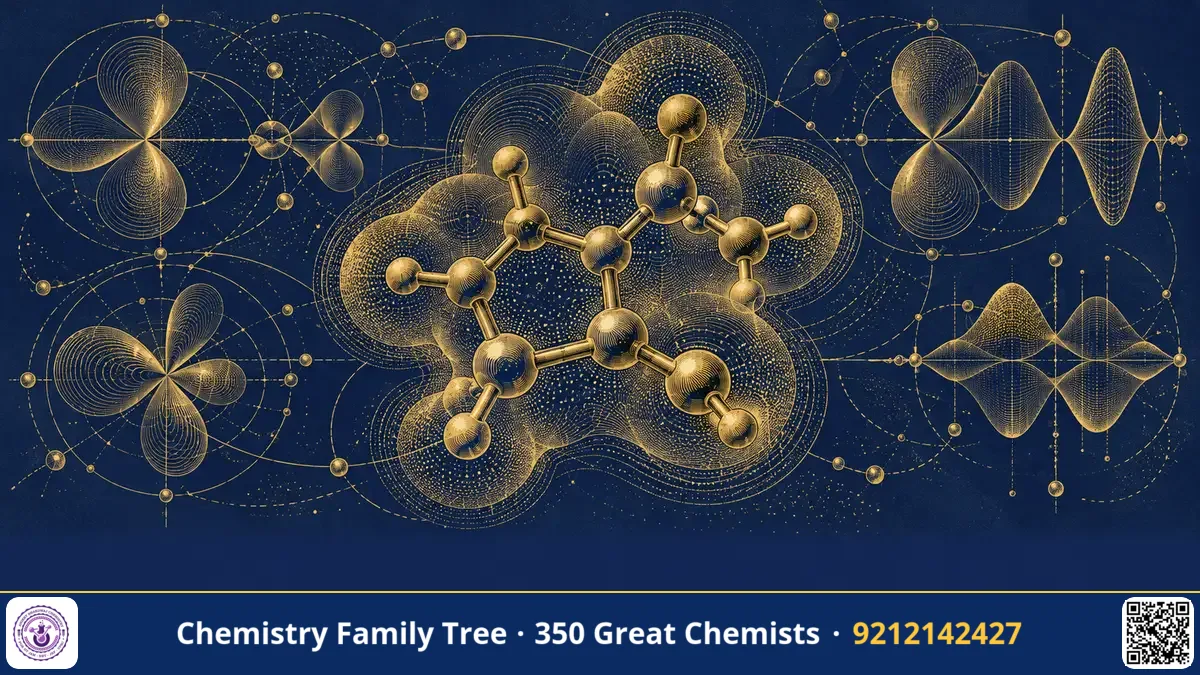
Modern computational chemistry can predict the shapes, energies and reactivities of molecules with a laptop. Behind most of these calculations stands density functional theory (DFT), developed by Walter Kohn and his collaborators in the mid-1960s. Kohn showed that all the properties of a many-electron system in its ground state can, in principle, be obtained from the electron density, a function of only three spatial variables, instead of the many-electron wavefunction, which depends on 3N variables. Kohn received half of the 1998 Nobel Prize in Chemistry for this; the other half went to John Pople for computational methods in quantum chemistry. This is an important topic for GATE, CSIR-NET and JAM physical chemistry.
The Scientific Problem Before the Discovery
The Schrödinger equation describes a molecule exactly, but it can only be solved exactly for the hydrogen atom and a few other simple systems. For N electrons, the wavefunction Ψ(r1, r2, … rN) has 3N spatial coordinates. For a molecule like caffeine with 102 electrons, this means more than 300 variables, which is impossible to handle directly.
Chemists used the Hartree–Fock method, which treats electrons as moving in the average field of others. It is useful, but it neglects electron correlation, the way electrons avoid each other. Methods that include correlation (configuration interaction, coupled cluster, Møller–Plesset perturbation theory) are accurate but become very expensive as the molecule grows. Physicists studying solids used simple approximations such as the Thomas–Fermi model, where energy is a function of the electron density, but this was too crude for chemistry. The big question was: can the density, which is a much simpler quantity, be used as the basic variable in a rigorous way?
The Discovery: Step by Step
In 1964, Pierre Hohenberg and Walter Kohn, then working at the University of California, San Diego, published a short paper titled "Inhomogeneous Electron Gas". In 1965, Kohn and Lu Jeu Sham published a second paper, "Self-Consistent Equations Including Exchange and Correlation Effects". These two papers form the basis of DFT.
The Hohenberg–Kohn theorems
- Theorem 1: The ground-state electron density ρ(r) determines the external potential v(r) (up to a constant), and therefore it determines the Hamiltonian and all properties of the system. In other words, the ground-state energy is a functional of the density: E = E[ρ].
- Theorem 2 (variational principle): The energy functional E[ρ] is minimum for the true ground-state density. Any trial density gives an energy greater than or equal to the true ground-state energy.
These theorems are existence proofs. They say that a universal functional exists, but they do not tell how to write it.
The Kohn–Sham approach
Kohn and Sham introduced a practical method. They imagined a fictitious system of non-interacting electrons that has exactly the same density as the real interacting system. The energy is then written as:
E[ρ] = Ts[ρ] + ∫ v(r) ρ(r) dr + J[ρ] + Exc[ρ]
Here Ts is the kinetic energy of the non-interacting electrons, the second term is the interaction with the nuclei, J[ρ] is the classical Coulomb repulsion of the electron cloud with itself, and Exc is the exchange-correlation energy, which contains everything that is not handled exactly by the other terms. The electrons move in an effective potential and obey one-electron equations, the Kohn–Sham equations:
[ −(ħ²/2m)∇² + veff(r) ] φi(r) = εi φi(r)
ρ(r) = Σ |φi(r)|²
Since veff depends on ρ, which depends on the orbitals, the equations are solved by a self-consistent field (SCF) cycle: guess ρ, build veff, solve for the orbitals, build a new ρ, and repeat until the density no longer changes.
The Chemistry Behind It
The exchange-correlation functional
If the exact Exc were known, DFT would give the exact ground-state energy. Since it is not known, approximations are used:
- LDA (local density approximation): Exc depends only on the density at each point, as in a uniform electron gas. It works well for metals and solids but overbinds molecules.
- GGA (generalised gradient approximation): Exc also depends on the gradient of the density, ∇ρ. Examples include PBE and BLYP.
- Hybrid functionals: A part of exact Hartree–Fock exchange is mixed in. The popular B3LYP functional is a hybrid, and it became very common in organic and inorganic chemistry.
DFT versus Hartree–Fock
Hartree–Fock includes exact exchange but misses correlation. DFT, with a good functional, includes both exchange and correlation approximately at a cost similar to Hartree–Fock, which scales roughly as N3 to N4. Post-Hartree–Fock methods such as CCSD(T) scale as N7. This is the reason DFT dominates for large molecules.
Limitations
Common functionals do not describe dispersion (van der Waals) forces well without empirical corrections, tend to underestimate band gaps and reaction barriers, and can fail for strongly correlated systems. Excited states are treated by time-dependent DFT (TD-DFT).
Applications Today
- Drug design: Predicting the binding and reactivity of molecules and calculating spectroscopic properties.
- Catalysis: Modelling reaction pathways and transition states on metal and oxide surfaces, for instance for fertiliser and hydrogen production.
- Materials science: Designing batteries, solar cell materials, semiconductors and superconductors.
- Spectroscopy: Predicting IR, NMR and UV-visible spectra to match experiments.
- India context: Many research groups in IITs, IISc and national laboratories use DFT software such as Quantum ESPRESSO, VASP, Gaussian and ORCA. M.Sc. and PhD students commonly learn DFT.
Exam Corner
- Hohenberg–Kohn theorem 1: ground-state density determines all properties. Theorem 2: variational principle for E[ρ].
- Wavefunction has 3N variables; the electron density has only 3 spatial variables.
- Kohn–Sham method uses a non-interacting reference system with the same density; Exc contains all unknown many-body effects.
- LDA, GGA and hybrid functionals (B3LYP is a hybrid). DFT is exact in principle, approximate in practice.
- Kohn got half of the 1998 Nobel Prize in Chemistry; Pople got the other half. Kohn was a physicist by training.
Common Misconceptions
- "DFT is an exact method in practice." It is exact in principle, but the exact exchange-correlation functional is unknown.
- "Kohn–Sham orbitals are real orbitals of electrons." They are mathematical constructs for a fictitious non-interacting system, though they are often similar to Hartree–Fock orbitals in shape.
- "DFT is an ab initio method just like HF." It does not use an approximate wavefunction in the same way, and practical functionals contain approximations and sometimes fitted parameters.
Quick Revision Box
- Hohenberg–Kohn 1964; Kohn–Sham 1965.
- E = E[ρ]; variational principle on density.
- Kohn–Sham equations solved by SCF iteration.
- Exc approximations: LDA, GGA, hybrid (B3LYP).
- Scaling better than correlated wavefunction methods.
- Nobel Prize in Chemistry 1998, shared with John Pople.
FAQ
Why is electron density easier than the wavefunction?
The density depends only on three spatial coordinates (x, y, z), regardless of the number of electrons, whereas the wavefunction needs 3N coordinates.
Who was Lu Jeu Sham?
He was Kohn's collaborator, and the "Sham" in "Kohn–Sham". He co-authored the 1965 paper that turned the Hohenberg–Kohn theorems into a practical method.
Is DFT a topic in GATE chemistry?
Yes. Basic ideas such as the two theorems, the role of electron density and comparison with Hartree–Fock can appear in physical chemistry questions in CSIR-NET and GATE.
Why did a physicist get the Chemistry Nobel Prize?
Because the method had a huge impact on chemistry. The Nobel committee honours the field that benefits, and DFT is now a daily tool for chemists.
Published by ABC Chemistry — IIT-JAM | CSIR-NET | GATE Chemistry Coaching. Visit abcchemistry.com

About the chemist
Walter Kohn
1923-2016 · United States · Nobel Chemistry 1998
Density-functional theory