Biography · Chemist no. 202 of 350
William E. Moerner (born 1953): The Chemist Who Counted One Molecule at a Time
Introduction
William Esco Moerner, known as W. E. Moerner, is an American physical chemist and professor at Stanford University. In 1989, as a researcher at IBM, he became the first person to detect the optical absorption of a single molecule in a solid, and later he helped show that fluorescent proteins can blink and be switched on and off by light. These results founded the field of single-molecule spectroscopy and laid the groundwork for super-resolution microscopy. He shared the 2014 Nobel Prize in Chemistry with Eric Betzig and Stefan Hell.
Early Life and Family
Moerner was born on 24 June 1953 in Pleasanton, California, USA. He grew up in the United States and showed strong ability in mathematics and science as a schoolboy. He attended high school in San Antonio, Texas, where he did well in science and mathematics, and then went to university in St. Louis. His full given name, William Esco, reflects a family tradition. Few other details about his family are widely documented, and he has generally kept his private life out of the public eye.
Education and Mentors
Moerner studied at Washington University in St. Louis, Missouri, where he took the unusual route of earning three degrees at the same time: a BS in physics, a BS in electrical engineering and a BA in mathematics, graduating in 1975. He then went to Cornell University, receiving his MS (1978) and PhD (1982) in physics, in the group of Albert J. Sievers, where he worked on infrared laser spectroscopy of solids. After his doctorate, he joined IBM's research laboratory in San Jose, California (the Almaden Research Center), where he continued to work on laser spectroscopy of solids.
Career Timeline
| Year | Event |
|---|---|
| 1953 | Born in Pleasanton, California |
| 1975 | BS (physics), BS (electrical engineering), BA (mathematics), Washington University in St. Louis |
| 1978 / 1982 | MS and PhD in physics, Cornell University |
| 1981-1995 | Research staff member at IBM Almaden Research Center |
| 1989 | First optical detection of a single molecule in a solid, with Lothar Kador |
| 1995 | Joined the University of California, San Diego, as professor of chemistry |
| 1997 | Reported blinking and photoactivation of single GFP molecules |
| 1998 | Moved to Stanford University, as professor of chemistry and of applied physics |
| 2014 | Nobel Prize in Chemistry |
Major Scientific Contributions
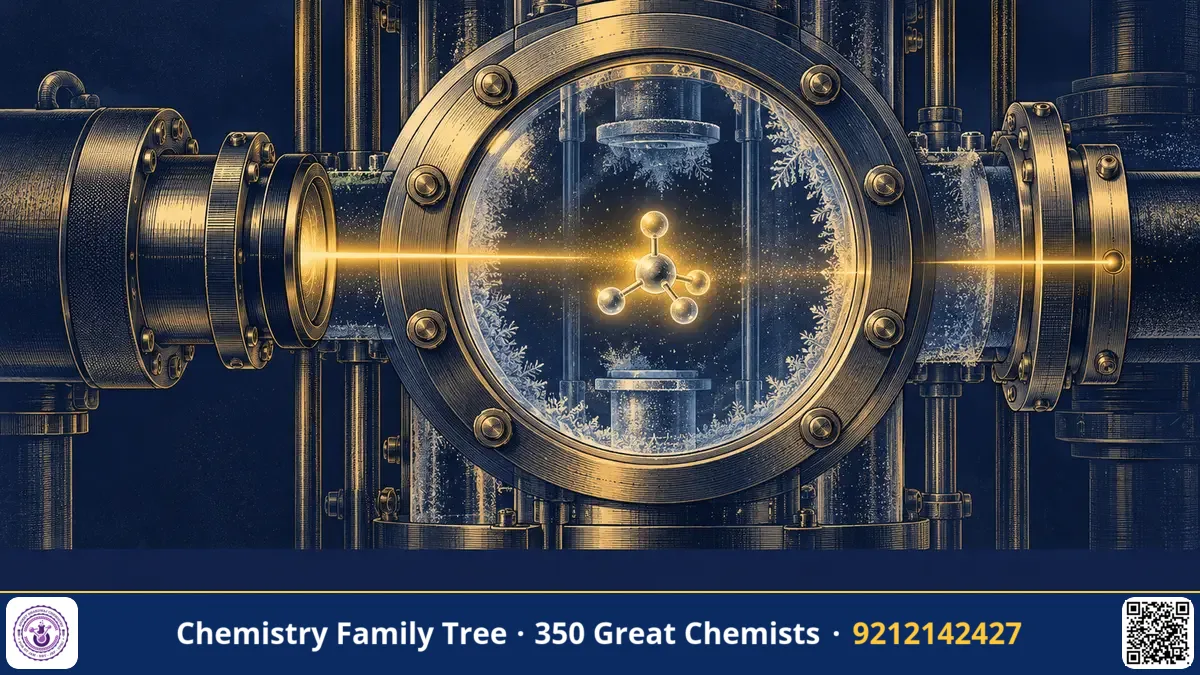
At IBM, Moerner explored spectral hole burning in solids for potential use in optical data storage, and also studied photorefractive polymers. His breakthrough was the 1989 detection of a single pentacene molecule in a p-terphenyl crystal at about 1.8 K, which gave a direct view of molecular properties without ensemble averaging. At UC San Diego and Stanford he extended the method to room temperature, to biological molecules and to living cells. His group discovered the blinking and optical switching of GFP variants in 1997, invented the anti-Brownian electrokinetic (ABEL) trap to hold single molecules in solution for long observation times, and developed a 3D imaging method with a double-helix point spread function. See the companion discovery post for the physical chemistry behind this work.
Awards, Honours and Nobel Prize
- Nobel Prize in Chemistry 2014, shared with Eric Betzig and Stefan W. Hell, "for the development of super-resolved fluorescence microscopy".
- Membership of the US National Academy of Sciences, and the American Academy of Arts and Sciences.
- Harry S. Mosher Professor of Chemistry and Professor of Applied Physics at Stanford University.
Personality, Struggles and Lesser-Known Facts
- Triple degree. He completed degrees in physics, electrical engineering and mathematics at the same time.
- An unlikely experiment. Many colleagues thought that detecting a single molecule by absorption was too difficult. He and his collaborator Kador used a clever combination of low concentration, narrow spectral lines and sensitive detection to do it.
- Collaboration across fields. His GFP work with Roger Tsien's laboratory joined physical chemistry and biology.
- Sharing credit. After the Nobel announcement, he thanked his students, postdoctoral fellows and collaborators for their contributions, such as Lothar Kador at IBM.
Legacy and Influence on Modern Chemistry
Single-molecule spectroscopy is now a central technique in chemistry, physics and biology. It allows scientists to study the dynamics of individual proteins, to watch enzymes working one turnover at a time and to track molecules in living cells. The discovery that single fluorescent proteins can be switched on and off by light led directly to PALM and STORM. Moerner's work also shows how a technique developed for one application (data storage) can open a completely different area of science. Many of his students now lead their own research groups in academia and industry.
Lessons for Students
- Master fundamentals. Moerner's skills in lasers, spectroscopy and electronics made the experiment possible.
- Ask "what is hidden by averaging?" Ensemble measurements hide diversity, and single-molecule methods reveal it.
- Be flexible across fields. His degrees in three fields prepared him for interdisciplinary science.
- Industrial labs can do great science. The breakthrough occurred at IBM, not in a university.
Quick Facts Box
- Born: 24 June 1953, Pleasanton, California, USA
- Died: Living (as of writing)
- Nationality: American
- Field: Physical chemistry, laser spectroscopy, biophysics
- Famous for: First optical detection of a single molecule (1989); GFP blinking; ABEL trap
- Nobel: Chemistry 2014 (with Eric Betzig and Stefan Hell)
FAQ
Where did Moerner do his famous experiment?
At the IBM Almaden Research Center in San Jose, California, in 1989.
Who was his collaborator in 1989?
Lothar Kador, a postdoctoral researcher at IBM.
Where does he work now?
At Stanford University, where he is a professor of chemistry and applied physics.
How is Moerner connected to Betzig?
His discovery of switchable single fluorescent proteins gave Betzig the idea for PALM, which uses controlled activation of individual molecules.
Published by ABC Chemistry — IIT-JAM | CSIR-NET | GATE Chemistry Coaching. Visit abcchemistry.com
About the chemist
William E. Moerner
1953- · United States · Nobel Chemistry 2014
Single-molecule spectroscopy