The discovery, explained · Chemist no. 143 of 350
William H. Stein: Finding How an Enzyme Works
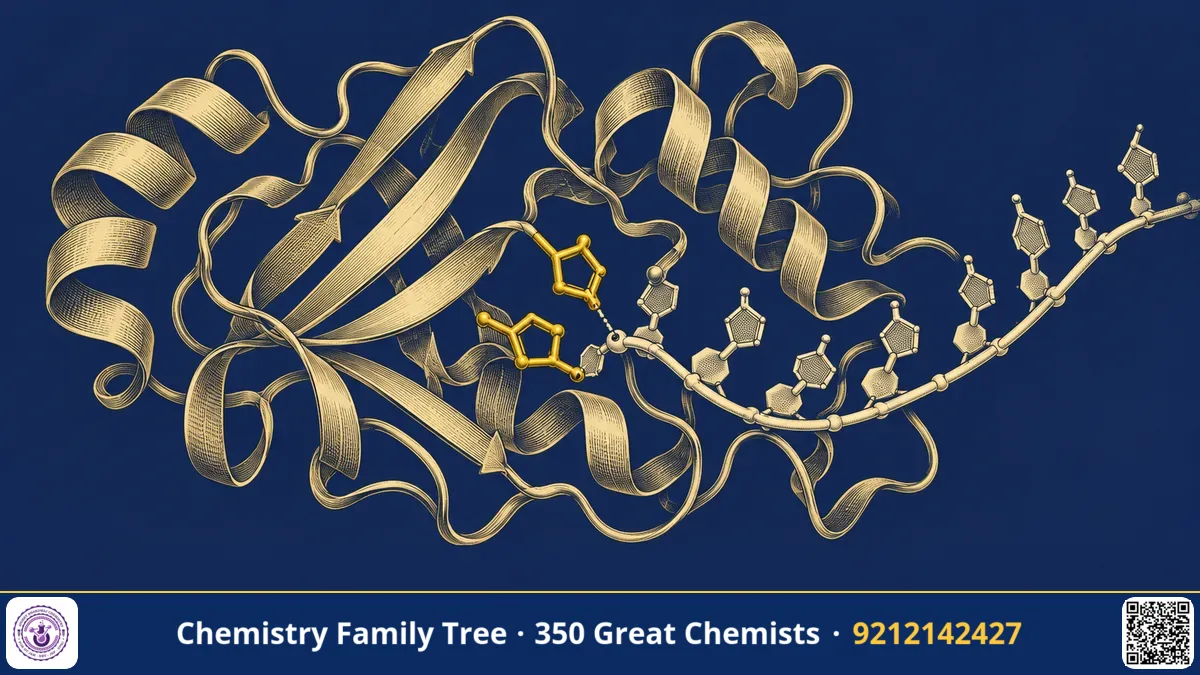
Enzymes are the catalysts of life, but until the 1950s no one knew exactly which atoms of an enzyme do the chemistry. William Howard Stein, working with Stanford Moore at the Rockefeller Institute, chose a small, tough enzyme, ribonuclease, and took it apart with chemical methods. They determined its amino acid composition, helped to establish its complete sequence, and used selective chemical modification to identify the amino acid side chains that carry out the reaction. Their work was one of the first full accounts of how a protein's chemical structure links to its catalytic function. In 1972 Stein and Moore shared one half of the Nobel Prize in Chemistry, and Christian Anfinsen received the other half.
The Scientific Problem Before the Discovery
In the early twentieth century, scientists debated whether enzymes were proteins at all. James Sumner crystallised urease in 1926 and showed it was a protein, and John Northrop crystallised pepsin and trypsin. By the 1940s it was accepted that enzymes are proteins. But a protein is a huge molecule, and the active site is only a small part of it. Which residues bind the substrate? Which carry out bond making and breaking? How can the analysis be done when the protein has more than a hundred amino acids?
Several tools were missing. There was no routine way of measuring amino acid composition accurately, no method for chemically modifying a single residue selectively, and no complete sequence of an enzyme. Stein and Moore set out to provide all three.
The Discovery and Experiments
- Analytical tools. The team developed ion-exchange chromatography and ninhydrin detection of amino acids, culminating in the automatic amino acid analyzer in 1958.
- Choice of enzyme. Bovine pancreatic ribonuclease A was available in large amounts from slaughterhouse pancreas, was stable to heat and acid, and had 124 amino acid residues. It cleaves RNA after pyrimidine nucleotides.
- Sequence. Using enzymatic digestion, chromatographic separation of the peptides and analysis with their analyzer, they and others (including the group of Anfinsen) established the full sequence in 1960. They also confirmed the position of four disulfide bonds.
- Chemical modification. Treatment with iodoacetate or bromoacetate at pH around 5.5 inactivated the enzyme. Hydrolysis and chromatography showed that the reagent had alkylated histidine residues at positions 12 and 119, giving carboxymethylhistidine. Only one of these two histidines could be modified in a single enzyme molecule, which showed they were close together in the three-dimensional structure and part of the same active site.
- Further evidence. Splitting the enzyme with the protease subtilisin gave an active fragment, ribonuclease S, made of a 20-residue S-peptide and a 104-residue S-protein, closely associated through non-covalent forces. This work, led by Frederic Richards, supported the importance of the N-terminal region (including His-12) for the active site.
The Chemistry Behind It
The reaction catalysed
Ribonuclease catalyses the cleavage of RNA by a two-step reaction involving a cyclic intermediate:
Step 1 (transphosphorylation):  RNA (3'-5' phosphodiester) → 2',3'-cyclic phosphate + 5'-OH end
Step 2 (hydrolysis):            2',3'-cyclic phosphate + H2O → 3'-phosphate
The 2'-hydroxyl group of ribose is essential. This is why DNA, which lacks a 2'-OH, is not cleaved by ribonuclease and is chemically more stable.
General acid-base catalysis
In step 1, His-12 acts as a general base, taking the proton from the 2'-OH so that the oxygen can attack the phosphorus atom. His-119, in its protonated form, acts as a general acid and donates a proton to the departing 5'-oxygen. In step 2, the roles are reversed: His-119 (now as base) activates a water molecule while His-12 (as acid) protonates the leaving group. This explains the bell-shaped pH-activity curve, with an optimum near pH 6-7, because one histidine needs to be protonated and the other deprotonated, matching the pKa values near 6.
Alkylation reaction
The histidine imidazole nitrogen acts as a nucleophile in an SN2 reaction:
Im-N: + ICH2COO- → Im-N+-CH2COO- + I-
This is a good example of how a reagent can be used as a chemical probe of an enzyme: the loss of activity parallels the extent of modification.
Other residues
Lysine-41 helps in binding and stabilising the negatively charged transition state of the phosphate. Other residues contribute to binding the pyrimidine base. Together they show that catalysis comes from a precise arrangement of just a few side chains in the folded protein.
Applications Today
- Enzyme mechanism teaching. Ribonuclease A is a standard textbook example of acid-base catalysis, transition state stabilisation and the role of pH.
- Molecular biology laboratories. RNase A is used to remove RNA from DNA preparations. RNase contamination is also carefully avoided during RNA work, using gloves and special treatments.
- Drug design. Understanding active-site chemistry allows rational design of inhibitors, a method behind many drugs. Some ribonucleases are being studied as anticancer agents.
- Protein chemistry. Chemical modification and mapping remain useful for identifying binding sites.
- India context. Enzyme kinetics and mechanism questions are regular in biochemistry papers across the country, and RNase A is the model.
Exam Corner
- Ribonuclease A: 124 amino acids, 4 disulfide bonds, catalytic residues His-12 and His-119, and Lys-41.
- Mechanism: general acid-base catalysis through a 2',3'-cyclic phosphate intermediate; 2'-OH required.
- Iodoacetate alkylates histidine (and cysteine and methionine in other proteins); loss of activity indicates an active-site residue.
- Ribonuclease S = S-peptide (residues 1-20) + S-protein (21-124), produced by subtilisin cleavage.
- Stein, Moore and Anfinsen shared the 1972 Nobel Prize in Chemistry.
Common Misconceptions
- "Ribonuclease cuts DNA too." It does not, because DNA has no 2'-OH group to form the cyclic intermediate.
- "Only one residue does catalysis." Two histidines work together as an acid and a base, with lysine helping.
- "Stein got the Nobel Prize in Medicine." His prize was in Chemistry.
Quick Revision Box
- Enzyme studied: bovine pancreatic ribonuclease A.
- His-12 = general base; His-119 = general acid (step 1).
- Intermediate: 2',3'-cyclic phosphate.
- Iodoacetate alkylation gave carboxymethylhistidine and inactive enzyme.
- Methods: ion-exchange chromatography, ninhydrin, automated analyzer.
- Nobel Prize in Chemistry, 1972.
FAQ
What did Stein contribute that was different from Moore?
The two worked as a single team and shared credit equally, so it is not sensible to separate their roles. The Nobel committee honoured them jointly.
Why is the cyclic phosphate important?
It is the intermediate that links the two steps, formed by attack of the 2'-OH on phosphorus, and it explains why RNA is cleaved but DNA is not.
Why is pH important?
The two active-site histidines must be in different protonation states, so activity is highest when both groups are near their pKa, around pH 6-7.
Is this topic in GATE or CSIR-NET?
Yes. Enzyme mechanism, acid-base catalysis and active-site identification are common themes.
Published by ABC Chemistry — IIT-JAM | CSIR-NET | GATE Chemistry Coaching. Visit abcchemistry.com
About the chemist
William Howard Stein
1911-1980 · United States · Nobel Chemistry 1972
Ribonuclease structure, amino acid analysis