The discovery, explained · Chemist no. 243 of 350
Prout's Hypothesis: The Idea That All Atoms Are Built from Hydrogen
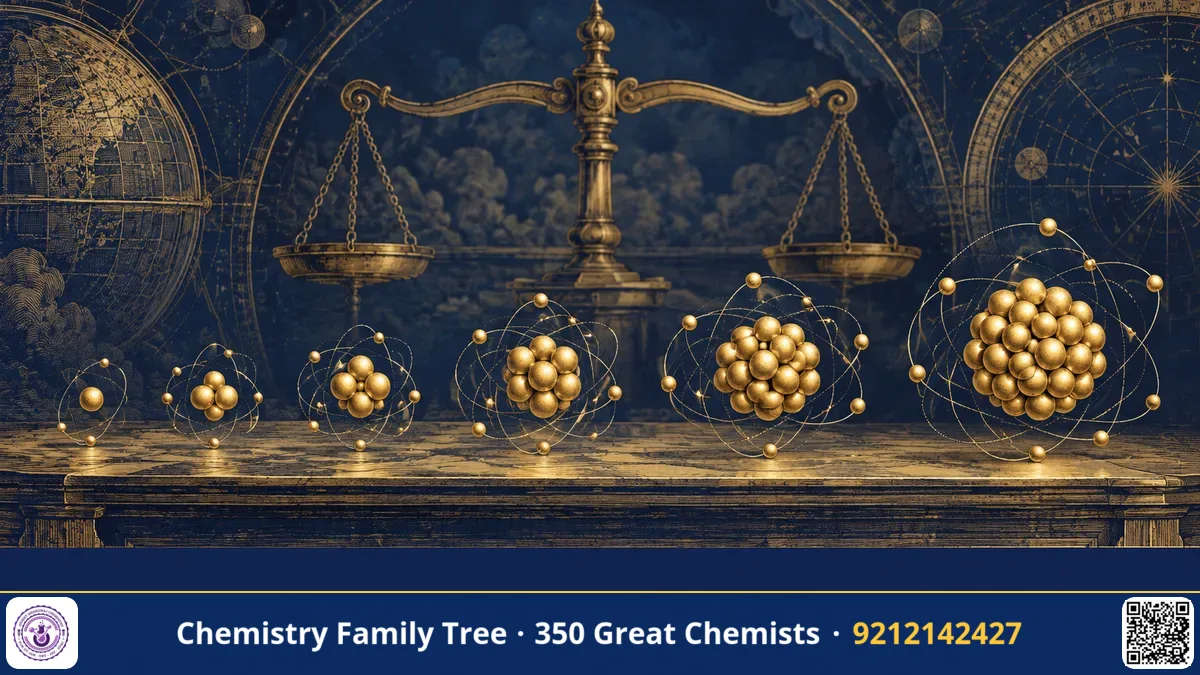
In 1815, an English physician published an anonymous paper with a bold claim: the atomic weights of all elements are exact whole-number multiples of the atomic weight of hydrogen. If true, hydrogen would be the one primary building block of matter. The physician was William Prout (1785-1850). His idea, now called Prout's hypothesis, was only partly correct, but it pushed chemists for a century to measure atomic weights with great care. It also pointed towards isotopes, protons and the structure of the nucleus. Prout also made an important medical discovery: he proved that the gastric juice in the stomach contains free hydrochloric acid. In this post we follow both ideas step by step, with the chemistry you need for school and competitive exams.
The Scientific Problem Before the Discovery
John Dalton had proposed in 1803-1808 that every element is made of identical atoms and that atoms of different elements differ in mass. Dalton gave relative atomic weights using hydrogen as 1. But the values were rough, and chemists had no agreed method to decide the formula of a compound. For example, Dalton took water as HO, so oxygen came out as 7 instead of 16.
When better data on gas densities arrived, many weights looked close to whole numbers. Gay-Lussac had shown in 1808 that gases combine in simple volume ratios. A question naturally arose: are these atomic weights whole numbers by accident, or because all atoms are made of one basic unit?
The Discovery / Experiment
Prout was a skilled analyst of gases and body fluids. He compared the densities of gases relative to hydrogen and the combining weights from analyses. Writing in the Annals of Philosophy (1815 and 1816), he noted that the values were very near whole numbers when hydrogen was taken as 1.
- Take hydrogen as the unit, H = 1.
- From gas density and combining ratios, find oxygen near 16, carbon near 12 and nitrogen near 14.
- Observe that these values are integers, and conclude that heavier atoms are formed from hydrogen atoms.
- Name the common basis of matter "protyle", the primordial substance (the name was used by later chemists for this idea).
Prout's idea:  Atomic weight of element = n x (atomic weight of H)
               where n is a whole number

H = 1   C = 12   N = 14   O = 16   (close to whole numbers)
Cl = 35.5   (half-integer, a problem)
Not every element obeyed the rule. Chlorine was measured at 35.5, and Prout's reply was that the data might contain errors. Later, very careful work by Jean Servais Stas in Belgium during the 1860s showed that the deviations were real. By then most chemists had dropped the hypothesis, though Stas himself began by supporting it.
Prout and the acid of the stomach
In 1823 Prout presented a paper to the Royal Society showing that the stomach juice of animals contains free hydrochloric acid. He distilled the juice and measured the chloride present, and by comparing it with bases found in the fluid, concluded that the acid was HCl and not a lactic acid as many believed. This earned him the Copley Medal in 1827. His method was a model of quantitative analysis applied to biology.
Stomach: parietal cells secrete H+ and Cl-  ->  HCl, pH about 1.5 to 3.5
HCl + pepsinogen -> pepsin (active)   (acid activates the enzyme)
The Chemistry Behind It
Why does Prout's rule almost work? The mass of an atom is mainly the mass of protons and neutrons in its nucleus. Each of these has mass close to 1 u, the same as hydrogen-1. So the mass of any single isotope is close to a whole number. That whole number is the mass number A.
Why then is chlorine 35.5? Natural chlorine is a mixture of two isotopes:
Cl-35 : abundance about 75.8 %      Cl-37 : abundance about 24.2 %
Average atomic mass = (35 x 0.758) + (37 x 0.242) = about 35.5
So the average weight of an element is not an integer when it has several isotopes. This was shown by Frederick Soddy's isotope concept (1913) and by F. W. Aston's mass spectrograph (1919), whose "whole number rule" says that the mass of each isotope is near an integer. In 1919 Ernest Rutherford showed that hydrogen nuclei (protons) can be knocked out of nitrogen by alpha particles, which made Prout's "hydrogen as a building block" idea seem partly right.
N-14 + He-4 (alpha) -> O-17 + H-1 (proton)
The small differences from exact integers are explained by the mass defect: some mass turns into binding energy, by E = mc2. The proton and neutron are also not identical. So the modern version is: all nuclei are built from protons and neutrons, which are nearly 1 u each.
Applications Today
- Mass spectrometry: Isotope masses near integers help identify compounds in forensic labs, drug testing and environmental analysis.
- Medicine: Prout's work on stomach acid is the basis of antacids and proton-pump inhibitors such as omeprazole, which reduce HCl secretion and are common in India for acidity and ulcers.
- Atomic mass standard: Today the unit u is defined as one twelfth of the mass of a carbon-12 atom.
- Nuclear science: The idea of nuclei built from smaller units leads to nuclear binding energy and power plants.
Exam Corner
- Prout's hypothesis: atomic weights are whole-number multiples of that of hydrogen; the primary matter was called protyle.
- Average atomic mass of Cl = 35.5 because of Cl-35 and Cl-37 in a 3:1 ratio, roughly.
- Aston's whole number rule applies to isotopic masses, not to average atomic weights.
- Mass defect = (sum of masses of nucleons) - (actual nuclear mass); binding energy = mass defect x c2.
- Prout showed free HCl is present in gastric juice; 1 u = 1/12 mass of C-12.
Common Misconceptions
- "Prout's hypothesis was completely wrong." Not so. It failed for average atomic weights, but it was right in spirit: isotopic masses are near integers and nuclei are built from nucleons.
- "Atomic weight and mass number are the same." Atomic weight is a weighted average of isotopes; mass number is an integer count of protons plus neutrons for one isotope.
- "Hydrogen atoms are the building blocks of all nuclei." Only protons, which are hydrogen nuclei, plus neutrons are the building blocks; neutrons were discovered by Chadwick in 1932.
Quick Revision Box
- William Prout (1785-1850), English physician and chemist.
- Hypothesis published 1815-1816 in the Annals of Philosophy, anonymously at first.
- Statement: atomic weight = whole-number multiple of hydrogen's.
- Exceptions like Cl = 35.5 are explained by isotopes.
- 1823: free HCl found in stomach; Copley Medal 1827.
- Whole number rule: Aston, 1919.
FAQ
Who proposed that atomic weights are multiples of hydrogen?
William Prout, an English physician and chemist, proposed it in 1815-1816. It is called Prout's hypothesis.
Why is chlorine's atomic weight 35.5 and not a whole number?
Because natural chlorine contains about three parts Cl-35 to one part Cl-37, so the weighted average is about 35.5.
Is Prout's hypothesis accepted today?
Not in its original form, but a modified form holds: every nucleus is made of protons and neutrons, each close to 1 u, so isotope masses are close to whole numbers.
What did Prout discover about digestion?
He showed in 1823 that the acid in the stomach is free hydrochloric acid, and he also classified foods into sugary, oily and protein-like groups.
Published by ABC Chemistry — IIT-JAM | CSIR-NET | GATE Chemistry Coaching. Visit abcchemistry.com
About the chemist
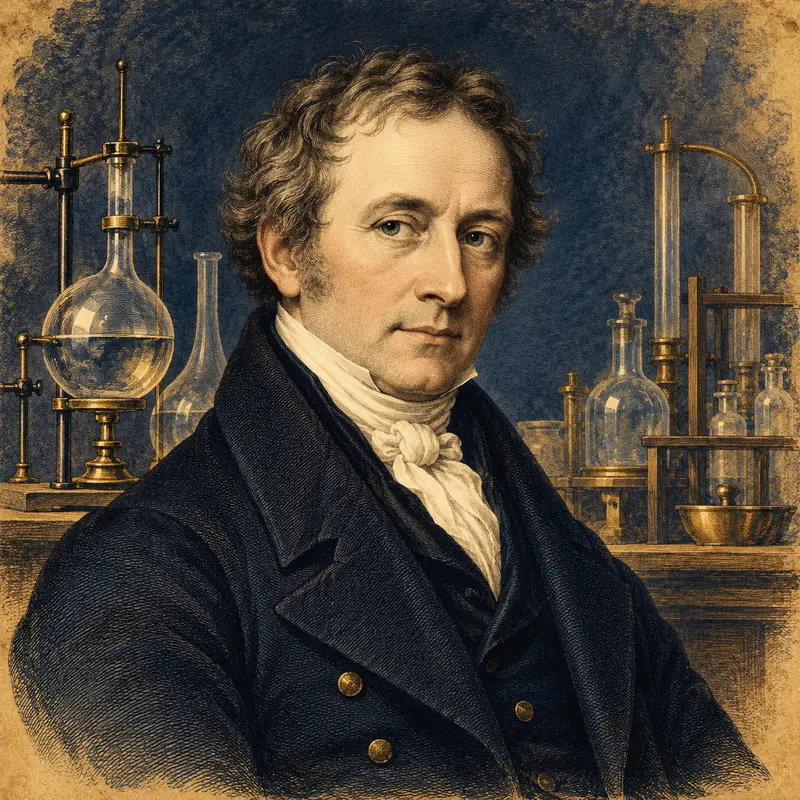
William Prout
1785-1850 · United Kingdom
Prout's hypothesis on atomic weights