Biography · Chemist no. 325 of 350
Yellapragada Subbarow: Complete Life and Legacy of the Forgotten Genius
Yellapragada Subbarow (1895-1948) was an Indian biochemist who, working in the United States, co-discovered ATP and phosphocreatine, invented a standard method for measuring phosphate and led the research that produced folic acid, methotrexate, diethylcarbamazine and the first tetracycline antibiotic. He died at the age of 53 and never received a Nobel Prize, which many scientists regard as a serious omission. For Indian students his life is a story of poverty, struggle and brilliance; for science, he is the man behind several medicines that save millions of lives today.
Early Life and Family
Yellapragada Subbarow was born on 12 January 1895 in Bhimavaram, in West Godavari district, in the Madras Presidency (today Andhra Pradesh). His father, Yellapragada Venkata Jagannatham, was a revenue inspector in the government, and his mother was Venkamma. The family belonged to a modest Telugu Brahmin background. His family was not wealthy. As a boy he was not a brilliant student at first; he failed his matriculation exam more than once before passing. As a young man he was drawn to the Ramakrishna Mission and wanted to become a monk and spend his life in service, but his mother's wishes and the family's needs brought him back to study.
Education and Mentors
Subbarow studied at the Hindu High School in Rajahmundry and Presidency College, Madras, where he joined the intermediate course and later the Madras Medical College. The teachings of Sri Ramakrishna and the Ramakrishna Mission influenced him strongly, and friends and well-wishers helped with his fees and, later, the cost of his journey to America. He took part in Gandhi's non-cooperation movement and wore khadi, a decision which, according to accounts, cost him a medical degree: he received only a licence (LMS) rather than the full MBBS from Madras Medical College in 1921, and this made it hard for him to get a government job. He then taught for a time at the Ayurvedic College in Madras, where he became interested in the chemistry of traditional Indian drugs. In 1922 he sailed for Boston, USA, to study tropical medicine at Harvard, with the help of friends and benefactors.
Career Timeline
| Year | Event |
|---|---|
| 1895 | Born in Bhimavaram, Madras Presidency |
| 1921 | Obtained LMS from Madras Medical College |
| 1922 | Sailed to Boston to study at Harvard School of Tropical Medicine |
| 1923-1924 | Moved to biochemistry at Harvard Medical School; worked as a night porter to support himself |
| 1924 | Ph.D. in biochemistry, Harvard |
| 1925 | Fiske-Subbarow phosphate method published |
| 1927 | Discovered phosphocreatine with Cyrus Fiske |
| 1929 | Isolated ATP with Fiske |
| 1930s | Worked on vitamins, liver extracts and anaemia treatments; appointed Associate Professor at Harvard in 1938 |
| 1940 | Joined Lederle Laboratories, Pearl River, New York, as Director of Research |
| 1945 | Synthesis of folic acid |
| 1947-1948 | Methotrexate/aminopterin, Hetrazan, Aureomycin programmes |
| 1948 | Died on 8 August at Pearl River, New York |
Major Scientific Contributions
- Fiske-Subbarow method: The standard colourimetric method for phosphate.
- Phosphocreatine and ATP: Key molecules of cellular energy, with Cyrus Fiske.
- Vitamin and liver factor work: Studies on the purification of factors against pernicious anaemia and on vitamin B12 and folic acid.
- Folic acid synthesis (1945): Chemical synthesis of the vitamin and its analogues.
- Methotrexate and aminopterin: Folic acid antagonists, the first effective chemotherapy against childhood leukaemia.
- Hetrazan (diethylcarbamazine): A drug for filariasis, widely used in India.
- Tetracycline-class antibiotics: Leadership of the Lederle programme that developed Aureomycin.
See our discovery blog for the chemistry of ATP, phosphocreatine and these drugs.
Awards, Honours and Nobel Prize
Subbarow did not receive a Nobel Prize. His co-worker Cyrus Fiske was also denied it. Many historians feel that his contribution to the biochemistry of energy deserved wider recognition. A fungus was named Subbaromyces splendens in his honour by a colleague, and India issued a postage stamp in his memory in 1995, the centenary of his birth.
Personality, Struggles and Lesser-Known Facts
- Night porter in Boston: To pay for his living, he worked as a night porter at Brigham Hospital and also cleaned glassware, while studying by day. He often slept little.
- No full professorship at Harvard: Despite his achievements, he was not given a permanent professorship, and he moved to industry at Lederle in 1940. Accounts differ on the reasons, which may include prejudice against a foreign scientist.
- Selfless collaborator: He is often described as a modest man who let colleagues take the credit. Co-workers at Lederle, such as Thomas Jukes and Harriet Kiltie, benefited from his guidance and encouragement.
- Family: He married Seshagiri in 1919. She stayed in India while he worked in the US, and he lived a very lonely, work-centred life.
- Debt to India: He remained deeply attached to India and its health problems.
- Heart attack: He died suddenly in his sleep of a heart attack in 1948, at a time of great discoveries.
Legacy and Influence on Modern Chemistry
Every ATP-powered process that students learn about, and every chemotherapy ward using methotrexate, goes back to his work. The Fiske-Subbarow method remained the standard for phosphate determination for decades and is the root of modern molybdenum blue methods. The idea that a structural analogue of a vitamin can stop a cancer cell began with the Lederle antifolates, which led to a whole class of antimetabolite drugs. Hetrazan changed the lives of people in tropical countries, including India. The story is also a reminder of the talent that India lost, because there was no suitable job for him at home. Indian students today have more scope, and his life asks us to remember the pioneers who opened the way.
Lessons for Students
- Do not give up after failure. He failed matriculation twice and still became a leading biochemist.
- A good method is a great discovery. His phosphate test made many later discoveries possible.
- Work for the benefit of people. He devoted his research to diseases of the poor and the sick.
- Do not wait for recognition. His science is remembered even without a prize.
Quick Facts Box
- Born: 12 January 1895, Bhimavaram, Madras Presidency (now Andhra Pradesh)
- Died: 8 August 1948, Pearl River, New York, USA
- Nationality: Indian
- Field: Biochemistry, medicinal chemistry
- Famous for: ATP and phosphocreatine, Fiske-Subbarow method, folic acid, methotrexate, Hetrazan
- Nobel: None
FAQ
Why did Subbarow not receive a Nobel Prize?
There is no single clear reason. His discoveries were shared with colleagues, the discovery of ATP was simultaneous with Lohmann's, and he died young, in 1948. Historians regard him as an overlooked scientist.
Where did Subbarow study in India?
He studied at Presidency College, Madras, and Madras Medical College, before leaving for Harvard in 1922.
What medicines are connected to Subbarow?
Methotrexate, folic acid, diethylcarbamazine (Hetrazan) and chlortetracycline (Aureomycin) were all developed under his direction at Lederle.
Is Subbarow included in Indian exam syllabuses?
He is increasingly mentioned for ATP, the phosphate test and anticancer drugs in biochemistry and general science sections.
Published by ABC Chemistry — IIT-JAM | CSIR-NET | GATE Chemistry Coaching. Visit abcchemistry.com
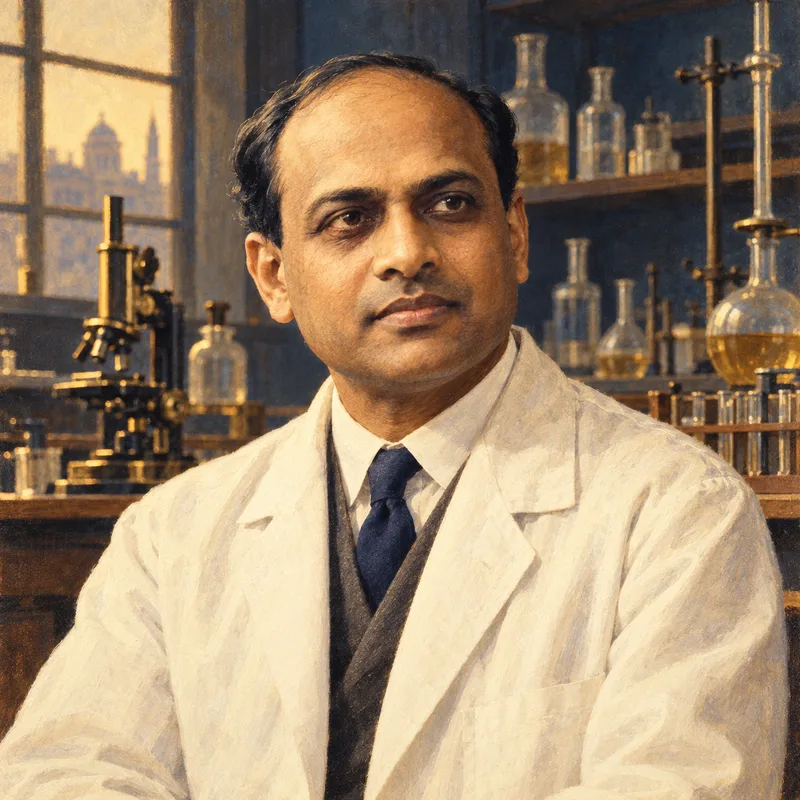
About the chemist
Yellapragada Subbarow
1895-1948 · United States
ATP and phosphocreatine; methotrexate, tetracyclines