Checking Your Answers: What the Answer Checker Does and Does Not Do
Verifying chemistry practice answers requires clarity on what automated scoring evaluates, what it excludes, and where your own analytical review remains indispensable.
What Automated Answer Evaluation Evaluates
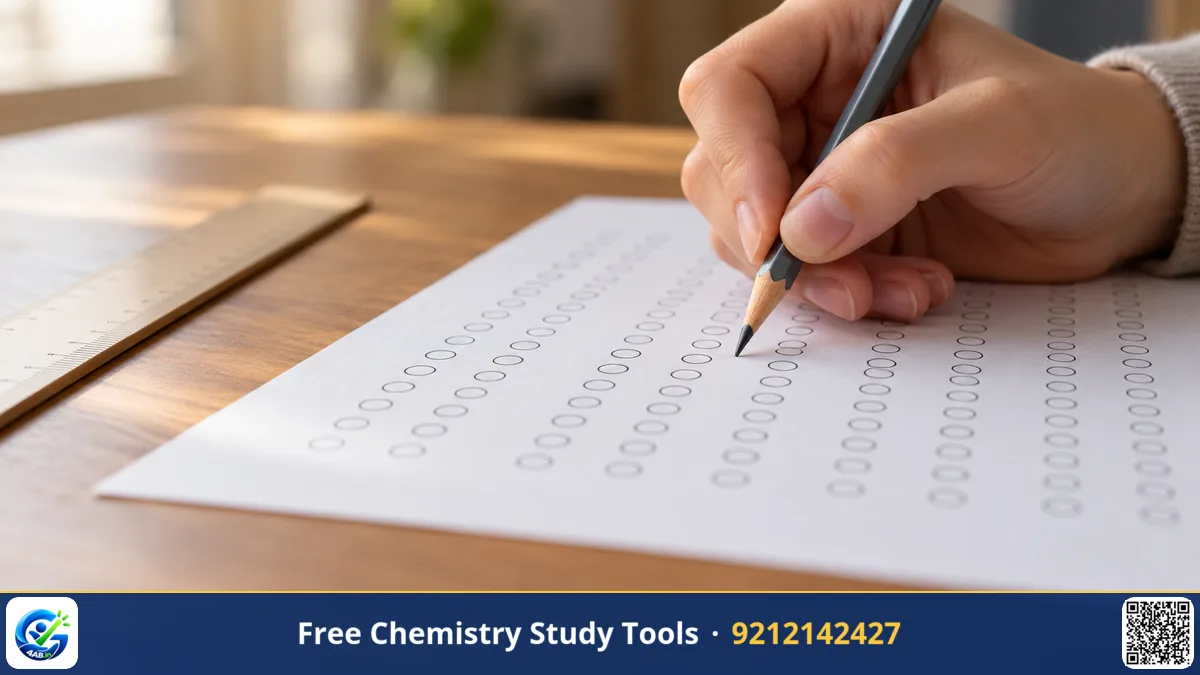
The AI Answer Checker is designed specifically to mark objective responses from test papers generated on the platform. When you complete an objective test, the system compares the answers you entered directly with the answer printed in the source papers. This includes questions sourced from CSIR-NET, GATE, and IIT-JAM archives.
It is equally important to understand what the evaluator does not do. The tool does not read handwriting, evaluate scanned drawings, or grade descriptive working steps. If you work through a multi-step thermodynamic derivation or write out a chemical mechanism on paper, the software cannot inspect your reasoning. It assesses only whether the answer you entered matches the printed answer. By relying strictly on published examination keys rather than speculative automated grading, the tool provides a transparent, factual verification of your final answers.
Generating and Solving a Paper Before Checking
An answer checker is useful only when applied to an honest, independent attempt. The recommended study workflow begins in the Question Bank, where you can configure and build a balanced practice paper. The bank allows you to filter previous-year chemistry questions by subject, category, chapter, topic, subtopic, difficulty, and year.
When generating a paper, you can specify the title, seed number, question count, duration in minutes, and difficulty mix across easy, medium, and hard tiers. Using the same seed number and filter criteria always reproduces the exact same paper, making it easy for study partners or classes to attempt identical tests. Once the paper is built, you should sit down with paper, a pen, and a scientific calculator to solve the questions under timed conditions. Avoid looking up solutions while testing. Only after finishing the entire paper should you open the evaluation screen, input your answers, and review the automated scoring report.
Why Unscored Items and Disputed Answers Are Excluded
A dependable evaluation system must maintain strict standards regarding the reference data it uses. On this platform, two specific types of questions are never assigned a pass or fail outcome during evaluation: self-practice questions and questions with disputed official keys.
Self-practice questions are optional practice items appended in their own distinct section at the end of a generated paper, and they do not carry an answer in the scoring key. Similarly, a few questions in the bank are flagged because their printed answer is disputed. The checker intentionally excludes both categories from scoring. Questions without an official printed key or with disputed outcomes are never counted as right or wrong. Including unverified answers would distort your percentage score and create false confidence or unwarranted discouragement. While these questions remain valuable for conceptual problem solving and classroom discussion, excluding them keeps your automated evaluation mathematically reliable.
Why Chemistry Calculations Demand Personal Verification
Automated objective checking confirms whether an entered option is correct, but it cannot verify whether your underlying chemical logic was sound. In physical and inorganic chemistry, complex calculations frequently involve several sequential operations where opposing mistakes can inadvertently cancel each other out.
For example, consider calculating the equilibrium concentration of hydronium ions, [H3O+], during the dissociation of sulfuric acid, H2SO4, into bisulfate, HSO4-, and sulfate ions, SO42-. An error in applying the second dissociation constant combined with a rounding slip might coincidentally yield a final number matching one of the multiple-choice alternatives. Similarly, determining oxidation numbers and electron counts in coordination complexes such as [Fe(CN)6]4- and [Fe(CN)6]3- requires methodical charge accounting. If you select the right option by guessing or through flawed intermediate algebra, the objective checker marks the question correct. For this reason, you must always audit your handwritten calculations to confirm genuine conceptual comprehension.
Practical Applications for Students and Teachers
Understanding the precise scope of automated evaluation allows you to incorporate it effectively into regular study routines. When applied purposefully, the tool saves time on routine verification while generating clean, objective performance records.
Recommended applications of the checker include:
- Rapidly verifying objective answer keys immediately after completing a timed mock examination.
- Eliminating time-consuming manual searches through multi-page answer keys across separate past-year papers.
- Helping a teacher see the weakest topics for a whole class.
- Generating structured test records to monitor performance trends across successive revision weeks.
- Pinpointing which specific objective questions need deeper group discussion during tutorial sessions.
By delegating the mechanical task of score verification to the software, students and educators can devote their primary study hours to substantive concept analysis and problem-solving practice.
Essential Diagnostic Steps to Carry Out Yourself
Because the evaluation software checks only final answers, thorough self-assessment requires deliberate follow-up actions once your score is visible. After reviewing the automated summary, carry out these essential diagnostic tasks on your rough working:
- Inspect intermediate arithmetic and formulas to ensure correct solutions did not result from accidental cancellation of errors.
- Verify oxidation states, formal charges, stoichiometric coefficients, and reaction conditions in chemical equations.
- Assign specific diagnostic tags to errors, categorizing each mistake as a conceptual gap, wrong formula, calculation slip, unit mistake, or sign error.
- Distinguish between questions missed due to genuine subject confusion and those caused by misreading the question stem or rushing under time limits.
- Re-solve missed numerical problems from scratch on paper before consulting reference solutions.
Completing this manual debrief ensures that you uncover the exact origin of every mistake before beginning another practice paper.
Tracking Long-Term Progress in Browser Storage
Your evaluation outcomes do not vanish when you close the browser window; they feed directly into My Progress. This profile is kept in your browser's local storage, so the records stay in that browser.
To prevent misleading conclusions, the progress tracker enforces a strict threshold: a topic with fewer than five scored answers is never categorized as strong or weak. Once five or more responses are logged, the dashboard displays mastery by topic and identifies weak concepts across inorganic, organic, and physical branches by difficulty. It also maintains a spaced-revision schedule that plans follow-up reviews one, three, seven, and twenty-one days after learning. When revision topics become due, you can use the revision paper builder to generate focused practice tests. This systematic connection between objective checking and spaced review supports disciplined preparation.
Key takeaways
- The tool scores objective items strictly against printed keys from previous-year papers.
- Unscored self-practice and disputed questions are never counted as right or wrong.
- Calculations, chemical mechanisms, and step-by-step working require personal review.
- Validated evaluation scores update your browser storage to guide scheduled revisions.
Frequently asked questions
Does the answer checker evaluate handwritten solutions or calculation steps?
No, the tool does not read handwriting or evaluate intermediate calculation steps. It checks only final objective responses against the official answer keys printed in the original examination papers, leaving all working for your personal review.
Why are self-practice and disputed questions excluded from the score?
Questions lacking a printed answer or containing disputed answer keys are excluded so your evaluation remains objective. Marking unverified items right or wrong would distort accuracy metrics, so the system never scores these practice items.
Where are evaluation results and error records stored?
Your results are kept in your browser's local storage, and My Progress describes them as stored in this browser only. The profile can be exported and imported if you want to move it to another device.
When does a chemistry topic show up as strong or weak in progress tracking?
A chemistry topic is classified as strong or weak only after you log at least five scored answers for it. This rule prevents premature conclusions based on isolated attempts or lucky guesses.
Open the Education tools. Everything here is free to try and needs no login. Start with the Question Bank and build your first paper.
Open the Education tools →