CSIR NET Electrochemistry — Conductance and Kohlrausch's Law
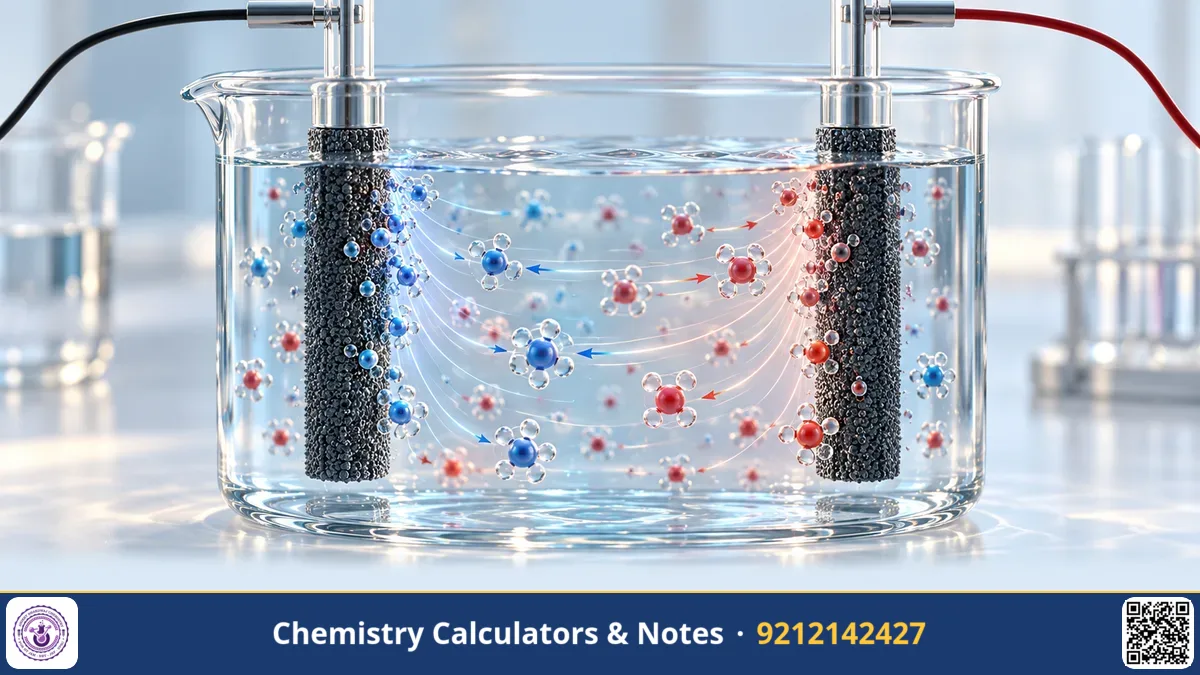
Conductance is one of the most reliably scoring corners of physical chemistry for CSIR NET Chemical Sciences. The physics is small, the formulas are few, and almost every question reduces to converting between four quantities — resistance, conductivity, molar conductivity and degree of dissociation. What separates a correct answer from a wasted three minutes is unit discipline. This article fixes the definitions, then works three numericals end to end.
The four quantities, in order
Start from resistance and build upwards. A conductivity cell of electrode area A and separation l filled with electrolyte has resistance R.
Conductivity κ = G × (l/A) = (1/R) × cell constant (S cm⁻¹)
Molar conductivity Λm = κ/c
• with c in mol cm⁻³ → Λm in S cm² mol⁻¹
• in practice, with c in mol L⁻¹: Λm = 1000 κ / c
The factor of 1000 is the single most common source of a wrong answer in this topic. It comes from 1 L = 1000 cm³ and nothing else. Molar conductivity is conductivity normalised for how much electrolyte is present, which is why it rises on dilution while conductivity falls: κ falls because there are fewer ions per cm³, but Λm rises because each mole of electrolyte is carrying current more effectively.
Kohlrausch's two statements
Students often merge two different results under one name. Keep them separate.
A plot of Λm against √c is linear; the intercept gives Λm° directly.
(2) Law of independent migration of ions (all electrolytes): Λm° = ν₊λ₊° + ν₋λ₋°
Each ion contributes a fixed limiting conductivity, independent of its partner.
Statement (2) is what lets you obtain Λm° for a weak electrolyte, where extrapolation of a √c plot is impossible because the curve shoots up steeply near infinite dilution. The Debye–Hückel–Onsager treatment explains the √c dependence physically: K = A + BΛm°, where the two terms are the electrophoretic effect (the ionic atmosphere drags solvent the wrong way) and the relaxation effect (the atmosphere takes time to re-form behind a moving ion).
| Ion (298 K, aqueous) | λ° / S cm² mol⁻¹ | Ion | λ° / S cm² mol⁻¹ |
|---|---|---|---|
| H⁺ | 349.6 | OH⁻ | 199.1 |
| K⁺ | 73.5 | Cl⁻ | 76.3 |
| Na⁺ | 50.1 | CH₃COO⁻ | 40.9 |
| NH₄⁺ | 73.5 | NO₃⁻ | 71.4 |
Note how far H⁺ and OH⁻ sit above everything else. That is not because they are small — it is the Grotthuss mechanism, in which a proton hops along a hydrogen-bonded chain of water molecules instead of physically migrating. A question asking "why is λ°(H⁺) about five times λ°(K⁺)?" is asking for that one word.
Worked example 1 — cell constant from a KCl standard
Q. A conductivity cell filled with 0.0100 M KCl (κ = 0.001413 S cm⁻¹ at 298 K) has resistance 484.1 Ω. The same cell filled with 0.00500 M of a salt gives R = 1050 Ω. Find the cell constant and Λm of the salt.
Step 1 — cell constant. κ = (1/R) × (l/A), so
l/A = κ × R = 0.001413 × 484.1 = 0.6841 cm⁻¹.
Step 2 — conductivity of the unknown.
κ = 0.6841 / 1050 = 6.515 × 10⁻⁴ S cm⁻¹.
Step 3 — molar conductivity.
Λm = 1000 × 6.515 × 10⁻⁴ / 0.00500 = 0.6515 / 0.00500 =
130.3 S cm² mol⁻¹.
Worked example 2 — Λm° for a weak acid
Q. Using the ionic values above, find Λm° for acetic acid, first directly and then from the conductivities of HCl, CH₃COONa and NaCl.
Direct route.
Λm°(CH₃COOH) = λ°(H⁺) + λ°(CH₃COO⁻) = 349.6 + 40.9 =
390.5 S cm² mol⁻¹.
Salt-cycle route (the version usually asked, because those three salts are
strong electrolytes whose Λm° can be measured by extrapolation):
Λm°(HCl) = 349.6 + 76.3 = 425.9
Λm°(CH₃COONa) = 50.1 + 40.9 = 91.0
Λm°(NaCl) = 50.1 + 76.3 = 126.4
Λm°(CH₃COOH) = 425.9 + 91.0 − 126.4 = 390.5 S cm² mol⁻¹ ✓
The two routes agree exactly, which is the whole content of the law of independent migration: Na⁺ and Cl⁻ cancel because each ion's contribution does not depend on its partner.
Worked example 3 — degree of dissociation and Ka
Q. 0.00100 M acetic acid has Λm = 49.0 S cm² mol⁻¹ at 298 K. Calculate α and Ka.
Step 1 — degree of dissociation. For a weak electrolyte, Arrhenius' relation applies:
α = Λm / Λm° = 49.0 / 390.5 = 0.1255 (12.55 %).
Step 2 — Ostwald dilution law.
Ka = cα²/(1 − α) = (0.00100 × 0.1255²) / (1 − 0.1255)
= (0.00100 × 0.015750) / 0.8745 = 1.575 × 10⁻⁵ / 0.8745 =
1.80 × 10⁻⁵.
That is the textbook value of Ka for acetic acid — a good sign that the arithmetic is right. Note that dropping the (1 − α) term would have given 1.58 × 10⁻⁵, a 12 % error; at α above about 5 % the approximation is no longer safe.
Transport numbers, in one line
Ionic mobility: u = λ / F, where F = 96485 C mol⁻¹
For HCl, t₊ = 349.6 / (349.6 + 76.3) = 349.6/425.9 = 0.821. Over 80 % of the current in hydrochloric acid is carried by the proton — again, the Grotthuss mechanism.
Common mistakes that cost marks
- Applying the √c law to a weak electrolyte. The steep rise of Λm for acetic acid on dilution is increasing dissociation, not an ion-atmosphere effect. Extrapolating that curve gives nonsense; use independent migration.
- Losing the factor 1000. Λm = κ/c only when c is in mol cm⁻³. With mol L⁻¹ you must write Λm = 1000κ/c.
- Forgetting stoichiometric coefficients. For CaCl₂, Λm° = λ°(Ca²⁺) + 2λ°(Cl⁻), not a simple sum of one of each.
- Confusing κ falling with Λm falling. On dilution κ always decreases and Λm always increases. Questions are often written to catch this.
- Dropping (1 − α) in Ostwald's law. Safe only for α below roughly 5 %.
Summary table
| Quantity | Formula | SI-practical unit | Behaviour on dilution |
|---|---|---|---|
| Conductance G | 1/R | S | Decreases |
| Conductivity κ | (1/R)(l/A) | S cm⁻¹ | Decreases |
| Molar conductivity Λm | 1000κ/c | S cm² mol⁻¹ | Increases |
| Limiting Λm° | ν₊λ₊° + ν₋λ₋° | S cm² mol⁻¹ | Constant (a limit) |
| Degree of dissociation α | Λm/Λm° | dimensionless | Increases |
Check your electrochemistry arithmetic instantly. The Nernst Equation calculator handles cell potentials, concentration dependence and the 0.0592/n term at 298 K — the companion calculation to almost every conductance question in Part C.
Open the Nernst Equation Calculator →