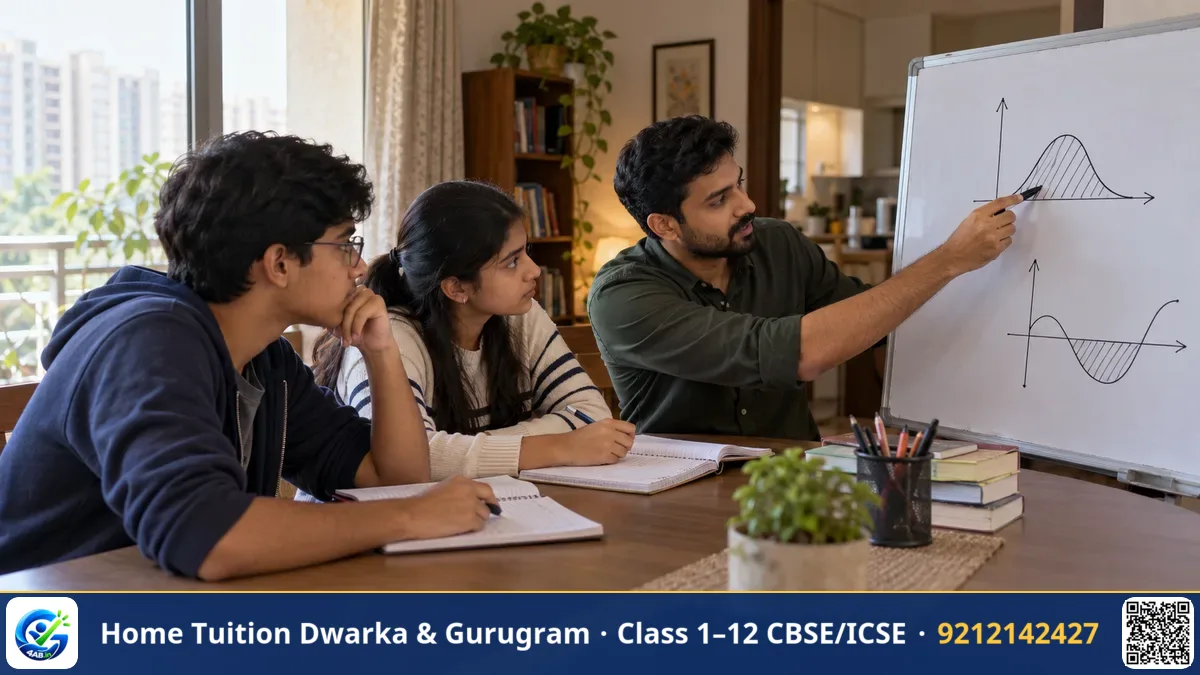
Area under curves is one of the shortest chapters in Class 12 Maths and one of the most dependable sources of marks, provided the sketch is right.
Application of Integrals in Class 12 is almost entirely about finding the area of a region bounded by curves and lines. The calculus is straightforward once the integration toolkit is in place. What decides the marks is the sketch: a student who draws the region correctly, identifies the points of intersection and chooses the right limits will usually finish the question. A student who skips the sketch tends to integrate the wrong function over the wrong interval.
| Applies to | Class 12 Maths, CBSE and ISC |
|---|---|
| Chapter | Application of Integrals (area under simple curves, between a curve and a line, between two curves) |
| Needs from earlier | Definite integrals, standard integrals, parabola, circle, ellipse and line from coordinate geometry |
| Realistic time | Ten days, mostly on sketching practice |
Why the sketch matters more than the integral
In a five-mark area question, a typical marking scheme gives credit for the figure, for the correct setup of the integral with limits, for the integration itself and for the final value. The figure alone may earn one or two marks. Even when a student makes a slip in the integration, a correct figure and a correct setup preserve most of the marks. This is the cheapest insurance in the whole paper.
Sketches do not need to be perfect. They need to show the axes, the curves roughly in the right shape, the points of intersection marked with coordinates, and the required region shaded. Five minutes of drawing practice per day for a week is enough to make this automatic.
The curves to be able to sketch from an equation
- Lines in the form y = mx + c, and vertical or horizontal lines.
- Parabolas such as y squared = 4ax and x squared = 4ay, and their shifted forms.
- Circles x squared + y squared = a squared, and circles with centre away from the origin.
- Ellipses in standard form.
- Occasionally the modulus function or a simple trigonometric curve over one interval.
These all come from Class 11 coordinate geometry. If a student cannot identify the conic from the equation, the area chapter will feel difficult for reasons that have nothing to do with integration. This is the same Class 11 dependency that appears again and again in Class 12.
Choosing limits and the direction of integration
The first step is to solve the two equations simultaneously to find the points of intersection. These points become the limits, or they split the region into parts. The second step is to decide whether to integrate with respect to x or y. As a rule, choose the direction in which the region is bounded by one upper and one lower curve over the whole interval, so that a single integral covers the region. Where the region needs two integrals, the student should write them separately and add.
When the region lies below the x-axis, the integral comes out negative. The area is the absolute value, and the question usually requires the student to say so. Regions that straddle the axis need to be split at the crossing point, with each piece taken in absolute value.
Standard question types
Questions repeat in a small set of forms: the area of a circle or ellipse, the area enclosed by a parabola and a line, the area between two parabolas, the area of a triangle given by three lines, and the area bounded by a curve and its ordinates. A student who has solved four or five of each form has seen essentially the whole range of what the board asks.
A habit worth building. After finding the answer, check it against the sketch. If the region visibly occupies about half a unit square and the answer is 14, something is wrong. A sense of scale catches arithmetic slips before the examiner does.
A ten-day plan
- Days 1-2: revise standard integrals and definite integral properties; sketch twenty curves from equations.
- Days 3-5: area under a single curve and between a curve and a line.
- Days 6-8: area between two curves, including cases needing a split.
- Days 9-10: timed mixed set of eight questions, then a correction session.
This chapter suits a short run of one-to-one sessions, since the tutor can watch the sketch being drawn and catch an error in the first thirty seconds. In Gurugram and Dwarka, many Class 12 students have this chapter squeezed between pre-board revision and entrance preparation, so a compact plan like this one helps.
Two worked patterns to practise
Take the region between the parabola y squared = 4x and the line y = x. Solving together gives the points of intersection at the origin and at (4, 4). Between those limits the parabola lies above the line, so the area is the integral of the difference, 2 times the square root of x minus x, from 0 to 4. The student writes the figure, the limits, the integrand, the integration and the value, which comes to 8/3 square units.
Now take a circle x squared + y squared = 16 and the line x = 2. The region to the right of the line within the circle is symmetrical about the x-axis, so the student can integrate the upper half and double it. Spotting symmetry is a small skill with a large payoff, because it halves the work and the chance of error. Practise looking for symmetry before every area problem.
Questions parents ask
Is this chapter heavily weighted in the board paper?
It carries a modest share of the total marks, but its questions are among the most predictable, which makes it a reliable source for students aiming at a high score.
What if my child dislikes drawing?
Practise with small, quick sketches and treat them as part of the working rather than as art. Two or three weeks of regular practice is enough to remove the dislike for most students.
Do students need to memorise area formulae for a circle or ellipse?
They should know the results, but the board may also expect the derivation by integration. Practise the integral method so that the result can be derived if asked.
Which earlier chapter causes the most trouble here?
Integration techniques, particularly substitution and standard forms, followed by conic sections from Class 11. If these are weak, fix them first.