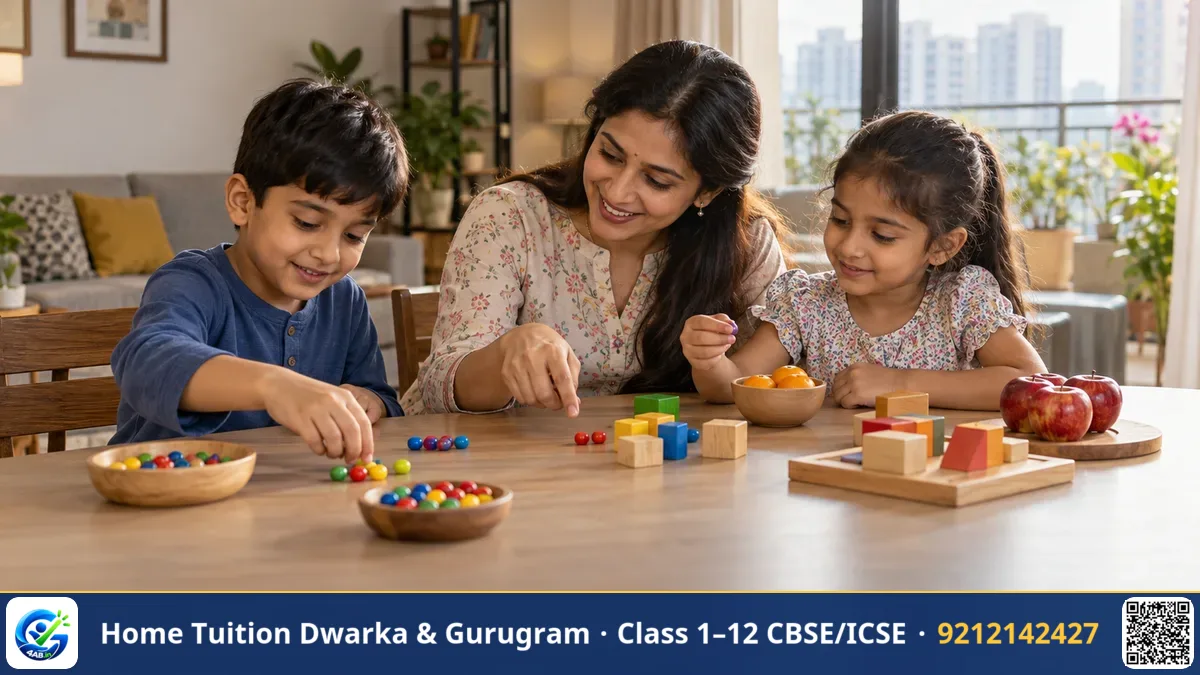
A child can write every answer in the workbook and still not know what a number is.
Updated 9 November 2026 · Great Home Tutor · Delhi, Dwarka and Gurugram
Number sense is the feeling that numbers stand for amounts that can be compared, split and combined. Children in Classes 1 and 2 who have it find addition and subtraction natural. Children who do not have it memorise answers and break down when the numbers or the question shape change. You can test it in five minutes at home, and you can build it with ordinary objects, not worksheets.
What number sense actually is
Number sense is not speed with sums. It is a set of quiet understandings: that the number 7 means seven things, that 7 is more than 5 and less than 9, that 7 can be made of 3 and 4 or of 5 and 2, that the 7 in 17 is not the same as a lone 7. A child who has these ideas can work out an unfamiliar sum by reasoning. A child who lacks them can only recall the sums they have seen.
The first two years of school are where this is laid down. It is also where it is most often skipped, because a workbook full of correct answers looks like understanding. It may only be good memory.
A five-minute check you can do at home
Sit with your child with a handful of small objects such as buttons, and try these in a relaxed way, not as a test.
- Counting out. Ask for eight buttons. Does the child count carefully and stop at eight, or grab a handful and guess?
- Which is more? Show two piles, one of six and one of nine, spread unevenly. Can they say which has more without counting one by one?
- Parts of a number. Put seven buttons out. Hide some under a cup and show the rest. “I can see four. How many are under the cup?”
- One more, one less. Without objects: “What is one more than nine? One less than twenty?” The step across a tens boundary is revealing.
- Tell me how you know. After any answer, ask “How did you find that?” The explanation matters more than the answer.
If the child is hesitant on the third and fourth, they have counting but not yet number relationships. This is common and very fixable at this age.
Signs the foundation is thin
- The child counts on fingers for every sum, and starts from one each time rather than counting on from the larger number.
- Answers are right on the worksheet but the child cannot make up a story for a sum.
- Writing numbers goes wrong: reversals, or writing 15 as 51 or 105.
- Word problems cause panic even when the arithmetic is easy, because the child does not see what the numbers refer to.
Finger counting is not the enemy. It is a perfectly good tool at this age. What you want to see is the child gradually needing it less, and counting on rather than counting all.
Building number sense with ordinary things
Number bonds through play
Take ten of anything. Split them into two groups and say the combination: 6 and 4. Do it again with a different split. Then hide one group and ask for the missing number. These ten-bonds are the most useful single thing for later addition and subtraction, including crossing a ten.
Number lines and steps
Draw a line on the floor with chalk or tape and let the child hop along it. “Start at 5, take three jumps forward. Where are you?” Then backwards. Walking an addition or subtraction teaches the order of numbers in a way that sticks.
Tens and ones with bundles
For Class 2, bundle ten straws or sticks with a rubber band. Show 23 as two bundles and three loose ones. Ask the child to make 31, then 40. This is the first step towards place value, which becomes crucial in Class 3.
Everyday amounts
Ask for the number of steps on the stairs, the plates needed for dinner, the difference between two heights. Small, regular, real uses of numbers do more than a page of drill.
What not to do
- Do not push written sums before the child can do them with objects.
- Do not use speed tests at this age. Anxiety about time sets the wrong attitude.
- Do not correct a wrong answer by telling the right one. Ask the child to count again, or show it with objects.
When a tutor helps
If the check above reveals gaps and a few weeks of home activities have not shifted them, a patient tutor can do this practical work with the child twice a week. In Classes 1 and 2, sessions should be short, around thirty to forty minutes, and made of several brief activities. Look for a tutor who uses objects and talks with your child rather than dictates. Our guide to what a Class 1 to 5 home tutor should cover describes the kind of foundation work to expect.
Questions parents ask
Is my child too young for a maths tutor?
In most cases yes, unless there is a clear difficulty. Home activities and playful practice are usually enough in Class 1.
My child learnt tables early. Does that mean number sense is good?
Not necessarily. Tables can be memorised like a poem. Check that the child knows what 4 times 3 means, for example by making it with objects.
How long should a daily maths activity be?
Five to ten minutes is plenty, done regularly. Short and frequent beats long and occasional.
What should I do if my child hates maths already?
Remove timing and marks, use games and objects, and praise the reasoning rather than the answer. Attitude is easier to change at this age than later.
Looking for a home tutor?
One-to-one at home in Delhi, Dwarka and Gurugram, or live online. Write to us with the class, subject and area.
Tell us what you need: Support@4ab.in