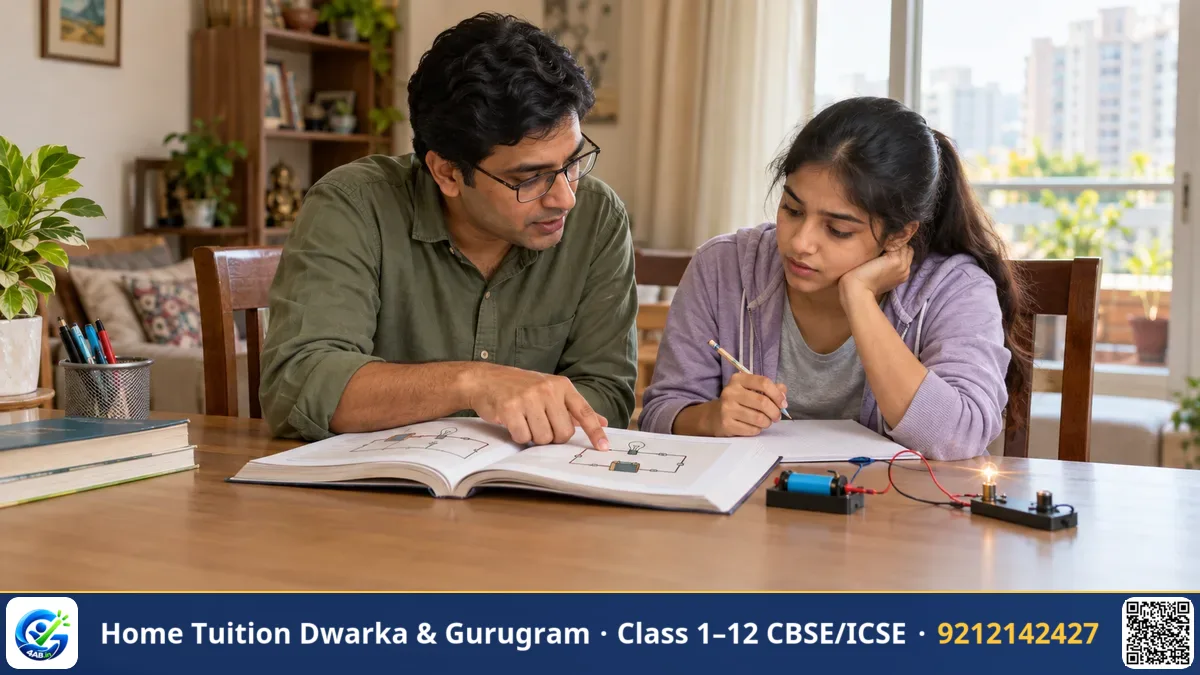
For many Class 10 students this is the first chapter where reading the textbook carefully is not enough to pass the test.
Updated 26 October 2026 · Great Home Tutor · Delhi, Noida and Gurgaon
Electricity is the chapter where Class 10 science stops rewarding memory and starts rewarding calculation. Most marks are lost on three things: not redrawing the circuit, not converting units before substituting, and choosing a formula before working out what is actually constant. All three are fixable habits rather than gaps in understanding.
| Applies to | Class 10 Science, CBSE |
|---|---|
| Depends on | Class 9 numerical habits, basic algebra |
| Usual loss | Unit conversion, parallel resistance, formula choice |
| Tuition | At home in Delhi, Noida and Gurgaon, or live online |
| Enquiries | +91 92121 42427 |
The chapter that changes what studying science means
Up to this point a diligent Class 10 student can do well by reading the chapter, learning the definitions and writing them back. Electricity does not work that way. A student can recite Ohm's law perfectly and still score badly, because the questions ask them to apply it to an arrangement of resistors they have not seen before.
This is why the chapter so often produces a sudden drop in a child who has never had trouble with science. Parents read it as the child losing interest. More often the child has simply run out of the study method that carried them this far, and nobody has given them the replacement.
Series and parallel: one rule each, applied in order
Almost all of the difficulty in this chapter is the same difficulty wearing different clothes. In a series arrangement the current is the same everywhere and the resistances add. In a parallel arrangement the potential difference across each branch is the same and the reciprocals add. That is the whole of it.
Students go wrong because they try to remember which formula belongs to which arrangement, rather than remembering which quantity stays the same. Once a student can say out loud "these two share the same current, so it is series", the formula follows without being memorised as a separate item.
- Redraw before you calculate. A circuit printed with wires bending around the page is often a simple arrangement drawn awkwardly. Redrawing it straight turns a confusing question into a routine one.
- Reduce in stages. Combine one pair at a time and write down each intermediate value. A single line of working that jumps to the final resistance earns nothing if the number is wrong.
- Sanity-check the parallel answer. The combined resistance of a parallel arrangement is always smaller than the smallest branch. A student who checks this catches the commonest error in the chapter without any help.
Where the marks actually leak
Units are the quiet destroyer here. Questions mix milliamperes with amperes, minutes with seconds, and kilowatt-hours with joules, and the student substitutes whatever number is printed. The habit worth building is mechanical: write the given quantities in a column, convert every one to its base unit before any formula appears, and only then start.
The second leak is formula choice in the power and heating questions. There are several expressions for power, and they are not interchangeable in practice, because the question will supply two of the three quantities and not the third. A student who fixes on one expression will spend three minutes finding a quantity they did not need. Teaching this as "look at what you have been given, then pick" takes far less time than teaching the algebra to rearrange it every time.
The third is the household wiring and safety material at the end of the chapter, which is short, is reliably asked, and is routinely left unread because students assume the chapter is all numericals. It is the cheapest set of marks in the topic.
The thing most parents get wrong here. When marks fall in this chapter the instinct is to arrange more science tuition. Quite often the real blockage is arithmetic and algebra, not physics. A child who cannot confidently handle reciprocals and fractions will find the parallel resistance formula genuinely hard, and no amount of explaining the physics will move it. A tutor who teaches both subjects should be checking this in the first session rather than assuming.
Reading a circuit diagram before touching a formula
We spend the first session on this topic without any calculation at all. The student is given several circuit diagrams and asked only to say, for each one, which components share a current and which share a potential difference, and where the ammeter and voltmeter would go. It feels like a waste of an hour to a student who wants to get to the sums. It usually saves three.
The same habit answers the instrument questions that appear every year: an ammeter goes in series and should have low resistance, a voltmeter goes across the component and should have high resistance. Students who have thought about what is shared find these obvious. Students who memorised them get them the wrong way round under pressure.
How the sessions are arranged
We teach one to one at home across Delhi, Noida and Gurgaon, and live online anywhere. In Dwarka the practical constraint on Class 10 science is usually the tuition calendar rather than travel: electricity tends to land close to the half-yearly in most schools, so the useful window for fixing it is narrow and worth booking early. Sessions are best at ninety minutes for this chapter rather than an hour, because a numerical practice run that is cut off halfway teaches the student to abandon problems.
Questions parents ask
My child is fine in biology and chemistry but not in this chapter. Is that a problem?
It is normal and it is worth taking seriously, because the physics content of Class 10 science is small in pages and large in marks. A child who avoids it is choosing to leave a predictable block of marks on the table every year.
Should we get a separate physics tutor for Class 10?
Usually not. Class 10 science is examined as one paper on one syllabus, and splitting it across two tutors tends to leave the biology under-taught. A single science tutor who is genuinely comfortable with numericals is the better arrangement at this stage. Separate subject tutors make sense from Class 11.
Are practical or activity marks attached to this chapter?
The school's internal assessment usually includes practical work across the year, and circuit activities are commonly part of it. The exact split is set by the school, so ask for it in writing rather than assuming.
How much practice is enough?
Fewer problems, properly written, beats many problems half-done. Ten numericals written out in full with given quantities, formula, substitution and unit will teach more than forty attempted in the head.
Can this chapter be taught online?
Yes, and it is one of the easier topics to teach online, because the circuit diagrams can be drawn and annotated on a shared screen. The condition is the same as always: the tutor must be able to see what the child is writing, not only hear the answer.
My child understands in the session and forgets by the weekend. What is happening?
Usually the session was spent watching rather than writing. Understanding a worked example and producing one from a blank page are different skills, and only the second one survives a week.
Need a tutor for this?
One-to-one at home in Delhi, Noida and Gurgaon, or live online. Free demo class.
Call / WhatsApp +91 92121 42427