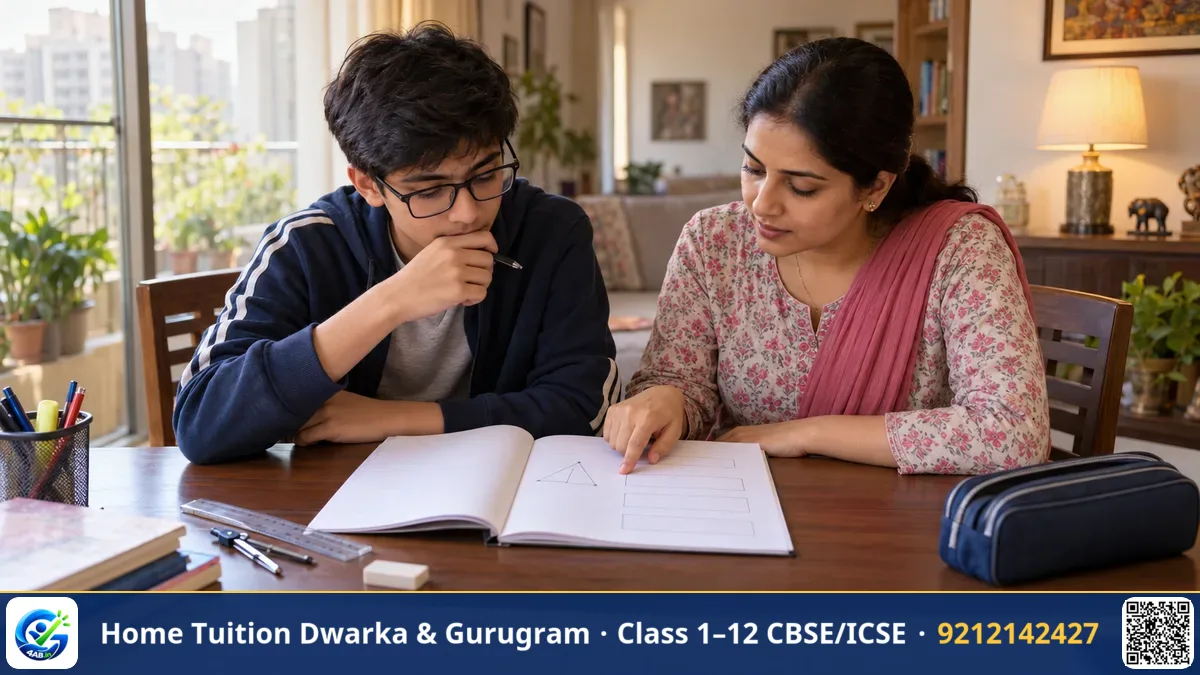
A proof can reach the right conclusion and still be marked down, because in Class 10 geometry the marks sit in the steps rather than the answer.
Updated 27 October 2026 · Great Home Tutor · Delhi, Noida and Gurgaon
Geometry in Class 10 is marked on a fixed skeleton: given, to prove, construction where one is needed, then each step with its reason written beside it. A student who shows only the working loses step marks even when the final line is correct. The repair is drilling that layout until it is automatic, not learning more theorems.
| Applies to | Class 9 and Class 10, CBSE and ICSE |
|---|---|
| Chapters | Triangles, Circles, Quadrilaterals |
| Usual loss | Reasons omitted, figure not drawn, criterion not named |
| Tuition | At home in Delhi, Noida and Gurgaon, or live online |
| Enquiries | +91 92121 42427 |
Why a correct proof still loses marks
Almost every parent who brings us a Class 10 geometry problem brings the same evidence: a test paper where the child has written something that looks, to a non-mathematician, entirely right. The triangles are similar. The answer matches. And the score is three out of five.
What has usually happened is that the student has written the mathematics and left out the justification. In geometry, the justification is not commentary on the proof. It is the proof. A step that says two angles are equal earns its mark only when the line beside it says why they are equal, and that reason has to be a stated fact, not a look at the figure.
This is a presentation problem rather than a comprehension problem, which is why it is so common in otherwise strong students. They can see the result. They have stopped noticing that the examiner cannot see what they saw.
The four-part layout, every single time
A tutor working on this will insist on the same structure whether the question carries two marks or five, and will keep insisting for several weeks, because the habit only helps once it survives exam pressure.
- Given. Written out from the question in the student's own notation, matching the figure they have drawn.
- To prove. One line. Writing this down often reveals that the student had been trying to prove something adjacent to what was asked.
- Construction. Only where one is needed, and drawn on the figure, not just described.
- Proof. Statements on the left, reasons on the right. The last line should be the same sentence as "to prove".
The figure matters more than students expect. A question that supplies no diagram is asking the child to produce one, and a proof written against a figure that was never drawn is difficult to award marks to even when the logic holds.
Similarity: naming the criterion is part of the mark
The Triangles chapter is where most of the Class 10 proof marks live. Students learn that AA, SAS and SSS establish similarity, and then write "therefore the triangles are similar" without saying which of the three they have used and which pairs of angles or sides establish it.
The drill that fixes this is narrow and dull and works: for a fortnight, every similarity question must end with a line naming the criterion and listing the correspondence in the right order. Order matters, because the proportions written afterwards follow the correspondence. A student who writes the vertices in the wrong sequence goes on to write a correct-looking ratio between the wrong pair of sides.
The basic proportionality result and the Pythagoras result behave the same way. They are quotable by name, and the mark comes from quoting them at the step where they are used.
Circles and tangents: short proofs, strict wording
The Circles chapter produces short proofs, which students treat as easy and therefore write carelessly. Two facts carry most of the questions: a tangent is perpendicular to the radius at the point of contact, and the two tangents drawn from an external point are equal in length. Both are worth quoting in full rather than gesturing at.
The common loss here is the student who proves the tangent lengths equal by measuring them on the diagram, or by asserting symmetry. Symmetry is an observation. The proof wants congruent triangles and a named criterion.
The thing most parents get wrong here. Buying a thicker book of solved proofs rarely helps. The child can already follow a proof someone else wrote; that is exactly why they think they know the chapter. What they cannot yet do is produce one on blank paper under time pressure, and that only comes from writing proofs out themselves and having the reasons checked line by line.
What this looks like in a session
We teach one to one at home across Delhi, Noida and Gurgaon, and live online anywhere. In Gurgaon most of our Class 10 slots run on weekday evenings after school, because the travel window in the middle of the day is unreliable and a proof session is not something to shorten. A typical hour on this topic is not an hour of explanation. It is roughly fifteen minutes of worked demonstration and forty of the student writing, with the tutor marking each line as it appears rather than at the end.
That marking-as-you-go matters. If a student writes five proofs and then hears about the missing reasons, they have practised the wrong habit five times. If the correction lands on line three of the first proof, the habit starts changing in the same session.
Questions parents ask
Does my child need to memorise the proofs of the theorems themselves?
Some theorems are listed in the syllabus as ones whose proof can be asked directly, and those do need to be known well enough to reproduce. The class teacher will have that list for the current year. The larger part of the marks, though, comes from applying theorems inside a new question, which is a different skill and needs different practice.
My child is good at algebra but weak at geometry. Is that normal?
It is very common, and it is usually about writing rather than ability. Algebra gives a visible trail of working that earns marks by itself. Geometry asks for an argument in sentences, which is closer to an English answer than most students expect.
Will more practice papers fix it?
Not on their own. Papers attempted and self-checked against an answer key tend to entrench the same omission, because the key shows the conclusion and the student confirms they reached it. Someone has to read the child's own lines and say which reason is missing.
Is ICSE geometry marked the same way?
The structure of the expectation is the same: statements with reasons, a clear figure, a named result. The chapter list and the weight given to construction and loci differ, so the practice should be done from the child's own board papers rather than a mixed question bank.
How long does it take to fix?
For a student who already understands the theorems, the layout habit usually holds after four to six sessions of supervised writing. If the underlying trouble is that the Class 9 geometry was never settled, it takes longer, because congruence has to be rebuilt before similarity makes sense.
Can this be taught online?
Yes, provided the tutor can see the child's page. We ask for the working to be held up or photographed at each step. Geometry is one of the topics where a tutor talking without seeing the written line is close to useless.
Need a tutor for this?
One-to-one at home in Delhi, Noida and Gurgaon, or live online. Free demo class.
Call / WhatsApp +91 92121 42427