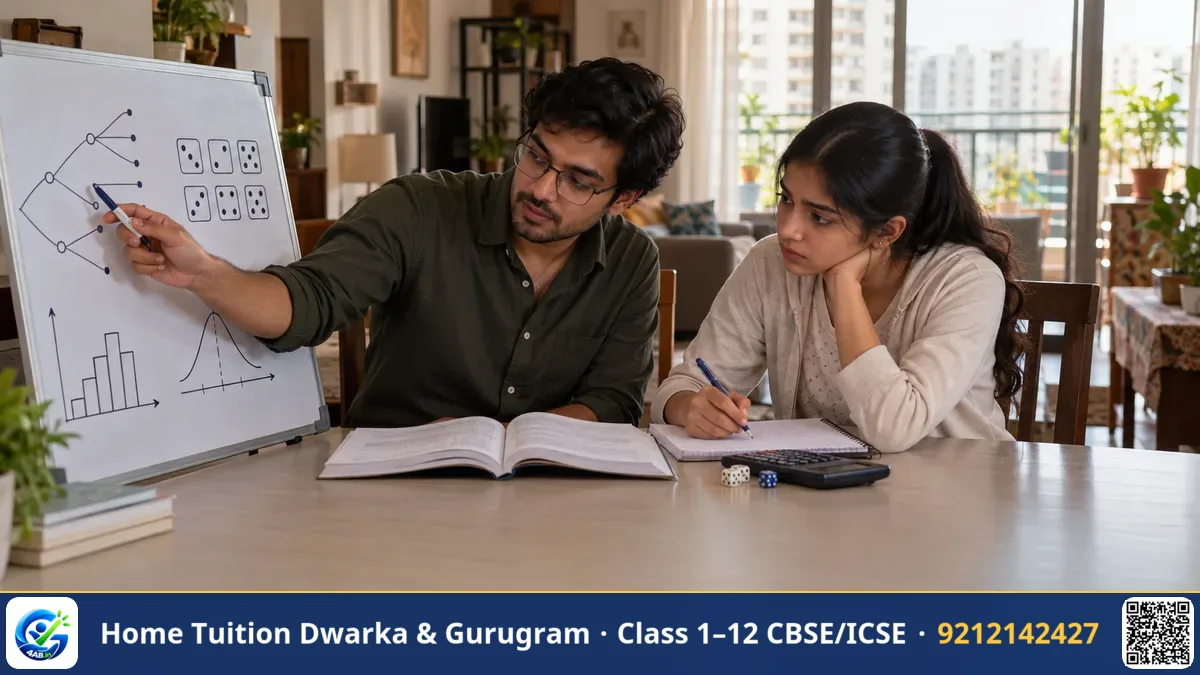
These two chapters sit at the end of the Class 11 book, and the calendar does the rest.
Updated 28 October 2026 · Great Home Tutor · Delhi, Noida and Gurgaon
Statistics and probability are the last chapters of Class 11 Maths and are often taught in the final fortnight before the annual exam. Students learn just enough to answer the questions, then forget it over the holidays. Class 12 probability, which is a large and scoring chapter, then lands on nothing. Do these two properly in the winter break instead.
| Applies to | Class 11 Maths, CBSE and ISC |
|---|---|
| Why it goes wrong | Position in the syllabus, not difficulty |
| Cost of skipping | Paid in Class 12 probability |
| Best time to fix | Winter break of Class 11 |
| Enquiries | +91 92121 42427 |
Why these two get rushed
There is nothing intrinsically hard about either chapter. They sit at the end of the book, and by the time a school reaches them the annual exam is close, revision has started and the class is tired. The teaching is compressed, the practice is thin, and the student answers the exam questions from short-term memory. That works for the exam and fails a year later.
Say this plainly to the child, because they usually assume the trouble is theirs. It is a scheduling problem, and knowing that makes them far more willing to revisit the work in a break rather than treating it as a punishment.
What Class 11 statistics is really asking
Until Class 11 statistics meant averages. Now it means spread. Two sets of marks can share the same mean and be completely different: one class clustered tightly, another split between very high and very low. Measures of dispersion exist to describe that difference numerically.
The conceptual load is small. The mark loss is almost entirely arithmetic.
- Table discipline. These questions are long tables of multiplication and addition. A student who sets the table out neatly, with a column heading for each quantity, will get them right. A student who works in the margin will not.
- Choosing the formula. Variance can be computed by more than one route and the routes look different. Picking the one that suits the data, rather than the one memorised first, saves both time and errors.
- Not stopping early. Standard deviation is the square root of variance. Forgetting the final square root is common enough to be worth naming out loud.
- Units and interpretation. A one-line comment on what the number means is often worth a mark and is almost always left blank.
Class 11 probability is not the Class 10 version
In Class 10, probability is counting favourable outcomes over total outcomes. Class 11 rebuilds it on sets. An event becomes a subset of a sample space; union, intersection and complement replace informal words like or, and, not. The addition rule follows from the set picture rather than from a formula to be memorised.
Students who never made that switch keep counting, and get away with it for most of Class 11. The bill arrives in Class 12, where conditional probability is unusable without confident set language. Test it directly: give a worded situation and ask the child to write the sample space and the events as sets before computing anything. Hesitation there is the whole diagnosis.
The thing most parents get wrong here. When Class 12 probability goes badly, the instinct is to book more Class 12 probability. Quite often the missing piece is two weeks old and one year back: the child cannot describe events as sets. Fixing that takes a couple of sessions, and the Class 12 chapter then behaves normally.
What to do, and when
Treat these two chapters as winter-break work rather than annual-exam work. In a break the student has time, the rest of the syllabus is not competing, and the material can be learned once instead of crammed twice. Four to six sessions is a reasonable shape: two on dispersion with full table practice, two on the set foundations of probability, and one or two on mixed questions. Failing that, revisit them in the summer before Class 12 starts, ahead of the school teaching Class 12 probability rather than after it.
Arranging this in Gurgaon
We teach one-to-one at home across Delhi, Noida and Gurgaon, and live online anywhere. Holiday scheduling in Gurgaon is usually easier than term-time scheduling, because the long distances between sectors matter less when a tutor is not working around school hours and evening traffic. A block of daytime sessions across a break is often simpler to arrange than a weekly evening slot, and for catch-up work a concentrated block is the right shape anyway.
Questions parents ask
My child scored well in these chapters in the annual exam. Is there still a problem?
Possibly. A good mark on a chapter taught two weeks earlier tells you the material was fresh, not that it was learned. The test is whether they can still do it in June. If they can, nothing needs doing.
Are these chapters worth many marks in Class 11?
Not a large share, which is part of why they get squeezed. Their real value is as the base for Class 12 probability, which is worth considerably more and is one of the more reliably scoring chapters there.
Can we skip statistics and only do probability?
If time is genuinely short, yes, prioritise probability, because that is what Class 12 builds on directly. But dispersion is a small chapter and largely arithmetic, so the saving is smaller than it looks.
Is a calculator allowed for these?
Check your board's rule for your child's year rather than assuming; it differs between boards and has changed over time. Either way, practise under the same condition the exam will impose, since table-heavy questions feel very different with and without one.
How do I tell whether the set language is missing?
Ask the child to write, in set notation, the event that a die shows an even number or a number greater than four. If they compute a probability instead of writing the set, the gap is there.
Need a tutor for this?
One-to-one at home in Delhi, Noida and Gurgaon, or live online. Free demo class.
Call / WhatsApp +91 92121 42427