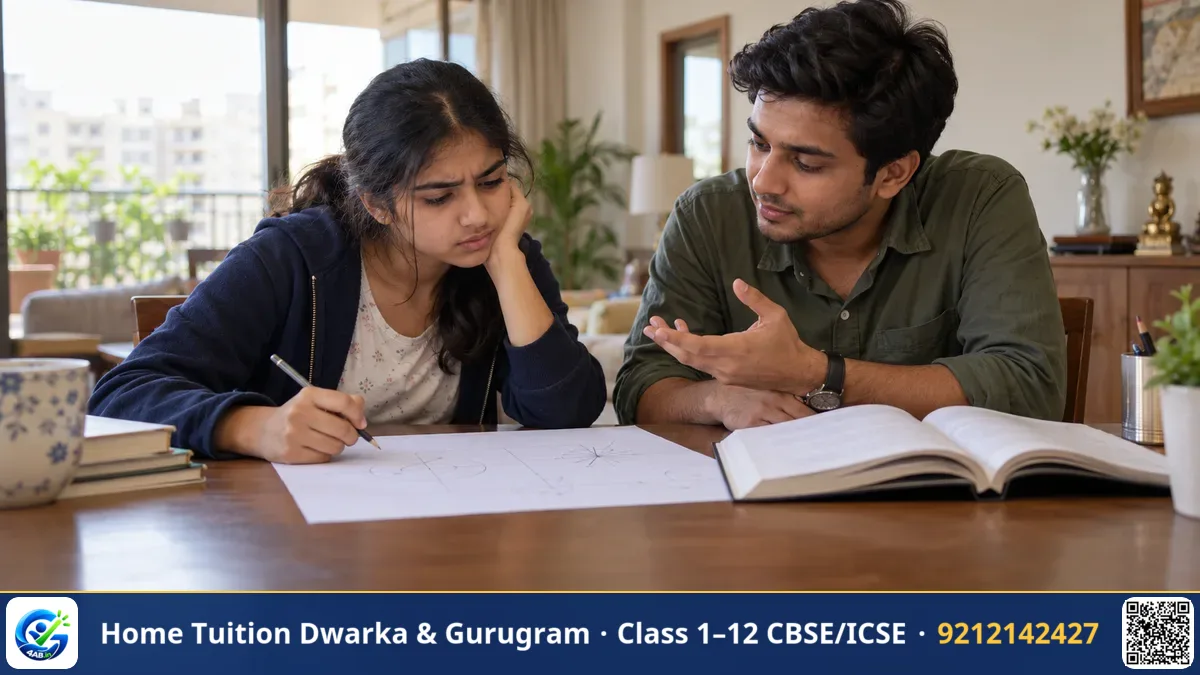
This is usually the first chapter in which a student cannot picture what the answer means, and that is what makes it feel hard.
Updated 30 October 2026 · Great Home Tutor · Delhi, Noida and Gurgaon
Complex numbers are algebraically easy and conceptually strange. Every rule in the chapter is ordinary algebra with one extra fact attached. Students struggle not because the working is difficult but because they are waiting for a picture that the number line cannot give them. Teach the purpose first, then the algebra becomes routine.
| Applies to | Class 11 Maths, CBSE and ISC |
|---|---|
| Difficulty | Low algebra, high strangeness |
| Common symptom | Correct steps, no idea what was proved |
| Enquiries | +91 92121 42427 |
Start with why anyone invented this
Until Class 11, every new kind of number arrived because the old kind ran out. Whole numbers could not handle subtraction, so integers appeared. Integers could not handle division, so fractions appeared. Each time the number line got more crowded and the child kept the same mental picture.
Complex numbers break that pattern, and no one tells students so. They arrive because squaring never produces a negative, which means a perfectly reasonable quadratic can have no solution at all. Rather than accept that, mathematics defines one new object whose square is minus one and then checks that the old rules still behave. A student who has been told this finds the chapter dull but manageable. A student who has not spends it quietly suspecting that everyone is pretending, which is exhausting and makes the algebra feel unreliable.
The algebra is ordinary, with one substitution
Adding, subtracting and multiplying complex numbers is exactly the algebra of two-term expressions the child already does, plus a single replacement at the end. Anywhere the square of i appears, write minus one. That is the whole rule.
- Powers of i. They cycle in fours. Students who work this out once, from the definition, never forget it. Students who memorise a list of four values forget it by February.
- The conjugate. Flip the sign of the imaginary part. Its only job at this level is to clear an imaginary number out of a denominator, exactly the way rationalising clears a surd. The technique is one the child has already used for two years under a different name.
- The modulus. Size without direction. Mechanically it is Pythagoras on the two parts, and telling a student so removes most of the mystery.
- Equality. Two complex numbers are equal only when both parts match separately. Nearly every question that looks like it needs a trick is actually this rule, used to turn one equation into two.
Where students actually lose marks
Four errors account for most of it. Treating i as an unknown to be solved for rather than a fixed quantity. Getting the sign wrong when the square of i is substituted, particularly inside a longer expansion. Dividing without multiplying by the conjugate first, then trying to simplify something that will not simplify. And leaving the answer in a form the question did not ask for, which loses the final mark even though the work was right. All four are correctable in a session or two, because none of them is a misunderstanding of the idea. They are habits, and habits respond to being caught in the moment rather than explained in general.
The thing most parents get wrong here. When a child says this chapter makes no sense, the instinct is to book more hours on it. Usually the child understands the working perfectly and is troubled by the meaning. Ten minutes on why the idea exists does more than another two hours of practice sums, and the practice then goes much faster.
Check which parts your syllabus includes
Syllabuses trim from year to year, and this chapter carries more optional material than most. The geometric picture, polar form and the argument are taught in full in some courses and left out of others. Do not assume from an old book or an older sibling. Look at the current syllabus document your child's school follows and at this year's sample paper, and mark which sub-topics are actually in. It takes ten minutes and prevents the two opposite wastes: drilling something that will not be asked, and being surprised by something that will.
How this runs as home tuition in Dwarka
We teach one-to-one at home across Delhi, Noida and Gurgaon, and live online anywhere. In Dwarka the sectors sit close enough together that a tutor can hold consecutive evening sessions nearby, so an extra mid-week hour before a unit test is usually easy to arrange. For a short, self-contained chapter like this, that matters more than it sounds. Complex numbers is often worth one concentrated push rather than a slow crawl across a month.
Questions parents ask
My child says this topic is pointless. Is it?
Not pointless, but the uses that justify it sit well beyond Class 11, in engineering and physics. At school level the honest answer is that it completes the number system so that every polynomial equation has solutions. Saying that plainly is better than pretending there is an everyday application.
Is it a hard chapter?
It is one of the easier chapters to score in, once the strangeness passes. The algebra is short, the question types repeat, and full marks are common. That is worth telling a child who has decided in advance that it will be difficult.
How much time should it take?
For most students, one to two weeks of ordinary classwork plus practice. If it is still unsettled after a month, the problem is usually the underlying algebra of expansion and simplification rather than the complex numbers themselves.
Does it connect to quadratic equations?
Directly. It is the reason a quadratic with a negative discriminant is no longer called unsolvable. The two topics are usually taught together, and a student who has settled quadratics will find this much easier.
Will this be needed in Class 12?
Less than most Class 11 chapters. It is worth learning properly for the marks and for the completeness of the idea, but if you are deciding what to revise in the break before Class 12, other topics repay the time more.
Need a tutor for this?
One-to-one at home in Delhi, Noida and Gurgaon, or live online. Free demo class.
Call / WhatsApp +91 92121 42427