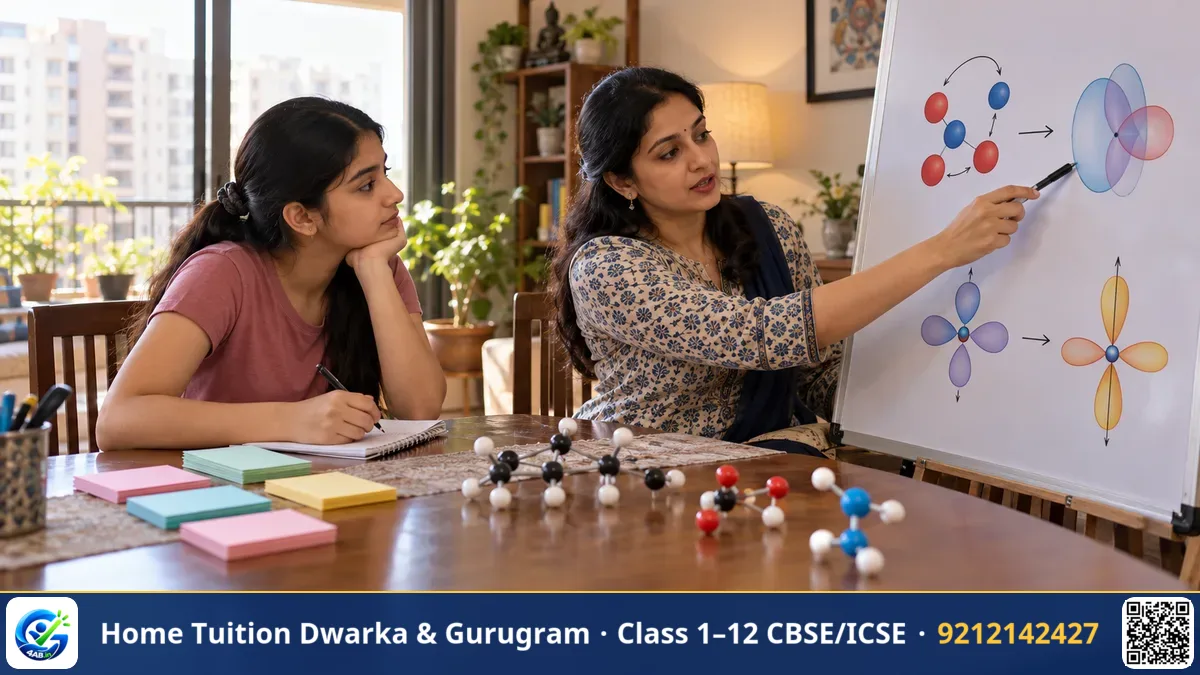
This is the chapter where students decide chemistry is only memory and stop trying to understand it. Half of it is memory. The other half explains itself.
Updated 27 October 2026 · Great Home Tutor · Delhi, Noida and Gurgaon
The d- and f-block chapter has a genuine memory load and a small set of explanations that generate most of the answers. Separate the two on the first day. Configurations, oxidation states and two named compounds must be learned. Colour, magnetism, catalytic behaviour and radii should be reasoned out, and they come from the same few ideas.
| Applies to | Class 12 Chemistry, CBSE and ISC |
|---|---|
| Genuinely memory | Configurations, common oxidation states, two named compounds |
| Genuinely reasoning | Colour, paramagnetism, catalysis, trends in radii |
| Reliable numerical | Spin-only magnetic moment |
| Enquiries | +91 92121 42427 |
Decide what is memory before you start
Students fail this chapter by treating all of it as a list to be learned, then finding the list too long and abandoning it. A tutor’s first job is to draw the line clearly.
On the memory side: the electronic configurations of the first transition series, including the two that break the pattern, chromium and copper; the common oxidation states, especially of manganese and iron; and the preparation, structure and oxidising behaviour of potassium dichromate and potassium permanganate, which are the two compounds the chapter is built around.
On the reasoning side sits almost everything else. Once a student can explain the properties, the answers stop needing to be recalled and start being derived, which is the difference between a shaky grade and a secure one.
The explanations that do the work
- Variable oxidation states. The outer s and the inner d levels are close in energy, so several electrons are available for bonding rather than a fixed number.
- Colour. Electrons move between d levels split by the surrounding ligands, and the light absorbed in doing so leaves the complementary colour visible. This also explains the exceptions: ions with an empty or a completely filled d sub-shell, such as scandium in the plus three state and zinc in the plus two state, have no such transition available and their compounds are colourless.
- Magnetic behaviour. Unpaired electrons make a species paramagnetic, and the spin-only expression relates the number of them to the magnetic moment. Counting the unpaired electrons correctly is the whole skill.
- Catalysis. Variable oxidation states let these metals accept and release electrons during a reaction, and their surfaces adsorb reactants. Both reasons are marked.
- Nearly constant radii across a series. The added electron enters an inner shell and screens the increasing nuclear charge, so the size changes little.
The one idea that keeps paying is the lanthanoid contraction. It explains why the elements of the second and third transition series are so close in size, and therefore why they behave so similarly and are hard to separate. Students who learn it as a definition cannot use it; students who learn it as a cause answer three different questions with it.
The order in which to teach it
Configurations first, then oxidation states, then the property explanations, and only then the two compounds. Starting with potassium dichromate and potassium permanganate, which is what a rushed revision does, is the reliable way to drown a student, because the preparation equations are meaningless until the oxidation-state reasoning is in place.
The spin-only calculation deserves its own short drill. It is brief, it is asked, and it can be made automatic in about twenty minutes of practice. That makes it one of the best returns in the chapter for the time invested.
The thing most parents get wrong here. When a child says they have read this chapter three times, the reading is the problem, not the effort. This material does not enter by being read. It has to be written — configurations written out, the permanganate half reaction balanced on paper — and then tested cold a fortnight later.
Chemistry slots in Noida
We teach at home across Delhi, Noida and Gurgaon, and online anywhere. In Noida the sectors are far apart, so a tutor usually holds a cluster of nearby sectors and those evening slots fill first. This chapter is normally taught in the middle of the board year, when nobody wants to be changing tutors or times, so it is worth asking early whether the tutor already teaches in your part of the city.
Questions parents ask
Is this chapter mostly memory, as my child claims?
Partly. The configurations and the two compounds are memory. Colour, magnetism and catalysis are not, and that is where most of the reasoning marks sit.
My child can name the colours but cannot explain them. Does that matter?
Yes. Questions are commonly set as explain why rather than state, and a colour recalled without its explanation earns nothing in that form.
NCERT or a reference book for the two compounds?
For CBSE, the textbook treatment is the one the paper follows. Use a reference book for extra practice questions, not for a different version of the content.
How many sessions does this chapter usually take?
Three or four, if the Class 11 periodic trends work is secure. This chapter assumes it, so that is worth checking first.
Need a tutor for this?
One-to-one at home in Delhi, Noida and Gurgaon, or live online. Free demo class.
Call / WhatsApp +91 92121 42427