Symmetry Lab › Ih › closo-Dodecaborate ion
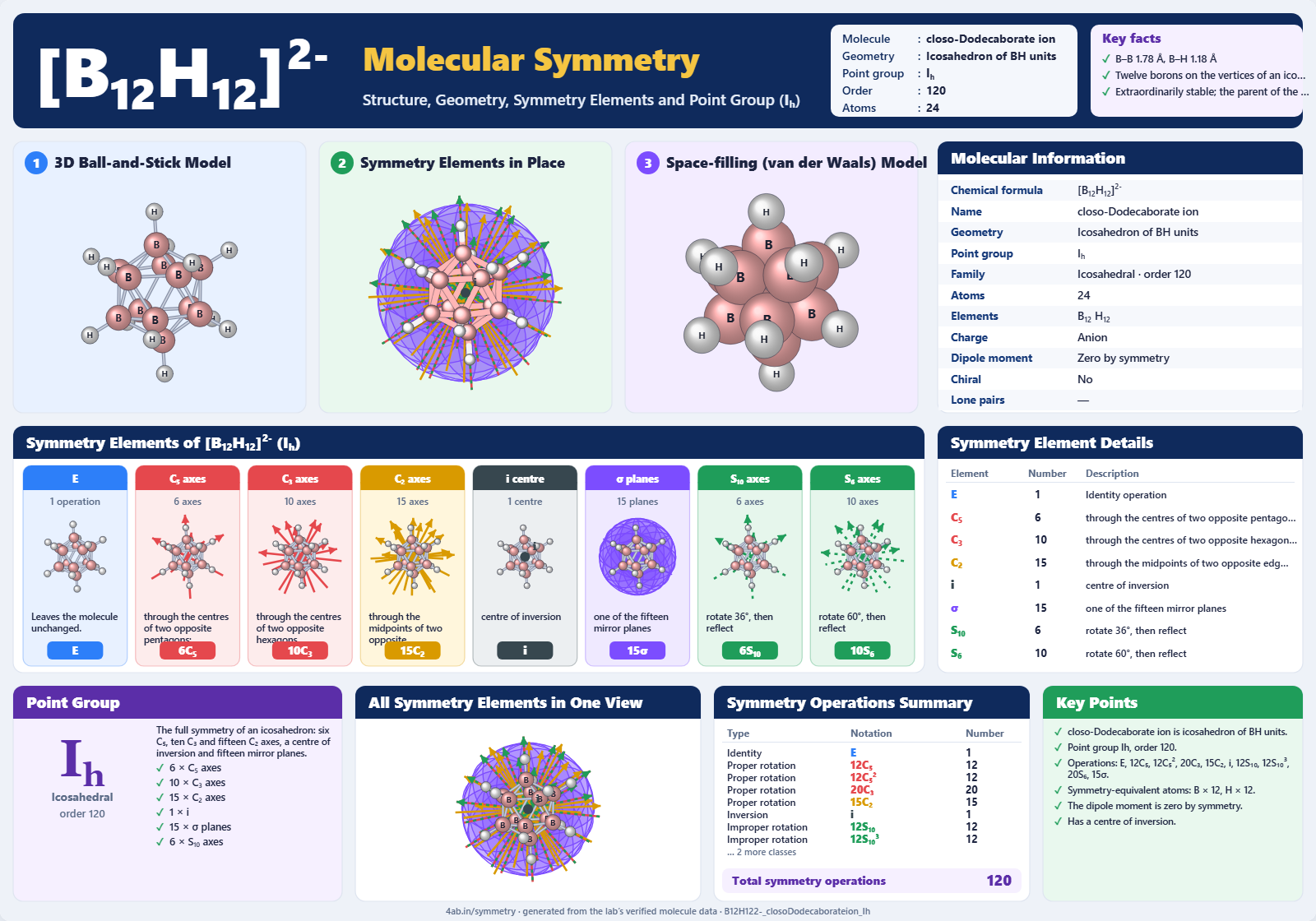
[B₁₂H₁₂]²⁻ closo-Dodecaborate ion
Icosahedron of BH units · point group Ih · order 120
- Point group
- Ih — The full symmetry of a regular icosahedron or dodecahedron: six C5 axes, ten C3 axes, fifteen C2 axes, a centre of inversion and fifteen mirror planes.
- Order
- 120
- Operations
- E, 12C₅, 12C₅², 20C₃, 15C₂, i, 12S₁₀, 12S₁₀³, 20S₆, 15σ
- Shape
- Icosahedron of BH units
- Atoms
- 24 (B × 12, H × 12)
Symmetry elements of [B₁₂H₁₂]²⁻
- C₅ (1) — through the centres of two opposite pentagons; also an S₁₀ axis
- C₅ (2) — through the centres of two opposite pentagons; also an S₁₀ axis
- C₅ (3) — through the centres of two opposite pentagons; also an S₁₀ axis
- C₅ (4) — through the centres of two opposite pentagons; also an S₁₀ axis
- C₅ (5) — through the centres of two opposite pentagons; also an S₁₀ axis
- C₅ (6) — through the centres of two opposite pentagons; also an S₁₀ axis
- C₃ (1) — through the centres of two opposite hexagons / three-fold vertices; also an S₆ axis
- C₃ (2) — through the centres of two opposite hexagons / three-fold vertices; also an S₆ axis
- C₃ (3) — through the centres of two opposite hexagons / three-fold vertices; also an S₆ axis
- C₃ (4) — through the centres of two opposite hexagons / three-fold vertices; also an S₆ axis
- C₃ (5) — through the centres of two opposite hexagons / three-fold vertices; also an S₆ axis
- C₃ (6) — through the centres of two opposite hexagons / three-fold vertices; also an S₆ axis
- C₃ (7) — through the centres of two opposite hexagons / three-fold vertices; also an S₆ axis
- C₃ (8) — through the centres of two opposite hexagons / three-fold vertices; also an S₆ axis
- C₃ (9) — through the centres of two opposite hexagons / three-fold vertices; also an S₆ axis
- C₃ (10) — through the centres of two opposite hexagons / three-fold vertices; also an S₆ axis
- C₂ (1) — through the midpoints of two opposite edges
- C₂ (2) — through the midpoints of two opposite edges
- C₂ (3) — through the midpoints of two opposite edges
- C₂ (4) — through the midpoints of two opposite edges
- C₂ (5) — through the midpoints of two opposite edges
- C₂ (6) — through the midpoints of two opposite edges
- C₂ (7) — through the midpoints of two opposite edges
- C₂ (8) — through the midpoints of two opposite edges
- C₂ (9) — through the midpoints of two opposite edges
- C₂ (10) — through the midpoints of two opposite edges
- C₂ (11) — through the midpoints of two opposite edges
- C₂ (12) — through the midpoints of two opposite edges
- C₂ (13) — through the midpoints of two opposite edges
- C₂ (14) — through the midpoints of two opposite edges
- C₂ (15) — through the midpoints of two opposite edges
- i — centre of inversion
- σ (1) — one of the fifteen mirror planes
- σ (2) — one of the fifteen mirror planes
- σ (3) — one of the fifteen mirror planes
- σ (4) — one of the fifteen mirror planes
- σ (5) — one of the fifteen mirror planes
- σ (6) — one of the fifteen mirror planes
- σ (7) — one of the fifteen mirror planes
- σ (8) — one of the fifteen mirror planes
- σ (9) — one of the fifteen mirror planes
- σ (10) — one of the fifteen mirror planes
- σ (11) — one of the fifteen mirror planes
- σ (12) — one of the fifteen mirror planes
- σ (13) — one of the fifteen mirror planes
- σ (14) — one of the fifteen mirror planes
- σ (15) — one of the fifteen mirror planes
- S₁₀ (1) — rotate 36°, then reflect
- S₁₀ (2) — rotate 36°, then reflect
- S₁₀ (3) — rotate 36°, then reflect
- S₁₀ (4) — rotate 36°, then reflect
- S₁₀ (5) — rotate 36°, then reflect
- S₁₀ (6) — rotate 36°, then reflect
- S₆ (1) — rotate 60°, then reflect
- S₆ (2) — rotate 60°, then reflect
- S₆ (3) — rotate 60°, then reflect
- S₆ (4) — rotate 60°, then reflect
- S₆ (5) — rotate 60°, then reflect
- S₆ (6) — rotate 60°, then reflect
- S₆ (7) — rotate 60°, then reflect
- S₆ (8) — rotate 60°, then reflect
- S₆ (9) — rotate 60°, then reflect
- S₆ (10) — rotate 60°, then reflect
Structure
- B–B 1.78 Å, B–H 1.18 Å
- Twelve borons on the vertices of an icosahedron
- Extraordinarily stable; the parent of the carboranes