ABC26OR0004 · General Organic Chemistry
Subject: Organic Chemistry · Chapter: General Organic Chemistry · Topic: Aromaticity · Exam: CSIR-NET JUNE 2011 · Marks: 2 · Difficulty: Easy
Among the carbocations given below
(a)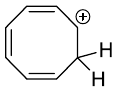 A is homoaromatic, B is antiaromatic and C is aromatic.
A is homoaromatic, B is antiaromatic and C is aromatic.(b) A is aromatic, B is antiaromatic and C is homoaromatic.
A is aromatic, B is antiaromatic and C is homoaromatic.(c) A is antiaromatic, B is aromatic and C is harmoaromatic.
A is antiaromatic, B is aromatic and C is harmoaromatic.(d)A is homoaromatic, B is aromatic and C is antiaromatic.
Answer
Answer (as printed): A
Explanation
Homoaromatic: The carbocation (A) has been aromatized by bypassing the $sp^3$ carbon atom. Antiaromatic compounds contain $4\pi$ electrons; all atoms are $sp^2$ hybridized and planar. The structure (B) has $4\pi$ electrons and follows the other requirements of an anti-aromatic compound. Hence (B) is anti-aromatic. The carbocation (C) follows the Huckel's rule. $(4n+2)\pi$ electrons $= 2\pi$ electrons. Hence, n = 0. (C) is aromatic.