ABC26OR0847 · Reaction Mechanism I
Subject: Organic Chemistry · Chapter: Reaction Mechanism I · Topic: Reaction Mechanism – I – General · Exam: JAM 2005-2022 · Marks: 2 · Difficulty: Hard
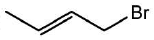
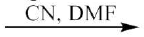
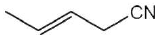

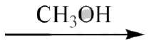
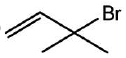

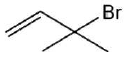
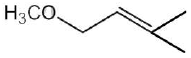
(a)(i) Only $\mathrm{S}_{\mathrm{N}} 2$ mechanism is operating here because. ${ }_{\mathrm{CN}}^{\Theta}$ is a strong nucleophilic. $\mathrm{CH}_{3} \mathrm{OH}$ is a weak nucleophile.
(b)DMF is an aprotic polar solvent in which nucleophilic does not get solvated. $\mathrm{CH}_{3} \mathrm{OH}$ is a protic polar solvent which stablises the carbocation formed in $\mathrm{S}_{\mathrm{N}} 1$ mechanism.
(c)Alkyl halide is primary, so steric hinderence is less. Alkyl halide is tertiary,
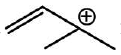
(d)Allylic group increases the electropositive character (because, $\mathrm{sp}^{2}$ carbon is more electronegative than $\mathrm{sp}^{3}$ carbon), so nucleophile can attach faster. (ii) here $\mathrm{S}_{\mathrm{N}} 1$ mechanism is operative because: In $\mathrm{S}_{\mathrm{N}} 1$ mechanism, carbocation formed is stablished by resonance with double bond. - -л. 3
Answer
SELF-PRACTICE — the source book printed no answer.
Nothing is invented here, so this question has no answer on record.
Explanation
No explanation was printed for this question.