
Question 1
The two compounds given below are:
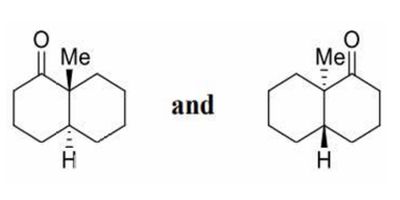
Correct Answer: (b) Identical
Explanation:
A 180° rotation about the carbonyl carbon–carbon bond converts one structure into the other. Since the two structures are interconvertible by simple rotation and no bond breaking is required, they represent the same molecule and are therefore identical, not enantiomers or diastereomers.
Explanation:
A 180° rotation about the carbonyl carbon–carbon bond converts one structure into the other. Since the two structures are interconvertible by simple rotation and no bond breaking is required, they represent the same molecule and are therefore identical, not enantiomers or diastereomers.
Correct Answer: (a) 1R,4R
Explanation:
The substituents at each chiral centre are numbered according to the CIP priority rules. The atom with the highest atomic number is assigned the highest priority. After orienting the lowest priority group away from the observer, the sequence of remaining substituents is traced. Both stereocentres show a clockwise arrangement, leading to R-configuration at positions 1 and 4.
Explanation:
The substituents at each chiral centre are numbered according to the CIP priority rules. The atom with the highest atomic number is assigned the highest priority. After orienting the lowest priority group away from the observer, the sequence of remaining substituents is traced. Both stereocentres show a clockwise arrangement, leading to R-configuration at positions 1 and 4.
Question 2
The configurations at the two stereocentres in the compound given below are:
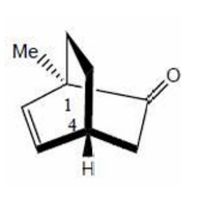
Correct Answer: (a) 1R,4R
Explanation:
The substituents at each chiral centre are numbered according to the CIP priority rules. The atom with the highest atomic number is assigned the highest priority. After orienting the lowest priority group away from the observer, the sequence of remaining substituents is traced. Both stereocentres show a clockwise arrangement, leading to R-configuration at positions 1 and 4.
Explanation:
The substituents at each chiral centre are numbered according to the CIP priority rules. The atom with the highest atomic number is assigned the highest priority. After orienting the lowest priority group away from the observer, the sequence of remaining substituents is traced. Both stereocentres show a clockwise arrangement, leading to R-configuration at positions 1 and 4.
Studying this for an exam? ABC Chemistry teaches it in class — Class 11 to CSIR-NET. Book a free demo →