Acid-Base Indicators: Choosing the Right One for a Titration
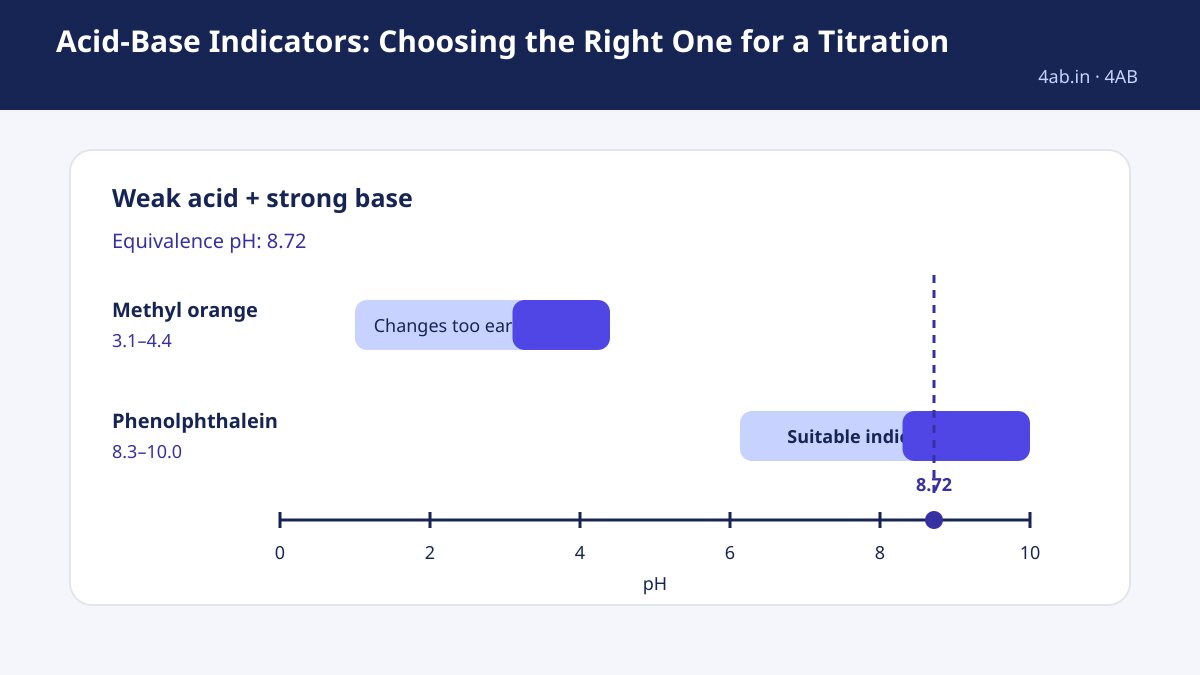
In a titration, the colour change of the indicator tells you when to stop. If you choose the wrong indicator, the colour changes at the wrong volume and your answer is wrong, even if every calculation is perfect. Class 11 and 12 practicals, and viva questions, often ask: “Why phenolphthalein for this titration and methyl orange for that one?” The answer comes from the pH at the equivalence point.

The rule
Choose an indicator whose range lies on the steep part of the titration curve, around the equivalence-point pH.
What this means
- Equivalence point – the moment when the acid and base have reacted in exactly the amounts given by the balanced equation.
- End point – the moment when the indicator changes colour. We want end point ≈ equivalence point.
- pKin – pKa of the indicator, which is itself a weak acid. The colour changes when [HIn] and [In⁻] are comparable.
- Steep part – near the equivalence point the pH changes by several units for a single drop of titrant. Any indicator that changes inside this jump gives an accurate result.
Common indicators (approximate ranges)
| Indicator | Approximate pH range | Colour change |
|---|---|---|
| Methyl orange | 3.1 – 4.4 | red → yellow |
| Methyl red | 4.4 – 6.2 | red → yellow |
| Phenolphthalein | 8.3 – 10.0 | colourless → pink |
Textbooks quote slightly different limits (for example 8.2–10.0 for phenolphthalein). Use the values in your own book for answers.
Worked examples: find the equivalence pH, then choose
Example 1: strong acid + strong base. 25.0 mL of 0.100 M HCl is titrated with 0.100 M NaOH. Find the pH near the equivalence point (25.0 mL).
At 24.9 mL of NaOH added: acid left = (25.0 − 24.9) × 0.100 = 0.0100 mmol in 49.9 mL. [H⁺] = 0.0100/49.9 = 2.004 × 10⁻⁴ M, so pH = 3.70.
At 25.0 mL: only NaCl is present, pH = 7.00.
At 25.1 mL: base left = 0.0100 mmol in 50.1 mL. [OH⁻] = 1.996 × 10⁻⁴ M, pOH = 3.70, pH = 10.30.
The pH jumps from 3.70 to 10.30 for just 0.2 mL. Methyl orange, methyl red and phenolphthalein all change inside this jump, so any of them works.
Example 2: weak acid + strong base. 25.0 mL of 0.100 M acetic acid (Ka = 1.8 × 10⁻⁵) with 0.100 M NaOH. Find the pH at equivalence.
At 25.0 mL NaOH, all acid becomes sodium acetate. Total volume = 50.0 mL, so [CH₃COO⁻] = 2.50 mmol / 50.0 mL = 0.0500 M.
Kb of acetate = Kw/Ka = 1.0 × 10⁻¹⁴ / 1.8 × 10⁻⁵ = 5.56 × 10⁻¹⁰.
[OH⁻] = √(5.56 × 10⁻¹⁰ × 0.0500) = √(2.78 × 10⁻¹¹) = 5.27 × 10⁻⁶ M.
pOH = 5.28, so pH = 8.72.
The equivalence point is on the basic side. Phenolphthalein (8.3–10.0) fits. Methyl orange (3.1–4.4) would change colour long before, giving a volume that is too small.
Example 3: weak base + strong acid. 25.0 mL of 0.100 M NH₃ (Kb = 1.8 × 10⁻⁵) with 0.100 M HCl. Find the pH at equivalence.
At 25.0 mL HCl, all NH₃ becomes NH₄⁺ at 2.50 mmol / 50.0 mL = 0.0500 M.
Ka of NH₄⁺ = Kw/Kb = 5.56 × 10⁻¹⁰.
[H⁺] = √(5.56 × 10⁻¹⁰ × 0.0500) = 5.27 × 10⁻⁶ M, so pH = 5.28.
The equivalence point is acidic. Methyl red (4.4–6.2) fits; methyl orange (3.1–4.4) is the usual school choice for a strong-acid/weak-base titration. Phenolphthalein would turn too early or fail here.
Example 4: half-way point. In Example 2, after 12.5 mL of NaOH, half of the acetic acid is converted. Then [CH₃COOH] = [CH₃COO⁻], and pH = pKa = −log(1.8 × 10⁻⁵) = 4.74. This is a useful way to find the Ka of a weak acid from a titration graph.
Summary table
| Titration | pH at equivalence | Suitable indicator |
|---|---|---|
| Strong acid + strong base | 7.00 | Any of the three above |
| Weak acid + strong base | Above 7 (8.72 in Example 2) | Phenolphthalein |
| Strong acid + weak base | Below 7 (5.28 in Example 3) | Methyl red / methyl orange |
| Weak acid + weak base | No sharp jump | No simple indicator works well; use a pH meter |
Mistakes to avoid
- Saying the equivalence point is always pH 7. It is 7 only when both acid and base are strong.
- Confusing end point with equivalence point. The indicator gives the end point; we hope it is close to equivalence.
- Forgetting that the total volume doubles at equivalence (25 + 25 = 50 mL), so the salt concentration is halved.
- Adding too much indicator. Indicators are weak acids or bases themselves; two or three drops are enough.
- Using the pH = pKa shortcut at the wrong point: it works only at the half-way point of a weak acid.
Exam relevance
| Where | What to expect |
|---|---|
| Class 11–12 practical exam and viva | Which indicator for which titration, and why. Your school or board will state the exact experiments. |
| Written papers | Short answers on equivalence pH and the hydrolysis of the salt formed. See your latest syllabus for the chapter. |
Use the pH tool to check the pH of a solution at any point on your titration.
Open the pH / pOH Calculator →Turn this concept into marks: solve previous-year CSIR-NET questions and take a timed quiz.
More Equilibrium articles