Boyle's Law and Charles's Law Numericals with Solutions
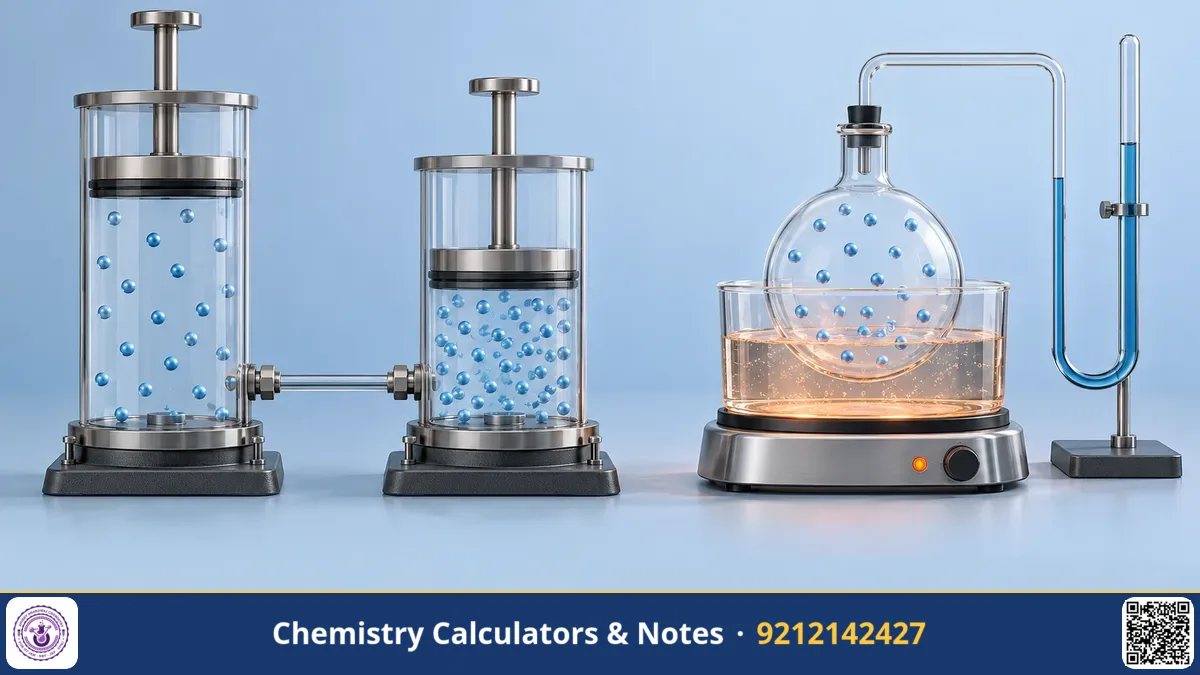
Boyle's law and Charles's law are the two oldest gas laws, and every Class 11 student meets them in the chapter on states of matter. The numericals look easy, yet many marks are lost on one small point: temperature must be in kelvin. This page states both laws, explains when each one applies, and works through five numericals with every step shown.
The laws
Charles's law (n and P constant): V1 ÷ T1 = V2 ÷ T2
Gay-Lussac's law (n and V constant): P1 ÷ T1 = P2 ÷ T2
Combined: P1V1 ÷ T1 = P2V2 ÷ T2
P is pressure (atm, bar, kPa or mmHg), V is volume (L or mL) and T is the absolute temperature in kelvin. For the pressure and volume, any unit works, as long as both sides use the same unit, because the unit cancels. For temperature, the unit must be kelvin: T (K) = t (°C) + 273.15. Many school books round this to 273, and the answers change only in the last digit.
In words: at constant temperature, if you squeeze a gas to half its volume, its pressure doubles (Boyle). At constant pressure, if you heat a gas, it expands in direct proportion to its kelvin temperature (Charles). At constant volume, heating raises the pressure in the same way (Gay-Lussac).
Which law do I use?
| What stays fixed | What changes | Law |
|---|---|---|
| Temperature and amount | P and V | Boyle: P1V1 = P2V2 |
| Pressure and amount | V and T | Charles: V1/T1 = V2/T2 |
| Volume and amount | P and T | Gay-Lussac: P1/T1 = P2/T2 |
| Only the amount is fixed | P, V and T | Combined gas law |
Each law is just the combined gas law with one quantity crossed out. The ideal gas equation PV = nRT contains all of them.
Worked example 1: Boyle's law
Question. A gas occupies 4.0 L at 1.00 atm. The temperature is kept constant and the gas is compressed to 2.5 L. Find the new pressure.
Formula. P1V1 = P2V2, so P2 = P1V1 ÷ V2.
Calculation. P2 = (1.00 × 4.0) ÷ 2.5 = 1.60 atm.
Check. The volume fell, so the pressure must rise. 1.60 is greater than 1.00, which agrees.
Worked example 2: Charles's law
Question. A balloon holds 300 mL of air at 27 °C. It is warmed to 57 °C at constant pressure. What is its new volume?
Convert to kelvin. T1 = 27 + 273 = 300 K. T2 = 57 + 273 = 330 K.
Formula. V2 = V1 × T2 ÷ T1.
Calculation. V2 = 300 × 330 ÷ 300 = 330 mL. (With 273.15 the answer is 329.99 mL, which rounds to the same value.)
Worked example 3: the Celsius trap
Question. What would you get in example 2 if you wrongly used the Celsius numbers?
Wrong working. V2 = 300 × 57 ÷ 27 = 633 mL.
The wrong answer says the balloon more than doubles when warmed by only 30 degrees, which is not sensible. The correct increase is 330 ÷ 300, a rise of only 10 per cent. The Celsius scale has an arbitrary zero at the freezing point of water, but gas volumes shrink towards zero at absolute zero, so only the kelvin scale works in these ratios.
Worked example 4: Gay-Lussac's law
Question. A sealed cylinder holds gas at 5.0 atm and 27 °C. It is heated to 127 °C. Find the pressure, assuming the volume does not change.
Kelvin. T1 = 300 K, T2 = 400 K.
Calculation. P2 = P1 × T2 ÷ T1 = 5.0 × 400 ÷ 300 = 6.67 atm.
This is why a closed gas cylinder or an aerosol can must never be thrown into a fire.
Worked example 5: the combined gas law
Question. A gas has a volume of 2.0 L at 1.0 atm and 27 °C. What will its volume be at 4.0 atm and 127 °C?
Kelvin. T1 = 300 K, T2 = 400 K.
Formula. V2 = V1 × (P1 ÷ P2) × (T2 ÷ T1).
Calculation. V2 = 2.0 × (1.0 ÷ 4.0) × (400 ÷ 300) = 2.0 × 0.25 × 1.333 = 0.667 L.
Check. Pressure up four times would give 0.50 L. Heating adds a factor 4/3, which gives 0.667 L. Both effects point the right way.
Where the laws fail
These laws describe an ideal gas. Real gases follow them well at low pressure and high temperature, and they deviate when the pressure is high or the temperature is close to the boiling point of the gas. The amount of gas must not change, so a leaking tyre or a reaction that makes or uses gas is outside these laws. For such cases use PV = nRT.
Common mistakes
- Using °C in Charles's or Gay-Lussac's law. Always convert to kelvin first.
- Using the wrong law. Read what is kept constant. If both P and T change, you need the combined law.
- Inverting the ratio. In Boyle's law, P and V are inverse; in Charles's law, V and T are direct. Use the sense check: does the answer move the way the physics says?
- Mixing units across the two sides. P1 in atm and P2 in mmHg will give nonsense. Convert so both match (1 atm = 760 mmHg).
- Taking the temperature difference. Use the temperatures, not (T2 − T1).
Exam syllabi differ in the exact set of gas laws they ask and in whether 273 or 273.15 is used, so check your own book or notification.
Check your answer with the combined gas law tool, which covers Boyle's and Charles's laws as special cases.
Open the Combined Gas Law Calculator →Turn this concept into marks: solve previous-year CSIR-NET questions and take a timed quiz.
More Solutions articles