pH of a Buffer After Adding Strong Acid or Base
A buffer is a mixture that resists a change in pH. In Class 11 and Class 12 exams the question is rarely “what is the pH of this buffer?” alone. The more common question is: what is the pH after a little strong acid or strong base is added? This page gives one clear method that works every time, with four worked examples.

The idea in one line
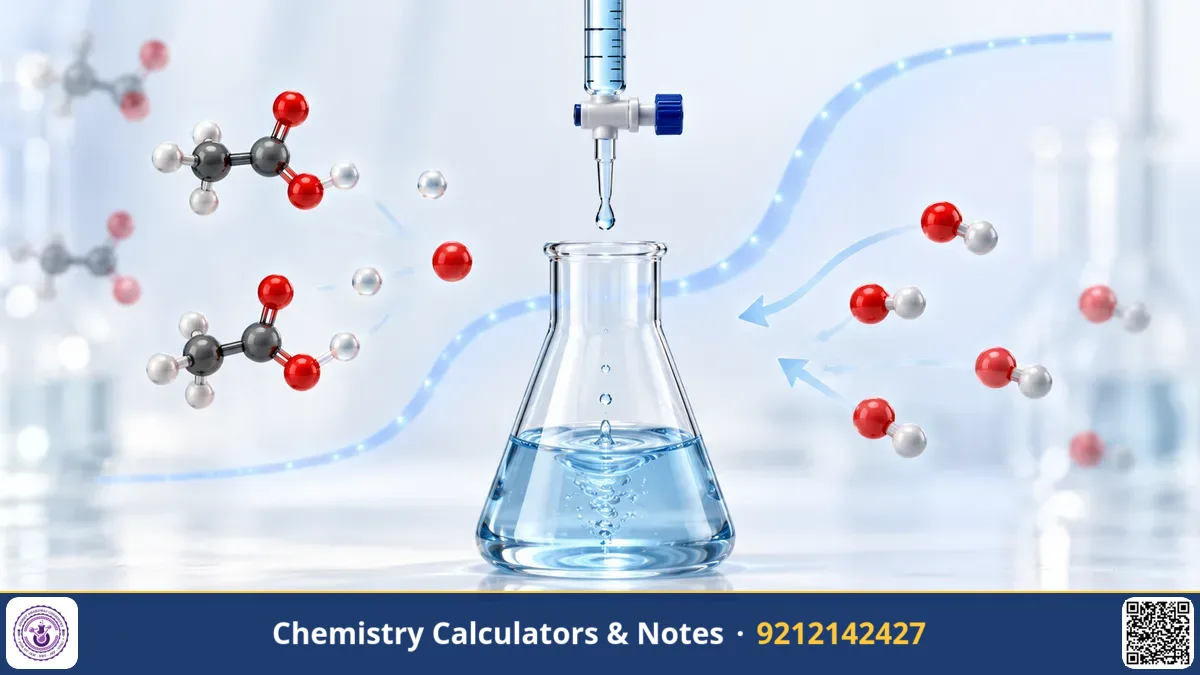
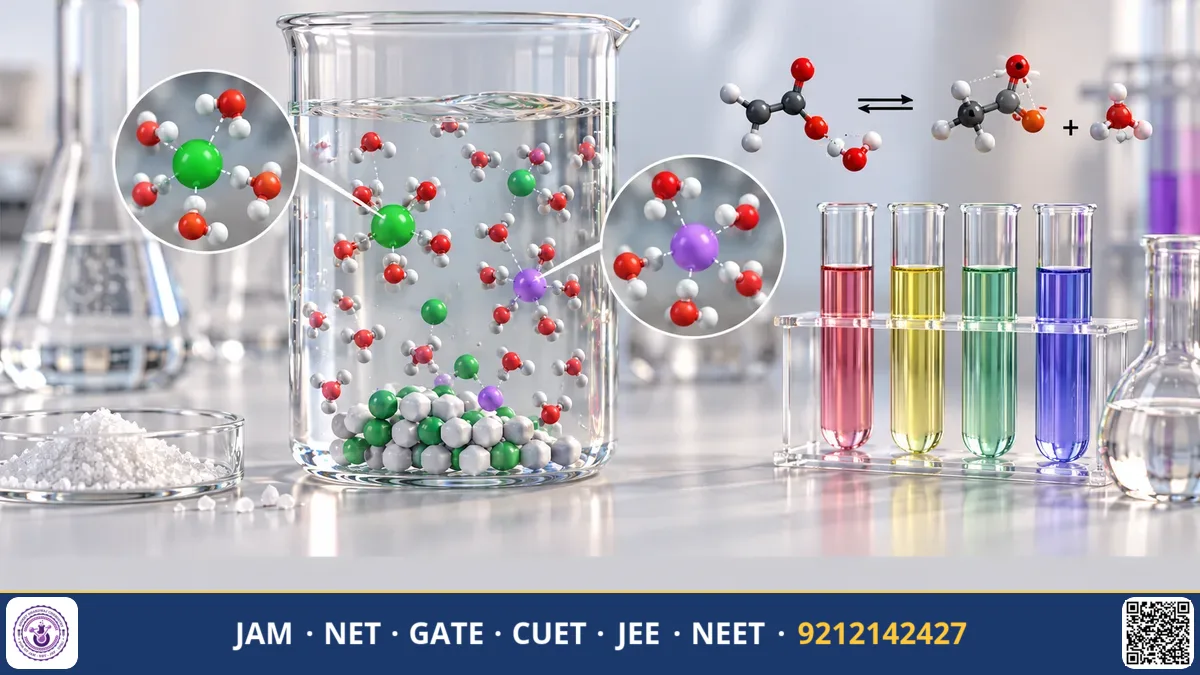
A buffer contains a weak acid (HA) and its conjugate base (A−), or a weak base and its conjugate acid. If you add a strong acid, the base part (A−) of the buffer uses it up. If you add a strong base, the acid part (HA) uses it up. So the buffer changes only a little, because one component becomes smaller and the other becomes larger by the same number of moles.
pH = pKa + log10 ( [A−] / [HA] )
pKa = −log10 Ka
What each symbol means
- pKa: the strength of the weak acid. For ethanoic (acetic) acid, Ka = 1.8 × 10⁻⁵, so pKa = 4.74.
- [A−]: concentration of the conjugate base (for example, ethanoate from sodium ethanoate).
- [HA]: concentration of the weak acid.
- Because both species are in the same solution and share the same volume, the volume cancels. You may use moles (or millimoles) instead of concentrations. This is the key shortcut when volumes change.
For a basic buffer such as NH3 / NH4Cl, convert to the acid side: pKa of NH4+ = 14 − pKb (at 25 °C). With Kb = 1.8 × 10⁻⁵, pKb = 4.74 and pKa = 9.26.
The four-step method
- Convert everything to millimoles (concentration in mol/L × volume in mL gives mmol).
- Write the neutralisation: strong acid added → A− decreases and HA increases by the same amount. Strong base added → HA decreases and A− increases by the same amount.
- Put the new mmol values in the Henderson–Hasselbalch equation.
- Check that neither component has become zero. If one has, the solution is no longer a buffer and you must use a different method.
Example 1: strong acid added to an ethanoic acid buffer. 100 mL of a buffer contains 0.20 M CH3COOH and 0.20 M CH3COONa. Find the pH before and after adding 10 mL of 0.10 M HCl. (Ka = 1.8 × 10⁻⁵.)
Before: moles of acid = 0.20 × 100 = 20 mmol; moles of salt = 20 mmol.
pH = 4.74 + log (20/20) = 4.74 + 0 = 4.74.
HCl added = 0.10 × 10 = 1.0 mmol.
H+ + CH3COO− → CH3COOH, so salt = 20 − 1 = 19 mmol and acid = 20 + 1 = 21 mmol.
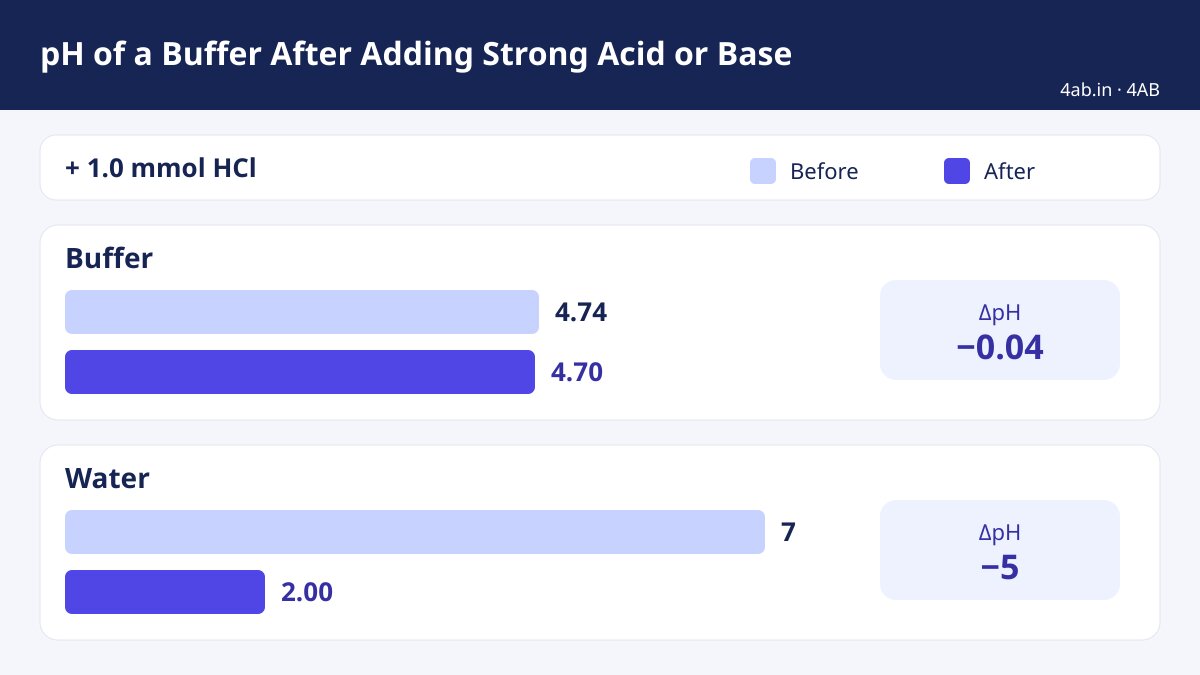
pH = 4.74 + log (19/21) = 4.74 + log 0.9048 = 4.74 − 0.0434 = 4.70 (4.701).
The pH fell by only 0.04 units.
Example 2: the same buffer with strong base. Instead of the HCl, add 1.0 mmol of NaOH (for example 10 mL of 0.10 M NaOH).
OH− + CH3COOH → CH3COO− + H2O, so acid = 20 − 1 = 19 mmol and salt = 20 + 1 = 21 mmol.
pH = 4.74 + log (21/19) = 4.74 + 0.0434 = 4.79 (4.788).
The pH rose by only 0.04 units. Notice that the two answers are symmetric about 4.74.
Example 3: compare with plain water. Add the same 1.0 mmol of HCl to 100 mL of pure water.
[H+] = 1.0 mmol / 100 mL = 0.010 M, so pH = 2.00. Water starts at pH 7, so it falls by 5 units. The buffer in Example 1 fell by 0.04. For 1.0 mmol of NaOH in 100 mL of water, [OH−] = 0.010 M, pOH = 2 and pH = 12.00. This comparison is what the phrase “resists change in pH” means in numbers.
Example 4: a basic buffer. 50 mL of 0.10 M NH3 is mixed with 50 mL of 0.10 M NH4Cl. Find the pH, and then the pH after adding 1.0 mmol of HCl. (pKa of NH4+ = 9.26.)
NH3 = 0.10 × 50 = 5.0 mmol; NH4+ = 5.0 mmol.
Initial pH = 9.26 + log (5/5) = 9.26.
HCl reacts with the base: NH3 + H+ → NH4+, so NH3 = 4.0 mmol and NH4+ = 6.0 mmol.
pH = 9.26 + log (4.0/6.0) = 9.26 − 0.176 = 9.08.
Here the base is the “A−” in the formula (NH3), and the acid is NH4+.
When the buffer stops working
The method holds only while both components are present in reasonable amounts. In Example 1 the buffer had 20 mmol of each component. If you added 20 mmol or more of HCl, all the ethanoate would be used up, and the pH would then be decided by the leftover strong acid. A buffer works best when the ratio [A−]/[HA] stays between about 0.1 and 10, which means pH = pKa ± 1. How much acid or base a buffer can absorb is called buffer capacity; it is larger when the concentrations of the two components are larger.
Common mistakes
- Adding the strong acid to the acid part. HCl is neutralised by the base component, so the base falls and the acid rises.
- Mixing units: using mmol for one component and mol for the other.
- Putting the ratio upside down. It is [base]/[acid], never [acid]/[base].
- Using the total volume when only moles are needed. The volume cancels, so work in mmol and skip the extra division (but you do need the volume when finding pH of plain water in comparisons).
- Using pKb directly with the Henderson–Hasselbalch acid formula. Convert to pKa of the conjugate acid first, or use pOH = pKb + log([salt]/[base]) and then pH = 14 − pOH.
- Forgetting that a strong acid added in large excess destroys the buffer completely.
Summary table
| What is added | Which component reacts | New [A−]/[HA] (mmol) | pH change |
|---|---|---|---|
| Strong acid (x mmol) | A− decreases, HA increases | (A − x) / (HA + x) | small decrease |
| Strong base (x mmol) | HA decreases, A− increases | (A + x) / (HA − x) | small increase |
| Water (dilution) | none | ratio unchanged | almost none |
| Excess strong acid or base | buffer exhausted | not valid | large jump |
In board exams, write the Henderson–Hasselbalch equation, show the mmol before and after addition, and then substitute. This earns method marks even if the final arithmetic slips. Check your own board’s latest syllabus for the exact level of buffer calculations expected.
Check your buffer pH answers: enter pKa and the amounts of acid and salt, and compare with your hand calculation.
Open the Buffer (Henderson–Hasselbalch) Calculator →Turn this concept into marks: solve previous-year CSIR-NET questions and take a timed quiz.
More Equilibrium articles