pH of Weak Bases: Kb, pKb and Ammonia Solutions
Most Class 11 students can find the pH of a weak acid, but a weak base such as ammonia often feels like a new problem. It is not. The method is the same, only the ion we calculate first is OH⁻ instead of H⁺. In board exams and in NEET and JEE Main practice, questions on ammonia solutions, Kb and pKb come up again and again, so it is worth learning the steps once, properly.

The formula
Kb = [BH⁺][OH⁻] / [B]
[OH⁻] = √(Kb × C) (when the base is weak and α is small)
pOH = −log₁₀[OH⁻] and pH = 14 − pOH (at 25 °C)
pKb = −log₁₀ Kb
What each symbol means
- Kb – base dissociation constant. It has no unit in most school problems. A larger Kb means a stronger base.
- C – the starting concentration of the base in mol/L.
- x or [OH⁻] – the OH⁻ concentration produced by the base at equilibrium.
- α – degree of dissociation = x / C. For a weak base α = √(Kb / C).
- 14 – this is pKw at 25 °C (Kw = 1.0 × 10⁻¹⁴). At other temperatures, Kw changes, so the value 14 changes too.
In these examples we use Kb of ammonia = 1.8 × 10⁻⁵ at 25 °C. This is the common textbook value. Some books give 1.76 × 10⁻⁵ or 1.77 × 10⁻⁵, so always use the value given in your question.
Worked examples
Example 1. Find the pH of 0.10 M NH₃ solution. Kb = 1.8 × 10⁻⁵.
Step 1: Kb × C = 1.8 × 10⁻⁵ × 0.10 = 1.8 × 10⁻⁶.
Step 2: [OH⁻] = √(1.8 × 10⁻⁶) = 1.342 × 10⁻³ M.
Step 3: pOH = −log(1.342 × 10⁻³) = 2.872.
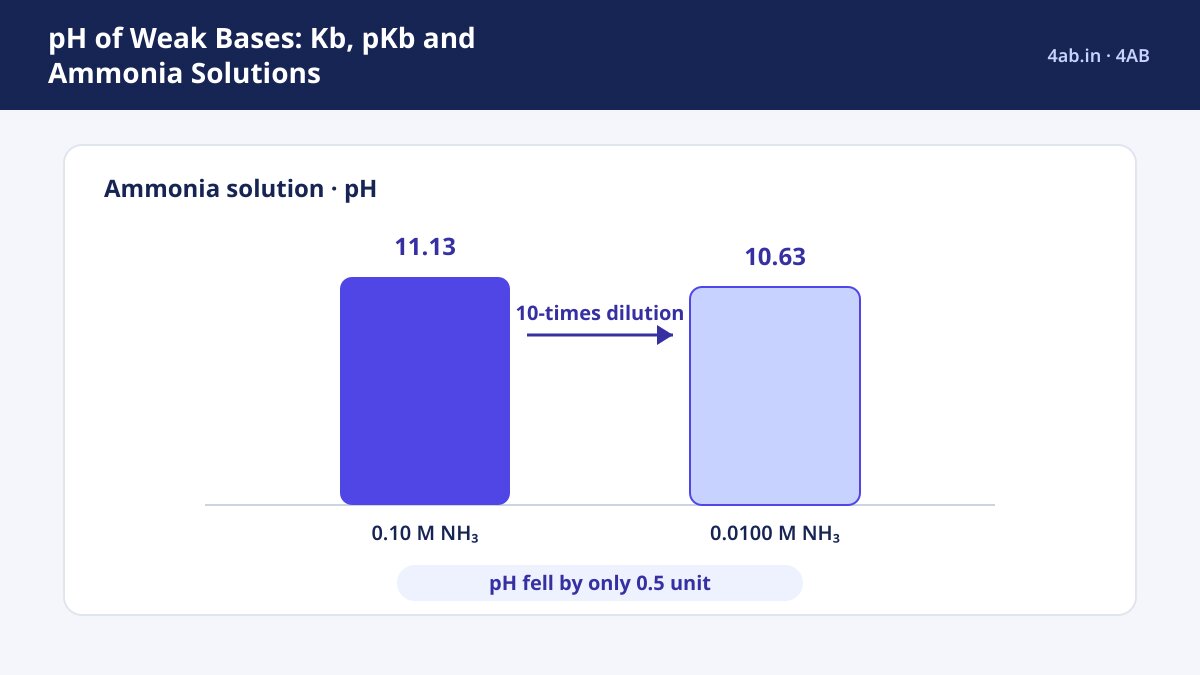
Step 4: pH = 14 − 2.872 = 11.13.
Check: α = 1.342 × 10⁻³ / 0.10 = 0.01342, i.e. 1.34 %. Since this is below 5 %, the approximation is fine. Solving the full quadratic gives [OH⁻] = 1.333 × 10⁻³ M and pH = 11.12, almost the same.
Example 2. What happens when the solution is diluted 10 times, to 0.0100 M?
[OH⁻] = √(1.8 × 10⁻⁵ × 0.0100) = √(1.8 × 10⁻⁷) = 4.243 × 10⁻⁴ M.
pOH = 3.372, so pH = 10.63.
α = 4.243 × 10⁻⁴ / 0.0100 = 0.0424, i.e. 4.24 %. The pH fell by only 0.5 unit for a 10-times dilution, not by 1 unit. This is because α rises as the solution gets more dilute: [OH⁻] changes by a factor of √10 ≈ 3.16 only. Here the 5 % rule is close to its limit, and the exact quadratic gives pH = 10.62.
Example 3. A 0.050 M solution of a weak base has pH 10.70. Find Kb and pKb.
pOH = 14 − 10.70 = 3.30, so [OH⁻] = 10⁻³·³⁰ = 5.012 × 10⁻⁴ M.
[B] at equilibrium = 0.050 − 0.000501 = 0.04950 M.
Kb = (5.012 × 10⁻⁴)² / 0.04950 = 2.512 × 10⁻⁷ / 0.04950 = 5.07 × 10⁻⁶.
pKb = −log(5.07 × 10⁻⁶) = 5.29.
Using the shortcut Kb ≈ [OH⁻]²/C gives 5.02 × 10⁻⁶ (pKb 5.30). The two answers agree to two figures.
Example 4. Find Ka of NH₄⁺, the conjugate acid of ammonia.
For a conjugate pair, Ka × Kb = Kw. So Ka = 1.0 × 10⁻¹⁴ / 1.8 × 10⁻⁵ = 5.56 × 10⁻¹⁰, and pKa = 14 − pKb = 14 − 4.74 = 9.26. This is why NH₄Cl solution is slightly acidic: see the article on salt hydrolysis.
Where students lose marks
- Writing pH = −log√(KbC). That gives pOH, not pH. For a base, always subtract from 14 at the end.
- Using Ka formulas for a base: [H⁺] = √(KaC) is for acids. For bases the square root gives [OH⁻].
- Forgetting that the 14 depends on temperature. If a question gives Kw at another temperature, use pKw from it.
- Thinking that a 10-times dilution always changes pH by exactly 1. It does for strong bases, but not for weak bases (see Example 2).
- Mixing up pKb and Kb: a stronger base has a smaller pKb.
- Using the √(KbC) shortcut when α is large (above about 5 %). Use the quadratic then.
Quick comparison: weak acid and weak base
| Quantity | Weak acid HA | Weak base B |
|---|---|---|
| Equilibrium constant | Ka = [H⁺][A⁻]/[HA] | Kb = [BH⁺][OH⁻]/[B] |
| Ion found first | [H⁺] = √(Ka C) | [OH⁻] = √(Kb C) |
| Convert to pH | pH = −log[H⁺] | pOH = −log[OH⁻], pH = 14 − pOH |
| Degree of dissociation | α = √(Ka/C) | α = √(Kb/C) |
| Conjugate partner | Kb(A⁻) = Kw/Ka | Ka(BH⁺) = Kw/Kb |
Exam relevance
| Exam | How this topic appears |
|---|---|
| CBSE / ICSE Class 11 (ionic equilibrium) | pH of ammonia solution, finding Kb from pH, α for a weak base. Check your current syllabus for the chapter list. |
| NEET / JEE Main | Short numericals combining Kb, dilution and conjugate pairs. Check the latest official syllabus notice for the exact scope. |
| Class 12 and later | The same Kb ideas return in buffers (NH₃/NH₄Cl) and in salt hydrolysis. |
Practice tip: do each problem once by hand, then verify the pH with the calculator. If the two answers differ, look for a missed power of ten or a forgotten “14 −” step.
Check your answers with the pH tool: enter the concentration and compare with your hand calculation.
Open the pH / pOH Calculator →Turn this concept into marks: solve previous-year CSIR-NET questions and take a timed quiz.
More Equilibrium articles