Collision Theory of Reaction Rates and the Steric Factor
The Arrhenius equation describes how k changes with temperature, but it does not explain why molecules react. Collision theory gives the first physical picture. It treats molecules as hard spheres, counts how often they collide, and asks what fraction of collisions are energetic enough to react. This page covers the formula, the meaning of the steric factor P, and numericals of the type seen in IIT-JAM, GATE and CSIR NET.

The three conditions for a reaction
- The molecules must collide.
- The collision must carry at least the threshold energy Ea (along the line of centres, in the simplest model).
- The molecules must be in a suitable orientation. This is the steric requirement.
The rate constant
ZAB = σ (8kBT / πμ)1/2 NA so k = P ZAB exp(−Ea/RT)
- σ = collision cross-section (m2), πd2 for hard spheres of collision diameter d.
- μ = reduced mass, mAmB/(mA + mB), in kg.
- kB = Boltzmann constant, 1.380649 × 10⁻²³ J/K; NA = 6.022 × 10²³ mol−1.
- ZAB here is the collision frequency factor per unit concentration, in m3 mol−1 s−1 (multiply by 1000 for L mol−1 s−1).
- exp(−Ea/RT) = fraction of collisions with energy at least Ea.
- P = steric factor, a number between 0 and 1 for simple reactions, representing the fraction of collisions with the correct orientation. Comparing Arrhenius’s A with P ZAB, P = Aexp/ZAB.
Note the temperature dependence: the prefactor goes as T1/2, while the exponential changes much faster. So collision theory predicts that a plot of ln k against 1/T is very nearly, but not exactly, a straight line.
Worked example 1: collision frequency factor
Two identical molecules of mass 40 u collide with cross-section σ = 0.40 nm2 at 500 K (practice values). Find ZAB.
μ = 40 × 40 / 80 = 20 u = 20 × 1.66054 × 10−27 kg = 3.3211 × 10⁻²⁶ kg.
(8kBT / πμ)1/2 = (8 × 1.380649 × 10−23 × 500 / (π × 3.3211 × 10⁻²⁶))1/2 = 727.5 m/s.
σ = 0.40 × 10⁻¹⁸ m2. ZAB = 0.40 × 10−18 × 727.5 × 6.022 × 1023 = 1.75 × 10⁸ m3 mol−1 s−1.
In practical units: 1.75 × 10¹¹ L mol−1 s−1.
Worked example 2: rate constant with a steric factor
For the same reaction, Ea = 100 kJ/mol and P = 0.10. Find k at 500 K.
Ea/RT = 100000 / (8.314 × 500) = 24.054, so exp(−24.054) = 3.57 × 10⁻¹¹. Only about 3.6 collisions in 1011 carry enough energy.
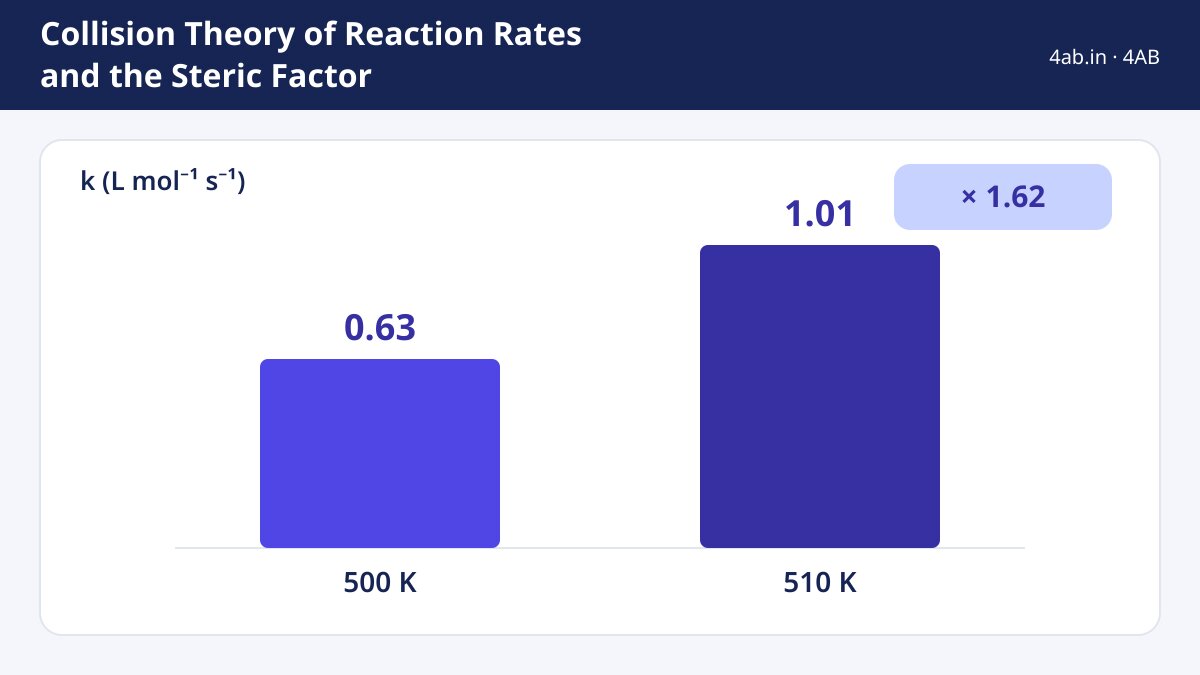
k = P ZAB exp(−Ea/RT) = 0.10 × 1.75 × 1011 × 3.57 × 10−11 = 0.63 L mol−1 s−1.
Worked example 3: how k changes from 500 K to 510 K
Find k at 510 K for the same data and the ratio k(510)/k(500).
Z at 510 K goes as T1/2: factor = (510/500)1/2 = 1.0100, a rise of only about 1%.
Exponential: Ea/RT = 100000/(8.314 × 510) = 23.58, factor relative to 500 K = exp(24.054 − 23.58) ≈ 1.60.
Combined ratio = 1.62, so k(510) ≈ 1.01 L mol−1 s−1. A 10 K rise increases k by about 62% here, almost all through the exponential term.
Worked example 4: finding P from an experimental A
An experiment gives an Arrhenius pre-exponential factor A = 2.0 × 10⁹ L mol−1 s−1. Using ZAB = 1.75 × 10¹¹ from Example 1, find P.
P = A / ZAB = 2.0 × 10⁹ / 1.75 × 1011 = 0.0114.
Only about 1% of collisions have the right geometry. A small P is typical for reactions between large molecules, where orientation matters. Simple collision theory cannot predict P; it must be taken from experiment.
Common mistakes
- Using the mass instead of the reduced mass. μ must be used for two different molecules.
- Using grams, not kilograms. Convert u to kg before applying the formula.
- Mixing m3 and L. Convert at the end (× 1000).
- Forgetting NA when you want a molar rate constant.
- Reading P > 1 as impossible. It is possible for some reactions (for example some ion reactions in solution), and it shows the simple model is incomplete.
- Saying all collisions are effective. Only a tiny fraction carry the energy and orientation needed.
Exam relevance
| Question type | Where to look |
|---|---|
| Calculate ZAB or k | Compute μ, the mean speed term, then multiply |
| Interpret the steric factor | P = Aexp/ZAB |
| Fraction of energetic collisions | exp(−Ea/RT) |
| Compare with transition state theory | Collision theory gives A from collisions; TST from partition functions |
Practice values only. Check the current official syllabus of your exam.
Once you know Ea and the pre-exponential factor, check temperature effects with the Arrhenius calculator.
Open the Arrhenius Equation Calculator →Reaction mechanisms stick only with practice: attempt previous-year CSIR-NET questions and a timed quiz.
More Organic articles